
A beautiful wall mural can look remarkably convincing in a showroom and strangely inexpensive once installed behind a British living room sofa. The difference is rarely the artwork alone. It is usually the relationship between the design, the wall’s dimensions, the furniture and the distance from which people actually see it.
The central mistake is treating a mural as an enlarged picture rather than architectural art that must work with the room. An oversized botanical leaf can overwhelm a modest terrace-house lounge. An elegant landscape can lose its focal point behind a radiator. Even a beautifully textured relief can resemble ordinary panelling under flat ceiling lighting.
These problems matter because changing a mural is more disruptive than replacing a framed print. Before committing to paint, wallpaper or removable panels, the sensible approach is to test the composition at actual size, map architectural interruptions and understand how the wall will look in everyday light. That preparation also reduces the risk of choosing something difficult to reverse when decorating tastes or moving plans change.
Wall murals that look intentional rather than inexpensive
- Test motif size, pattern density and viewing distance together. A design that looks balanced on a screen may fail at full scale behind furniture.
- Plan around radiators, doors and existing finishes before ordering. Choose mural materials according to wall condition and likely removal needs.
- Assess lighting and long-term flexibility. A mural should remain convincing in normal daily use, not only in ideal photographs.
- Why Does a Wall Mural Make a Room Feel Smaller When the Pattern Scale Is Off by 30%?
- How to Plan a Wall Mural Around UK Radiators and Doors Without Awkward Cut-Offs?
- Which Is Smarter for UK Homes: Painted Mural, Wallpaper Mural, or Peel-and-Stick for a 2-Year Horizon?
- The Trend Trap: The Mural Style That Starts to Look Dated After 18 Months
- When Should You Install a Wall Mural During a Redecorate: Before Flooring or After Lighting Is Set?
- Why Can Minimalist Art Look Like a Blank Canvas Until You Step Back 2 Metres?
- Why Can Wall Reliefs Look Like Ordinary Panels Until Side Light Hits at 30 Degrees?
- Why Do Wall Reliefs Look Flat Until You Get This 1 Shadow Angle Right?
Why Does a Wall Mural Make a Room Feel Smaller When the Pattern Scale Is Off by 30%?
A wall mural can make a room feel smaller when its motifs occupy too much of the visible wall, leaving insufficient space for the eye to understand the composition. A 30% scale mismatch is a useful hypothetical testing scenario, not an established threshold. The effect depends on motif size, repetition, viewing distance and furniture placement.
Imagine a botanical mural featuring leaves designed to measure approximately 100 cm across. If the motif is enlarged by 30%, those leaves become 130 cm wide. That change may appear modest on a digital preview, but in a compact lounge it can leave only fragments of each leaf visible around the sofa and television.
The artwork no longer reads as a coherent botanical composition. It becomes a collection of large shapes pressing against the room’s boundaries. That visual compression can make the wall feel closer, even though its physical position has not changed.
Three separate variables determine whether the result works:
- Motif size: the dimensions of each flower, leaf, landscape feature or geometric element relative to the wall and furniture.
- Repeat density: how frequently prominent elements appear. Several medium-sized motifs may look busier than one carefully positioned large motif.
- Viewing distance: the location from which the full design can be understood, including the sofa, doorway and any adjoining corridor.
The third variable is often underestimated. A mural designed for a four-metre viewing distance may feel overwhelming in a narrow room where the main view begins just inside the doorway.
Furniture creates another failure point. If a sofa hides the bottom third of a landscape, the horizon or principal subject may appear disconnected from the remainder of the design. The result can look like poorly cropped wallpaper rather than a deliberately composed artwork.
Before ordering, photograph the wall from the main seating position at normal eye level. Overlay the proposed design on the photograph, preserving its proportions. Mark the sofa outline, television, shelves and any visible wall boundaries.
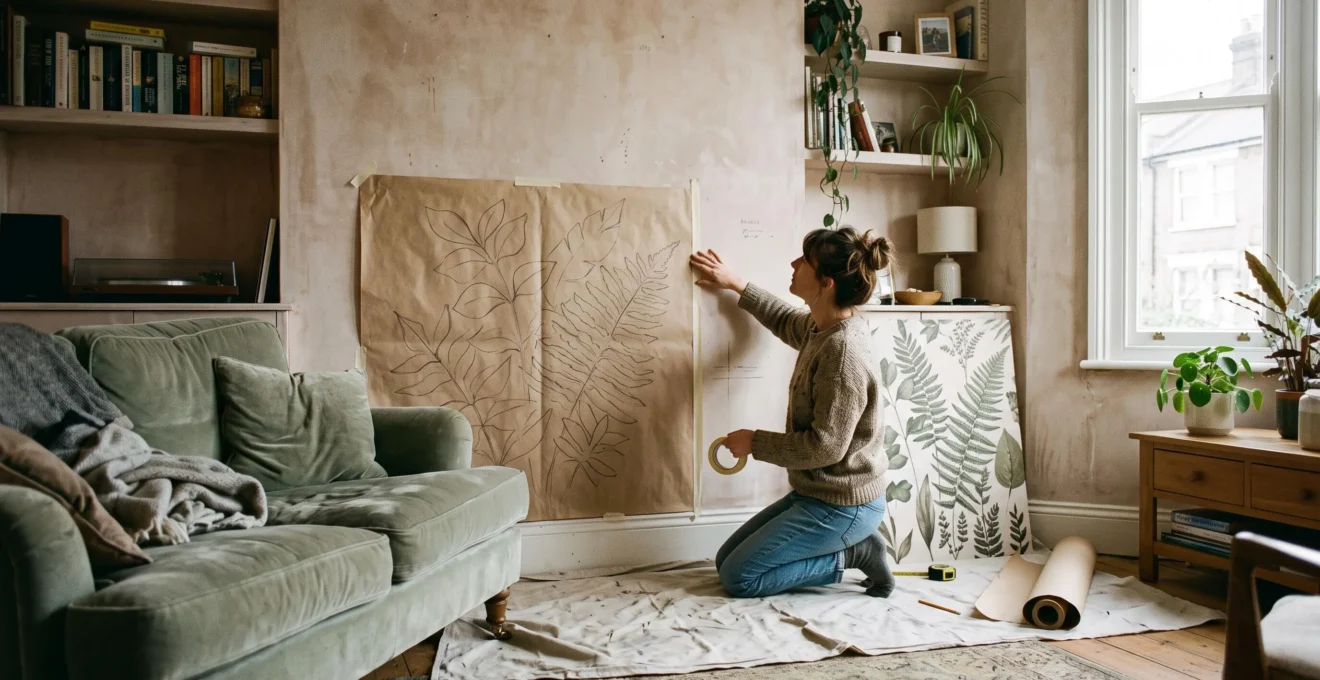
Then test the focal motif at full size using kraft paper or a projected outline. Stand at each everyday viewing position rather than judging only from directly in front of the wall.
If the subject feels crowded, reduce its scale, reposition its focal point or simplify the composition. A larger wall does not automatically require a larger motif.
The objective is not to maximise the amount of artwork visible. It is to make the artwork feel proportionate to the room that contains it. Once the visual scale works, the next challenge is ensuring the architecture does not interrupt it.
How to Plan a Wall Mural Around UK Radiators and Doors Without Awkward Cut-Offs?
Plan a wall mural around UK radiators and doors by drawing the entire wall to scale before choosing the artwork. Record radiator dimensions, pipework, door architraves, picture rails and chimney breasts. Position the mural’s focal elements within the uninterrupted areas, then select a composition whose edges can be cropped without making the design look incomplete.
British homes frequently contain architectural details that complicate mural installation. A Victorian terrace may have a chimney breast, tall skirting boards and picture rails. A more recent property may have radiators positioned directly beneath windows or near internal doors.
These features are not necessarily design obstacles. They become problems when the mural is ordered without accounting for them.
A simple scaled wall elevation is more reliable than a photograph alone. Measure the total wall width and height, then mark each fixed element in its actual position. Include radiator valves and pipe exits, not just the radiator casing.
Radiators deserve particular attention because they introduce access and temperature considerations. A wallcovering should not obstruct radiator operation, servicing or essential access to fittings. Material suitability near heat sources must be checked against the product instructions and the actual installation conditions.
Where pipework interrupts the wall, a panel-based mural may offer more practical installation and replacement options than a single uninterrupted sheet.
Next, consider how the artwork behaves when interrupted. Cloud formations, soft gradients, atmospheric landscapes and irregular organic textures generally offer more forgiving boundaries. A figure whose face disappears behind a doorframe or a geometric line that no longer aligns across an opening makes the interruption conspicuous.
For a chimney breast, consider whether the design should occupy only the projecting central surface. That can make the mural appear deliberately integrated rather than stretched across several changing wall planes.
Older and protected buildings require an additional check. In England, Historic England‘s Listed Building Consent advice note distinguishes ordinary wallpaper redecoration from alterations affecting historically significant decorative finishes.
Listed-building status, sensitive existing finishes and individual property restrictions may influence what can be installed or removed. The position differs across UK jurisdictions, so owners should verify applicable requirements rather than assume permission is either always necessary or never necessary.
Tenants and leaseholders should also check relevant agreements before undertaking substantial decorative work.
Once the usable wall area is established, the material decision becomes easier: the best mural format is the one that fits both the architecture and the likely length of time it will remain in place.
Which Is Smarter for UK Homes: Painted Mural, Wallpaper Mural, or Peel-and-Stick for a 2-Year Horizon?
For a two-year decorating horizon, peel-and-stick may be attractive on compatible, sound painted walls, while pasted wallpaper can offer a more established installation method and painted murals provide custom artistic flexibility. None is universally easier to remove. The right choice depends on wall condition, humidity, surface preparation and the amount of redecoration acceptable at move-out.
A two-year horizon changes the purchasing question. Instead of considering only which mural looks best today, assess what the wall may need to look like when the property is sold, let again or redecorated.
The following comparison is qualitative. Actual costs, durability and removal outcomes depend on the product, substrate and installer rather than on format alone.
| Decision factor | Painted mural | Pasted wallpaper mural | Peel-and-stick mural |
|---|---|---|---|
| Upfront cost | Highly variable; bespoke artist labour can be a significant component | Product, wall preparation and installation determine total cost | Material and installation costs vary; simpler fitting does not guarantee a lower total |
| Reversibility | Usually requires repainting and potentially priming | Removal depends on adhesive, wallcovering and underlying surface | Designed for removal, but paint damage remains possible |
| Plaster and newly skimmed walls | Requires adequately dry, prepared surfaces | Requires suitable drying, preparation and adhesive compatibility | Requires a compatible, sound, adequately cured painted surface |
| Radiators and humidity | Paint-system suitability and service access matter | Adhesive and wallcovering specifications matter | Adhesion can be sensitive to surface and environmental conditions |
| Design flexibility | Custom painting and local adjustments are possible | Printed composition depends on supplied panels | Printed composition depends on supplied panels |
The major misconception concerns removable wallpaper. The word removable does not guarantee damage-free removal, particularly where existing paint is weak, chalky or insufficiently cured.
In Tempaper‘s explanation of removable wallpaper, the manufacturer acknowledges that removal can lift some matte or flat paint finishes. It also identifies heavy texture and inadequately cured fresh paint as potential installation problems.
This is product-specific manufacturer guidance, not an independent finding that every self-adhesive mural behaves identically. It does, however, undermine the assumption that peel-and-stick is automatically the safest option for every rented property.
Test a sample in an inconspicuous area and follow the manufacturer’s stated surface preparation, curing and removal instructions. A recently skimmed wall should not be treated as ready merely because its surface looks pale and dry.
For pasted wallpaper murals, installation accuracy introduces a different risk. Multi-panel designs may require a prescribed hanging sequence, exact drop alignment and consistent colour across panels.
Before installation, inspect every supplied panel, confirm its position in the design and check identifying information for mismatched production runs where applicable. The Wallcoverings Association‘s residential wallpaper installation instructions recommend checking materials, numbering panels, following the correct sequence and examining initial installed panels before continuing.
These practices provide useful safeguards, although bespoke mural manufacturers may specify different installation procedures.
For homeowners expecting to remain longer than two years, permanence may be a benefit rather than a drawback. A painted mural can be appropriate when the artwork is intended to become part of the room’s identity and future repainting is acceptable.
Choose the finish with an acceptable exit strategy. An impressive mural that needs manageable repainting later may be a better decision than a supposedly removable product installed on unsuitable plaster.
The Trend Trap: The Mural Style That Starts to Look Dated After 18 Months
A mural can start looking dated when its identity depends heavily on a fashionable colour palette or recognisable social-media design. Eighteen months is an illustrative timeframe, not a measured lifespan. Trend-led arch shapes, saturated terracotta waves and similar motifs may become less appealing as surrounding interiors change, especially when the design is expensive to replace.
Some decorative choices are strongly associated with a particular visual moment. A large painted arch in a fashionable shade may look fresh when paired with matching furniture and accessories, but less convincing after those elements are changed.
The problem is not that arches or warm colours are inherently poor choices. It is that the mural may rely on a very specific decorative combination to feel complete.
Consider two hypothetical designs. The first is a large terracotta wave composition with several saturated colour blocks. The second is a muted architectural landscape, organised around depth, proportion and subtle tonal variation.
Both could work beautifully. However, the landscape may be easier to accommodate if the homeowner later changes curtains, upholstery or lighting because its visual structure does not depend as heavily on one fashionable palette.
This is a design judgement, not evidence that geometric murals age faster in every home.
The useful distinction is composition versus colour dependency. Ask whether the mural would still look intentional if the sofa, cushions and adjacent painted walls changed colour.
Also consider whether the subject has a convincing relationship with the building. A landscape that follows the wall’s proportions or a geometric composition aligned with architectural features can feel integrated rather than applied.
For homeowners worried about resale, the objective is not to anticipate every future buyer’s taste. It is to avoid making an already expensive decorative decision unnecessarily difficult to reverse.
A strongly personalised mural may be appealing to some buyers and distracting to others. There is no reliable universal rule that it reduces a property’s sale price.
If neutralising the wall becomes desirable before marketing, compare repainting with removal. Painted designs may need suitable preparation, primer and additional coats to prevent the original composition showing through. Wallpaper removal may involve adhesive residue or substrate repairs.
Neither approach should be assumed to be cheaper without considering the existing finish.
One compromise is to use a trend-led colour or shape on a smaller, repaintable panel, leaving the main wall with a more enduring composition.
A mural need not be neutral to age gracefully. It needs a visual reason to belong in the room beyond its current popularity. That judgement is best made before installation, when lighting and renovation sequencing can still be adjusted.
When Should You Install a Wall Mural During a Redecorate: Before Flooring or After Lighting Is Set?
Install a mural after dusty structural and plastering work is complete, once the wall is sufficiently dry and prepared, and after the lighting layout has been decided. Final flooring may be installed before or after the mural depending on the project, provided surfaces are properly protected. The critical requirement is controlling dust, moisture and access.
A mural should not be treated as an isolated decorative task. Its successful installation depends on work undertaken earlier in the renovation, particularly plastering, sanding, painting and the positioning of electrical fittings.
Dust can contaminate prepared surfaces and interfere with adhesive bonding. Newly applied plaster can retain moisture, while fresh paint may require additional curing before certain self-adhesive coverings are suitable.
These concerns become especially relevant in an unheated UK property during colder months. Low room temperatures and persistent moisture can complicate drying and installation conditions. Follow the specific product instructions rather than relying on a universal waiting period.
Lighting should be planned before approving the mural composition. That does not mean every decorative light fitting must be installed permanently before the wallcovering. It means the intended light direction, electrical positions and likely effect on colour or texture should already be understood.
A carefully chosen landscape may look balanced in daylight but become visually uneven under a strong spotlight. A textured mural can gain dramatic depth under directional lighting while revealing wall defects that were barely visible under ordinary ceiling illumination.
Woodwork introduces another sequencing decision. Skirting, coving and picture rails should be sufficiently resolved to establish the mural’s final boundaries. Any subsequent drilling, sanding or fitting work must be planned to avoid damaging the finished surface.
Where new flooring is involved, installers may prefer to complete wall decoration before the floor’s final exposed finish, with suitable temporary protection and controlled access. In other projects, finished flooring can remain in place under adequate protection.
Five checks before mural installation day
- Confirm dusty works are complete. Produce a room-preparation sign-off confirming that plastering, major sanding and structural alterations are finished.
- Verify the wall is ready. Record the surface condition and confirm drying, curing and preparation requirements against the selected product’s instructions.
- Finalise architectural boundaries. Produce an annotated wall elevation showing finished skirting, coving, doors and other fixed features.
- Approve the lighting arrangement. Record intended light positions and review the mural sample under conditions resembling normal room use.
- Agree installation and protection arrangements. Produce a short installation-day plan covering flooring protection, panel handling, access and manufacturer-specific drying requirements.
After installation, avoid placing furniture against the finished wall until the selected materials have reached the condition specified by the manufacturer or installer. There is no single supported curing period that applies to painted, pasted and self-adhesive murals alike.
The correct sequence is the one that protects the finished artwork while preserving installation quality. Once those conditions are secured, the next decision is more subtle: how much of the artwork can actually be understood from the room’s normal viewing positions?
Why Can Minimalist Art Look Like a Blank Canvas Until You Step Back 2 Metres?
Minimalist wall art can resemble an unfinished surface when its lines, tonal contrasts or focal elements are too subtle for the distance and lighting from which it is viewed. Stepping back two metres may help the composition become legible, but that distance is a practical test rather than a universal threshold. Room layout determines whether restraint reads as intentional.
Minimalist murals depend on small visual differences carrying considerable meaning. A pale line drawing, restrained abstract shape or low-contrast landscape may contain very little information at close range.
From farther away, the viewer can sometimes understand the relationship between elements more readily. Negative space becomes part of the composition rather than appearing to be an area where decoration is missing.
But this effect is not guaranteed. Fine lines can also become less visible with distance, especially under poor lighting or against a similarly coloured wall.
That is why minimalist design requires the same scale testing as an oversized mural, although the failure may appear in the opposite direction.
Where oversized motifs overwhelm a small room, understated motifs can disappear into it.
In a compact study, for example, a delicate line mural may be viewed primarily from a desk positioned close to the wall. If the most important elements are spaced too widely, the viewer may see isolated fragments rather than the intended composition.
A living room offers a different arrangement. A restrained mural behind a sofa may read clearly from an opposite armchair, provided furniture does not hide the visual anchor.
To test a minimalist design, measure the normal distance between the wall and the main viewing position. Include the doorway view, rather than assuming people will always sit where the furniture plan suggests.
Place a suitably sized sample at the proposed focal height and examine it under daylight and normal evening lighting. If the design disappears, consider stronger contrast, thicker lines or a more concentrated composition.
Do not automatically make every element larger. Increasing visual weight may solve the problem without sacrificing the restrained character of the artwork.
Televisions and shelving require particular caution. A small focal element positioned directly behind a screen may be completely obscured, leaving the rest of the mural looking accidentally sparse.
Minimalism works when its quietness is deliberate and perceptible. The principle extends to textured wall reliefs, where an apparently simple surface may depend less on printed contrast than on the direction of light.
Why Can Wall Reliefs Look Like Ordinary Panels Until Side Light Hits at 30 Degrees?
Wall reliefs can resemble ordinary flat panels under diffuse lighting because shallow textures produce few visible shadows. Directional light makes surface depth easier to perceive. An incident angle of approximately 30 degrees can provide noticeable modelling, although it is not a universal optimum. The result depends on texture depth, source position, wall condition and viewing angle.
A relief mural differs fundamentally from a flat printed mural. Its visual character comes from actual changes in surface depth: raised ridges, recessed areas, carved forms or moulded details.
For those features to become visible, the lighting must establish differences between illuminated surfaces and their shadows.
When a wall receives broadly diffuse ambient light, shallow ridges may have similar brightness on both sides. The relief can therefore appear flatter than it does in a showroom photograph taken with carefully positioned directional lighting.
The architectural-lighting specialist ERCO explains this relationship in its technical explanation of lighting angles and surface texture.
Its examples distinguish limited modelling at a 60-degree incidence angle from more visible modelling at 30 degrees, with particularly strong texture emphasis under grazing light at approximately 5 degrees. These figures use the source’s convention for measuring incidence angle and should not be confused with an arbitrary angle from the floor or ceiling.
For a relief mural, the appropriate light direction depends on the surface geometry. Vertical ridges and horizontal grooves, for example, can respond differently to the same lamp position.
Before choosing a fixed fitting, move a suitable lamp around a small textured sample and observe how the shadows change from the room’s main seating position.
The timing of the test matters. In UK homes, available daylight may change substantially between seasons, while evening use often depends on artificial lighting. A relief that looks expressive beside a sunlit window may appear restrained when the family uses the room after dark.
Test under the lighting conditions that will actually dominate the space, not simply the brightest available daylight.
Directional light also creates an important complication. The same shallow beam that reveals beautiful texture can expose uneven plaster, roller marks, uneven joins and panel seams.
More dramatic grazing light therefore demands more careful wall preparation. A surface that seems smooth under ordinary ambient illumination may not be visually acceptable when strongly lit from the side.
The strongest relief is not necessarily produced by the shallowest possible light angle. A successful result balances texture definition with surface quality and visual comfort, which leads to one final test before purchasing a three-dimensional mural.
What to establish before choosing a relief mural
- Confirm that a practical directional light source can illuminate the intended wall without being obstructed by furniture or surrounding architecture.
- Inspect the real wall for surface defects under the proposed lighting, not just under general ceiling illumination.
- Decide whether the desired effect genuinely requires physical relief or whether a flat mural would meet the design objective with fewer installation dependencies.
Why Do Wall Reliefs Look Flat Until You Get This 1 Shadow Angle Right?
Wall reliefs can look flat when their lighting fails to produce enough directional shadow to reveal the surface profile. There is no single correct angle for every relief. The practical solution is to test light direction, source height and viewing position against a physical sample before installation, then choose an arrangement that makes texture visible without exaggerating wall defects.
The decisive question is not simply whether a relief mural looks attractive in a catalogue. It is whether the room can support the lighting that makes its three-dimensional qualities apparent.
Imagine a textured feature wall located at the end of a narrow corridor. If adjoining walls prevent a useful lateral light position, achieving consistent grazing illumination may be difficult. A flat printed composition might provide a stronger and more predictable decorative result in that setting.
By contrast, a larger dining room with room for carefully positioned directional lighting may offer greater flexibility. Light can travel across the textured surface, producing a visible sequence of highlights and shadows.
These are two different purchasing decisions. A printed mural primarily requires control over artwork scale, cropping and sightlines. A relief mural adds surface depth, lighting geometry and potentially more demanding substrate preparation.
A simple experiment can reveal whether the additional complexity is worthwhile.
- Attach a small ridged cardboard panel or a genuine material sample to the intended wall using a temporary fixing appropriate for the surface.
- Position a movable lamp or torch so that light travels across the ridges rather than illuminating them only from directly in front.
- Vary the direction and height of the light while observing from the room’s normal seating or standing position.
- Repeat the experiment at the times the room is normally occupied, including after dark where relevant.
- Compare the resulting shadows with any unwanted emphasis on surrounding plaster unevenness, joins or other surface imperfections.
This is an exploratory visual test, not a substitute for professional lighting design or the installation requirements of a particular product. A cardboard sample cannot reproduce every property of a finished relief, but it can expose obvious constraints before money is committed.
Do not assume that adding a brighter downlight will solve weak texture definition. Greater brightness does not necessarily create the lateral shadow gradients required to reveal shallow relief.
Equally, strong grazing light should not be selected solely because it creates dramatic photographs. In a lived-in room, excessive contrast or conspicuous imperfections may make the surface less comfortable to look at.
The strongest overall mural design integrates four considerations: scale, sightline, architecture and light. Each affects the others. A large motif needs sufficient viewing distance; a carefully placed focal point needs to remain visible around furniture; a relief needs lighting that its location can physically accommodate.
The wall’s decorative finish should therefore be the outcome of planning rather than the starting point.
Start with one practical action: photograph the intended wall from the place where the room is most often experienced, then mark its obstructions, visible boundaries and light direction. Use that evidence to test a full-size composition or physical sample before choosing the final mural. A design that survives those checks has a much better chance of feeling like part of the architecture rather than decoration applied afterwards.
Can a wall mural work in a small UK living room?
Yes. A small living room does not automatically require a small or discreet mural. Choose a composition that can be understood from the main viewing position, and avoid placing essential details behind furniture. Test motif size and repeat density at full scale before ordering. A single well-positioned subject can work better than an elaborate pattern containing too many competing elements.
Is peel-and-stick mural wallpaper safe for a rented property?
Not automatically. Removal can damage certain paint finishes, and adhesion may be unreliable on heavily textured or insufficiently cured surfaces. Check the tenancy agreement, confirm that the manufacturer considers the wall finish compatible and test a sample in an inconspicuous location. Permission to decorate and confidence in damage-free removal are separate considerations.
Should a wall mural cover the entire wall or only a defined section?
Either can work. A full-wall mural is suitable when the composition can accommodate furniture, doors and other boundaries. A defined section may be more effective where a chimney breast, awkward radiator position or narrow viewing angle interrupts the wall. The important test is whether the artwork has visually intentional edges rather than appearing arbitrarily cropped.
Can an existing mural be covered instead of removed?
Sometimes. A painted mural may be covered with an appropriate preparation and repainting system, depending on the existing coating and wall condition. Covering wallpaper or relief materials is a different decision because loose edges, surface texture and incompatible adhesives may compromise the new finish. Inspect the substrate and follow the proposed covering manufacturer’s requirements before proceeding.
Does a mural need special lighting to look expensive?
Not necessarily. A flat printed mural can look convincing under ordinary room lighting when its colours, scale and placement are appropriate. Physical wall reliefs depend more strongly on directional illumination because shadows reveal their depth. Test both daylight and normal evening lighting before approving the design, especially when a textured surface or subtle colour palette is involved.