
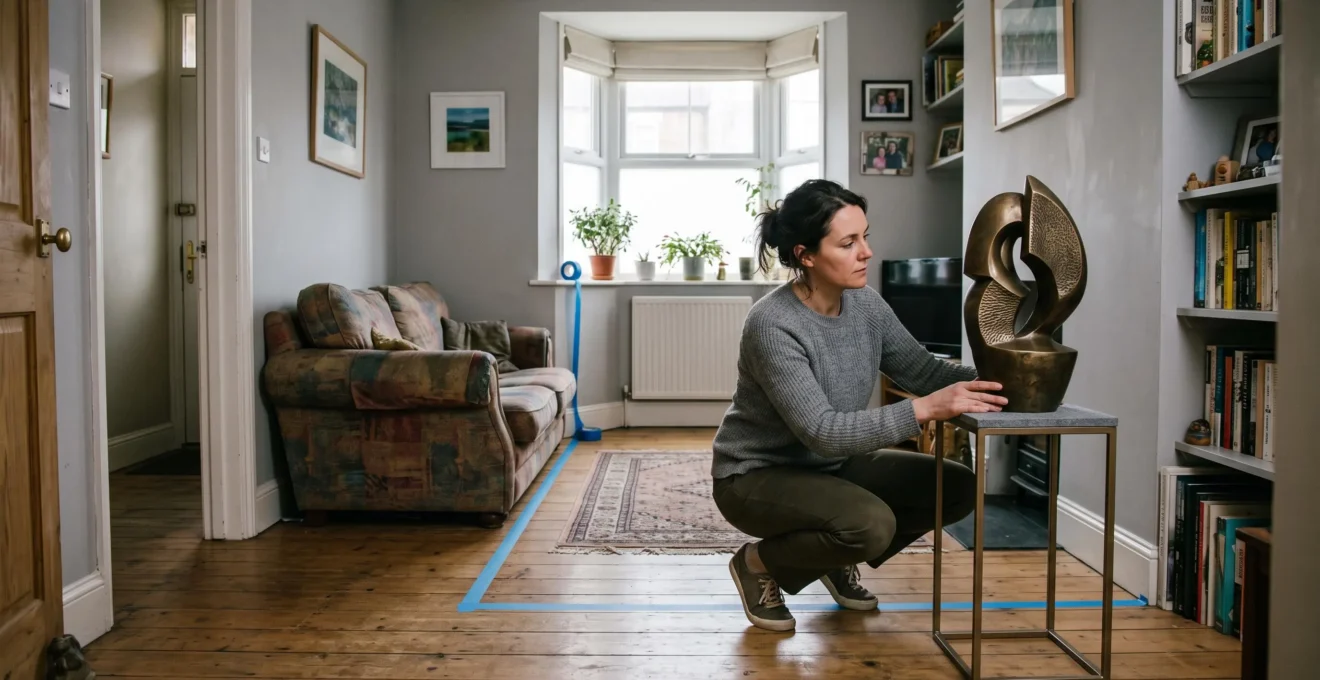
A contemporary sculpture can look extraordinary in a gallery and strangely inconvenient beside your sofa. The floor might be clear, the artwork might be beautiful, yet the room suddenly feels harder to navigate. Often, the problem is neither the sculpture nor your taste. It is the relationship between the object’s silhouette, the surrounding space and the routes people take through the room.
The one placement rule is to position sculpture outside natural walking routes, where its complete silhouette remains clearly visible against a relatively quiet background. Think of it as protecting both physical clearance and visual breathing room. A sculpture should have somewhere to belong without making people walk around it or forcing the eye to untangle its shape from furniture.
This matters in UK homes where bay windows, radiators, fireplaces and narrow doorways can leave fewer usable display positions than a floor plan suggests. The right solution may involve a slimmer plinth, a different viewing angle, a wall-mounted relief or simply waiting until the furniture layout has settled.
The essentials of placing contemporary sculpture at home
- Protect the walking route: position sculpture in a space people naturally pass beside, not through, while maintaining a clear view of its outline.
- Check stability separately from appearance: consider weight distribution, floor condition, plinth dimensions and the possibility of accidental contact.
- Test the actual room: photograph the sculpture’s silhouette, mark its intended footprint and observe changing daylight before deciding on its permanent position.
- Why Can Sculpture Make UK Rooms Feel Cluttered Even When the Floor Is Clear ?
- How to Choose a Sculpture Size and Plinth for a UK Home Without Scratched Floors or Wobbles ?
- Which Works Better in Smaller UK Homes: Wall-Mounted Reliefs or Freestanding Sculpture ?
- The Safety Mistake That Turns a Beautiful Sculpture Into a Household Hazard in 1 Bump
- When Should You Buy Sculpture: Before Finalising Furniture Layout or After the Room Flow Is Set ?
- How to Position Reflective Sculpture to Avoid Harsh Glare From UK Window Light ?
- Which Finish Works Better in UK Homes: Matte Streamlined Sculpture or High-Polish Metal ?
- Why Does Streamlined Sculpture Look ‘Expensive’ Even Without Detail When the Silhouette Is Right ?
Why Can Sculpture Make UK Rooms Feel Cluttered Even When the Floor Is Clear ?
Contemporary sculpture can make a UK living room feel cluttered because its shape demands attention even when it occupies very little floor area. Irregular outlines, projecting elements and competing backgrounds make the eye work harder to understand the space. The solution is to create optical clearance as well as physical clearance, allowing the artwork to read as one distinct form.
Unlike a framed picture, sculpture introduces depth and multiple viewing angles. A curved bronze form may look composed from the doorway but merge into a lamp, shelving unit and chair when viewed from the sofa. The room is not necessarily overcrowded; several unrelated outlines are overlapping within the same field of vision.
This is why the familiar instruction to place a sculpture in an unused corner can fail. In a narrow terraced living room, two converging walls may trap the artwork’s silhouette. A nearby radiator, curtain, fireplace or bay-window frame can make that background even busier.
The negative space test offers a practical way to diagnose the problem:
- Photograph the proposed placement from the doorway and your usual seat.
- Convert each photograph to greyscale or view it while squinting.
- Look for a distinct outline with visible space around important curves or projections.
- Move the sculpture slightly or rotate it, then compare the photographs.
If you struggle to separate the sculpture from the furniture behind it, visitors may struggle too. The test is a visual judgement aid, not a scientifically established measure of clutter.
Actual room dimensions also matter, but whole-home averages cannot tell you how much display space is available. The English Housing Survey findings on dwelling sizes report an average usable dwelling floor area of 96 m² in England in 2024, compared with 76 m² for private rented dwellings and 66 m² for social rented dwellings. These are dwelling-wide figures, not measurements of living rooms or available circulation space.
96 m²
Average usable floor area of dwellings in England in 2024, according to the English Housing Survey. This figure describes the entire dwelling, not the size of a typical sculpture display area.
Ministry of Housing, Communities & Local Government, English Housing Survey, published July 2026.
The most useful display space is therefore not simply the largest empty patch of floor. It is a position where the artwork remains visually legible without obstructing the room’s everyday functions.
Once the outline reads cleanly, the next question is whether the sculpture and its support have the right proportions and stability for that location.
How to Choose a Sculpture Size and Plinth for a UK Home Without Scratched Floors or Wobbles ?
Choose sculpture dimensions from the main viewing position, then assess the combined footprint, weight and stability of the artwork and its plinth. A visually balanced piece can still damage flooring or become unstable on uneven boards. Floor protection and structural stability require separate solutions: soft contact materials can reduce scratching, but they do not automatically prevent wobbling or tipping.
Start with the sightline. Sit where you normally relax and observe the width of the wall or visual zone you want the piece to anchor. As an initial design experiment, try a combined sculpture-and-plinth width of roughly one-third of that zone. This is a proportioning heuristic, not an established safety standard.
For example, in a hypothetical room with a visually available wall zone measuring 180 cm, a combined display width near 60 cm could provide a starting point. A narrow, tall sculpture may need less width; a heavily projecting sculpture may require more surrounding space.
Viewing distance changes the result. A piece that reads beautifully from across an open-plan living area may overwhelm a narrow sitting room where the sofa sits close to the display.
The plinth itself deserves as much attention as the sculpture. Its protective feet, contact area and load-bearing capability must suit the floor and the artwork.
| Material | Main purpose | Important limitation |
|---|---|---|
| Felt pads | Reduce abrasive contact with suitable finished wooden or laminate surfaces. | May allow movement; not a substitute for stabilising the display. |
| Cork pads | Provide a protective contact layer where compatible with the floor finish. | Can compress and may not correct uneven support. |
| Silicone-rubber feet | Provide grip and, in suitable adjustable designs, help accommodate minor irregularities. | Compatibility, compression and possible marking must be checked. |
| Rigid, properly supported base | Distribute load and support the sculpture’s intended mounting arrangement. | May still need specialist anchoring or floor assessment. |
Before purchase, request the artwork’s weight, base dimensions, centre-of-gravity information if available, and any mounting requirements. On older suspended timber floors, examine the exact position for movement or deterioration. A heavy sculpture or concentrated plinth load may warrant assessment by a qualified structural professional; visible floor movement alone cannot establish load capacity.
A wider base can improve stability in some designs, but increasing plinth size without considering the walking route may recreate the visual problem you were trying to solve.
Where a plinth would occupy too much valuable floor area, a wall-mounted artwork may offer a more convincing solution, provided the wall can support it safely.
Which Works Better in Smaller UK Homes: Wall-Mounted Reliefs or Freestanding Sculpture ?
Wall-mounted reliefs usually suit smaller UK rooms when preserving circulation space is the priority and the wall can support the installation. Freestanding sculpture is often preferable when a room has an unused floor position with a clear sightline and sufficient stability. The better choice depends on wall construction, display flexibility, lighting and household safety rather than floor area alone.
A relief is a three-dimensional artwork intended to project from a supporting surface. It can create depth without requiring a plinth in the middle of the room. In a narrow hallway or compact living room, that distinction may be valuable.
However, floor space and wall space are competing resources. UK rooms frequently use walls for radiators, storage, television screens, artwork and furniture. A relief that fits between two cupboards may still conflict with a door swing or create a projecting obstacle in a narrow passage.
The physical wall matters too. Fixings suitable for solid masonry are not automatically appropriate for plasterboard or a stud partition. In older properties, plaster condition and the material behind it need checking before installation. A substantial or valuable relief should be installed using a mounting system specified for the work and verified against the wall structure.
The following comparison helps separate aesthetic appeal from practical constraints.
| Decision factor | Wall-mounted relief | Freestanding sculpture |
|---|---|---|
| Floor circulation | Preserves floor area, although projections still require clearance. | Requires a safe footprint outside walking routes. |
| Installation | Depends on wall condition, suitable anchors and mounting design. | Depends on floor suitability, balance, base design and possible anchoring. |
| Lighting | Side lighting can reveal relief depth; flat lighting may diminish it. | Can reveal changing silhouettes as the viewer moves. |
| Rearrangement | Moving may involve new fixing points and wall repairs. | Often easier to reposition if weight and installation allow. |
| Accidental contact | A secure, correctly positioned relief avoids some floor-level bump risks. | May be vulnerable to contact, climbing or tipping. |
Consider a hypothetical terraced living room with an unused floor area beside a fireplace. A compact freestanding sculpture with a clear silhouette might work better there than a relief squeezed between the television and shelving. By contrast, if that floor area forms part of the route to the kitchen, a securely mounted relief may be the more sensible choice.
Neither format automatically guarantees visual balance. A relief needs enough surrounding wall to establish depth, while a freestanding sculpture needs a backdrop that does not swallow its outline.
Once a freestanding piece becomes a serious option, its vulnerability to household movement must take priority over its decorative impact.
The Safety Mistake That Turns a Beautiful Sculpture Into a Household Hazard in 1 Bump
The most consequential placement mistake is putting a top-heavy or narrow-based freestanding sculpture along a natural walking route. Someone brushing against its upper section may create enough turning force to topple it, even if the artwork is heavy. Keeping vulnerable pieces away from circulation, assessing their balance and arranging suitable supports are more reliable precautions than assuming weight alone makes them safe.
Imagine a hypothetical bronze sculpture on a tall, narrow plinth between the sofa and doorway. The base may appear solid when undisturbed, but accidental contact near the top creates a turning effect around its support edge. The height of that contact, the centre of gravity and the effective base width all influence tipping risk.
The Canadian Conservation Institute advice on caring for Inuit carvings highlights the importance of weight distribution, balance and avoiding locations where objects may be bumped. Although the guidance focuses on Inuit carvings, its general stability concerns are relevant when evaluating other sculpture formats.
“Sculptures should be displayed with care. They should not be located near traffic areas where they can be bumped accidently”
A stability check should begin without pushing, rocking or deliberately stressing a valuable artwork. Examine the base design, mounting instructions, contact points and condition of the proposed support. A gentle stability assessment may be appropriate for an ordinary robust display when the manufacturer permits it, but an improvised hip-height push test is not a validated safety procedure and can damage or topple the piece.
If the sculpture appears unstable, stop and seek appropriate installation advice. Possible remedies include a properly engineered wider base, a compatible restraint or repositioning away from movement. Do not drill into valuable artwork or improvise fixings without specialist approval.
Children and pets create additional considerations. A sculpture reachable from a sofa, staircase or climbing position may be at risk even when it sits outside the main walking route. The roughly 90 cm height sometimes used as a preliminary reach-check prompt is not a validated child-safety clearance; taller works and upper projections may also be reachable. Sharp edges, slender protrusions and detachable elements deserve particular attention.
Upstairs landings and suspended timber floors require care with concentrated loads, vibration, nearby stairs and the consequences of a fall. Heavy displays with uncertain structural support should be assessed professionally rather than judged by appearance.
UK household safety guidance reinforces the broader importance of securing tall, heavy objects. Causeway Coast and Glens Borough Council’s home safety advice discusses furniture toppling hazards and suitable restraints. It is general household guidance, not a sculpture-specific mounting specification.
Five checks before committing to a sculpture position
- Trace everyday movement: mark the routes from doors to seating and adjoining rooms on a sketch. Deliverable: a room plan showing circulation routes.
- Mark the proposed footprint: use removable painter’s tape where suitable, including the plinth’s full dimensions. Deliverable: a visible floor outline.
- Review stability information: record the artwork’s weight, base size and supplied mounting requirements. Deliverable: a short display specification.
- Inspect surrounding hazards: note reachable projections, door swings, pets, climbing opportunities and nearby stairs. Deliverable: a household risk checklist.
- Confirm the installation method: obtain appropriate advice for uncertain structural loads, mounting or restraint requirements. Deliverable: a documented safe placement decision before installation.
The safest way to avoid forcing a vulnerable sculpture into a poor location is to settle the furniture and movement pattern before making a major purchase.
When Should You Buy Sculpture: Before Finalising Furniture Layout or After the Room Flow Is Set ?
For most UK homes, buy a large freestanding sculpture after the furniture layout and natural walking routes are established. Furniture determines how people cross the room, where they sit and which views matter. Choosing sculpture afterwards allows you to match its scale and footprint to real conditions instead of reshaping daily movement around an expensive object.
A sculpture displayed in a gallery has space arranged around it. At home, the sofa, doors, radiators and existing storage already define much of that space. Bringing a large piece home first can lead to compromises: narrowing a walkway, blocking a cabinet or placing the sculpture against a visually crowded background.
The useful planning tool is a circulation map. Draw your room, then trace the routes you actually use: doorway to sofa, sofa to kitchen, hallway to stairs or seating to bay window. Mark where people turn, carry objects or pass each other.
Look for positions outside those routes. These are potential display zones rather than automatically safe dead spaces. They still need sufficient visibility, appropriate structural support and clearance from doors, heat sources and other hazards.
Once you identify a candidate location, mark its footprint with removable tape and live with the outline for about a week. This is a practical trial period rather than a scientifically established requirement. Notice whether anyone repeatedly steps into the proposed space or whether the outline makes furniture access awkward.
For a piece you already love, ask the seller about a smaller version, a compatible alternative mount, a temporary viewing arrangement or the possibility of inspecting its dimensions before committing. A wall-mounted format may offer a workable compromise if installation conditions permit.
Hypothetical example: planning around a compact sitting room
A homeowner considering a tall abstract sculpture marks the proposed plinth beside the doorway. During the following week, the outline repeatedly interferes with the route between the sofa and kitchen.
The homeowner tests a second, unused position alongside a wall, photographs it from the sofa and checks the stability requirements. The second location preserves movement and gives the sculpture a clearer silhouette. The example illustrates a decision process, not a documented household study.
Buying prematurely can also create avoidable costs. Storage, specialist transport, reinstallation and eventual resale may become necessary if the piece has no suitable position. The exact financial consequences depend on the artwork and purchase arrangements.
After the physical location is settled, observe how daylight behaves there. A sculpture that fits perfectly at midday may produce uncomfortable reflections later in the day.
How to Position Reflective Sculpture to Avoid Harsh Glare From UK Window Light ?
Position reflective sculpture by checking where sunlight and reflected highlights travel from the artwork towards seating and screens. Rotation often solves glare more effectively than moving the entire piece. In UK homes, low winter sun can make reflections particularly noticeable, while window orientation, neighbouring buildings and the hours you use the room determine the actual risk.
Polished metal, glass and highly reflective surfaces can redirect concentrated light. A sculpture does not create additional daylight, but its reflective faces can produce bright secondary highlights that compete with the surrounding room.
A metal sculpture facing a bay window may seem pleasantly luminous on an overcast morning. Under direct afternoon sunlight, the same polished plane could send a sharp reflection towards the sofa or television.
Window orientation offers useful clues, but not a complete answer. North-facing windows often provide softer, more diffuse daylight, while east-facing windows may introduce direct morning sun and west-facing windows stronger direct light later in the day. South-facing windows can also produce glare, particularly when the sun is low. Shading and neighbouring buildings modify all these patterns.
The U.S. Department of Energy’s natural daylighting guidance identifies window orientation and glare management as important considerations in residential spaces. Applying those principles to reflective sculpture is a practical room-planning approach, not a validated universal rule for artwork positioning.
Before final installation, observe the intended position at the times the room is actually used:
- Check the sculpture’s proposed location during morning use, especially near east-facing glazing.
- Repeat the observation when direct afternoon light reaches the room.
- Sit on the sofa and view the television from its normal position.
- Rotate a safe mock-up or movable sample to see whether reflected highlights can be redirected towards an unobtrusive surface.
- Reassess during a different season if the room experiences significant changes in direct sunlight.
On a valuable, heavy or fixed artwork, rotation should only be attempted using an appropriate handling method. Do not twist a sculpture on an unsuitable plinth or drag it across flooring.
Diffuse light reveals form; direct specular reflections can overwhelm it. The goal is not to eliminate every highlight but to preserve the artwork’s shape without repeatedly dazzling occupants.
When changing the viewing angle cannot control glare, a different surface finish may be more suitable than repeated relocation.
The final light check should influence whether you choose a matte surface, full polish or a combination of the two.
Which Finish Works Better in UK Homes: Matte Streamlined Sculpture or High-Polish Metal ?
Matte streamlined sculpture is often easier to integrate into visually busy UK rooms because it produces fewer sharp reflections and lets the outline dominate. High-polish metal can work beautifully where lighting, backdrop and viewing angles are controlled. Neither finish is universally better: choose according to the exact position, maintenance expectations and amount of available light.
Matte surfaces tend to scatter reflections more broadly than mirror-polished surfaces. In a narrow living room with shelves, patterned furnishings and multiple light sources, this can help the sculpture maintain a quieter visual presence.
However, matte does not automatically mean visually stronger. A dark, low-reflectance sculpture against a dark wall may lose definition, especially in a room with limited daylight. Its silhouette might benefit from a lighter background or carefully positioned indirect illumination.
High-polish metal offers a different experience. Reflections can make curved surfaces appear animated as daylight changes, but those reflections can also introduce visual complexity and glare. The same finish may feel calm in one setting and distracting in another.
Maintenance matters because the artwork will be lived with rather than merely viewed.
| Practical consideration | Matte finish | High-polish metal |
|---|---|---|
| Visual behaviour | Usually produces softer, less defined reflections. | Produces stronger highlights and reflections of nearby objects. |
| Low-light rooms | May need contrast or directional lighting to define the form. | Can catch available highlights but may also reflect dark surroundings. |
| Fingerprints and marks | Visibility depends on coating, colour and material. | Smudges and contact marks may be more obvious. |
| Routine care | Requires material-compatible cleaning; some coatings can be delicate. | May need frequent careful dusting to maintain appearance. |
| Changing daylight | Generally less prone to concentrated glare. | More sensitive to window and viewing angles. |
UK household humidity and condensation can affect some materials or finishes, but the appropriate conservation response depends on the sculpture’s composition and coatings. It would be misleading to assume all polished metal sculptures develop water spots or all matte surfaces conceal damage.
A useful middle ground is a predominantly matte silhouette with a limited polished accent. A single reflective curve or plane can draw attention to the form without surrounding the entire piece with distracting reflections.
Ask the artist or seller which cleaning products and display conditions are appropriate. Abrasive cloths, household polishes and moisture can damage some surfaces, so material-specific instructions take precedence over generic cleaning routines.
The final decision should follow a room test: first establish where the sculpture belongs, then evaluate sample finishes or photographs under the light that reaches that position.
Once the finish is appropriate, the most important visual judgement remains the sculpture’s silhouette: the outline that makes its presence feel intentional instead of intrusive.
What to remember before choosing the final piece
- Protect a clear, recognisable outline from the main viewing position; a visually complicated background can undermine an otherwise elegant sculpture.
- Choose the display location through circulation, stability and daylight checks before deciding whether the finish works.
- In a compact room, assess whether one visually strong sculpture offers greater clarity than several smaller, competing forms.
Why Does Streamlined Sculpture Look ‘Expensive’ Even Without Detail When the Silhouette Is Right ?
Streamlined sculpture can appear refined without elaborate surface detail because a clear silhouette communicates balance and deliberate design. From across a room, viewers often register the overall outline before examining texture or small features. This visual coherence may create an impression of quality, although it does not establish the artwork’s monetary value, craftsmanship or authenticity.
Think of a continuous bronze curve against a pale wall. The eye can follow its shape without interruption. Even a relatively small piece may establish a strong presence when the form is visually distinct and the surrounding background allows it to stand apart.
Now imagine the same sculpture positioned against a patterned curtain, a tall houseplant and several picture frames. The outline may fragment into competing contours. Nothing about the artwork itself has changed, yet it can become harder to appreciate.
This explains why expensive materials alone cannot guarantee an elegant result. A highly polished metal object may appear visually unsettled when its reflections compete with the surroundings. Conversely, a modestly sized matte piece can appear composed when its proportions, placement and lighting work together.
The silhouette test helps assess this before purchase:
- View the sculpture from the distance at which it will normally be seen.
- Photograph its profile against a plain background, where possible.
- Convert the image into a dark silhouette or examine it while squinting.
- Check whether the primary shape remains identifiable and balanced.
- Repeat the test against the actual proposed room background.
This test is a curatorial technique rather than a validated predictor of perceived value. It helps reveal whether the form has the clarity you want, not whether the artwork is objectively good.
Not every worthwhile sculpture needs a simple outline. Complex, expressive or deliberately fragmented work may be artistically compelling. Such pieces can still succeed at home, but they may require more space around them and fewer competing objects within the same view.
For smaller UK rooms, one streamlined form can sometimes work better than a collection of detailed miniature sculptures. Several separate outlines introduce additional focal points, potentially reviving the cluttered impression identified at the beginning.
The original placement rule brings these choices together: keep the sculpture outside the path of movement and protect a readable silhouette against a quiet background. Sizing, plinth design, fixing, lighting and finish should reinforce that decision rather than contradict it.
Choose one candidate position, mark its footprint and photograph it from your usual seat. Confirm the installation is safe, observe the daylight and compare the silhouette with the rest of the room. When those checks work together, contemporary sculpture can become part of everyday living rather than something everyone feels obliged to avoid.
Can a contemporary sculpture stand directly on a wooden floor?
It can be appropriate when the sculpture is stable, its contact surfaces are compatible with the floor finish and the load is safely supported. Protective pads may reduce scratching, but they cannot guarantee stability or prevent concentrated-load damage. Check the artist’s display instructions and seek professional advice for unusually heavy pieces or uncertain floor structures.
How far should sculpture be placed from a radiator?
There is no universal distance suitable for every sculpture. The appropriate separation depends on material, adhesives, coatings, heat output and the surrounding environment. Avoid exposing vulnerable artworks to excessive heat or repeated temperature changes, and request material-specific guidance before placing sculpture near a radiator.
Can a rented UK flat accommodate wall-mounted sculpture?
Potentially, but the installation depends on the wall structure, the sculpture’s weight and the terms of the tenancy. Check whether drilling or permanent fixings require permission before proceeding. A freestanding alternative may avoid wall alterations, provided it remains stable and safely positioned.
Should contemporary sculpture be lit with a dedicated spotlight?
Not necessarily. Existing natural or ambient lighting may already reveal the sculpture’s form effectively. Directional lighting can help distinguish a silhouette or emphasise surface depth, but strong highlights, glare and material sensitivity must be considered. Test the effect from normal viewing positions before installing additional lighting.
What if the sculpture looks good from one seat but awkward from the doorway?
Prioritise the views encountered most frequently while keeping every circulation route safe. Try a small rotation, a different plinth height or a slightly altered background to improve the secondary view. A sculpture does not need to look identical from every angle, but its placement should remain understandable and unobtrusive as people move through the room.