
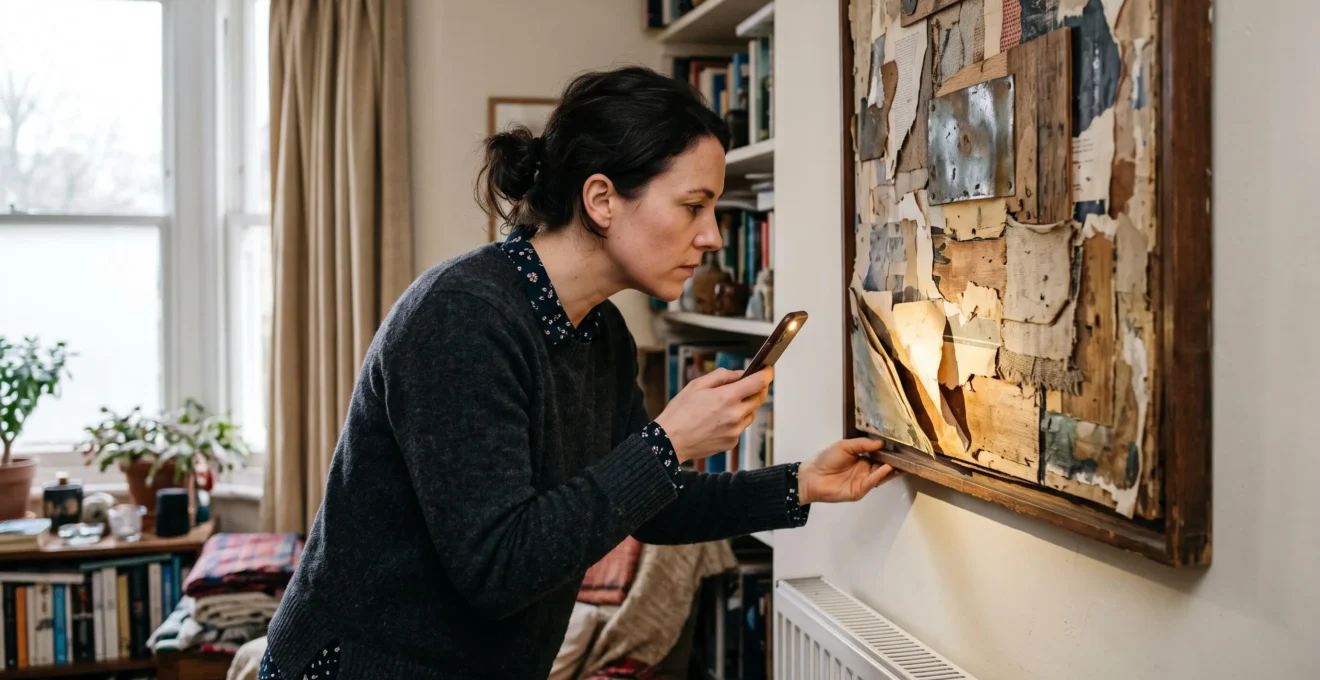
A textured artwork can look magnificent in a gallery and become unexpectedly troublesome once it hangs above a radiator, beside a busy hallway or near an open-plan kitchen. The difference is not necessarily artistic quality. It is often the way its materials respond to ordinary domestic conditions.
Mixed media art combines materials that may react differently to moisture, temperature changes, handling and airborne contaminants. Paper can distort, wood can move, adhesives can lose their grip and exposed metal can corrode. These risks do not make mixed media inherently unsuitable for a home, but they make construction and placement particularly important.
Before buying, examine four material risks: moisture-sensitive organic components, corrosion-prone metals, uncertain adhesives and inadequately protected supports or backs. Then consider how the artwork will be cleaned, moved and displayed. A carefully constructed assemblage can provide years of enjoyment, while an expensive piece with poorly understood materials may demand more attention than expected.
Mixed media art: what matters before buying
- Check the materials and construction, not simply the price, artist’s reputation or apparent solidity.
- Inspect edges, joints, the reverse and surface under angled light without pressing or flexing fragile components.
- Choose the artwork and its position together: humidity, heating, cooking pollutants and everyday contact determine how practical it will be.
- Why Can Mixed Media Art Start Failing Within 12 Months in a Central-Heated UK Home?
- How to Inspect a Mixed Media Artwork for Hidden Weak Points in Under 3 Minutes?
- Which Is Easier to Live With: High-Relief Mixed Media or Flat Assemblage on Panel?
- The Online-Photo Trap: The Mixed Media « Texture » That Looks Premium Until You See It at 30 cm
- When Should You Commission Mixed Media: After You Fix Damp, After Painting, or Only After Heating Is Stable?
- Why Can a Tapestry Reduce Echo in Hard-Floor UK Rooms More Than You Expect?
- The Placement Mistake That Can Make Textile Art Smell or Discolour Near Kitchens
- Why Do Handcrafted Tapestries Make a Room Feel Warmer Even When the Heating Stays the Same?
Why Can Mixed Media Art Start Failing Within 12 Months in a Central-Heated UK Home?
Mixed media art can show damage during its first year in a centrally heated home because changing indoor humidity makes different materials expand, contract or lose moisture at different rates. Paper, timber, adhesives and metal do not respond identically. The resulting stresses can cause lifting, warping, cracking or corrosion, although 12 months is not a scientifically established failure deadline.
During colder months, central heating can lower indoor relative humidity. When heating patterns change or moisture enters the room through everyday activities, humidity may rise again. An artwork made from several tightly bonded materials must accommodate those changes without allowing each component to move freely.
The Canadian Conservation Institute’s technical explanation of relative humidity damage describes how moisture changes affect organic materials and how constrained movement can produce cracking, deformation and separation.
Three deterioration mechanisms deserve particular attention:
- Adhesive failure: paper, fabric, painted layers or decorative objects begin lifting because the bond cannot accommodate movement or has deteriorated.
- Hygroscopic movement: moisture-responsive wood, paper and certain textiles change dimensions, potentially bending a panel or distorting a collage.
- Corrosion: susceptible metal components react with moisture and environmental contaminants, producing tarnishing or rust that may also stain adjacent materials.
These mechanisms may interact. For example, a wooden panel that moves with humidity can stress an adhesive joint holding a metal ornament. The ornament’s weight may then increase the risk of detachment. Whether this happens depends on the specific materials, their arrangement and the surrounding conditions.
The first winter is a useful observation period because it exposes an artwork to the home’s normal heating regime. Take a photograph when the piece arrives, then compare edges, corners and joints periodically under similar lighting. Record any new distortion rather than assuming every surface irregularity indicates active deterioration.
Traditional oil paintings can also suffer humidity-related damage. Mixed media is not automatically less durable; its distinctive challenge is the number of potentially incompatible components that may be combined.
The practical question is not whether the artwork will remain completely unchanged, but whether its materials and construction can tolerate the conditions of the intended room.
How to Inspect a Mixed Media Artwork for Hidden Weak Points in Under 3 Minutes?
A three-minute inspection can reveal visible warning signs in mixed media art, particularly staining, lifted edges, unstable-looking joints and distorted supports. Start with the reverse, examine corners and seams, then use angled light to assess surface irregularities. This is a rapid screening method, not a professional condition assessment or proof that hidden adhesives are stable.
Begin by asking the seller to show the reverse safely. Look for water tide marks, discolouration, mould-like deposits, cracks or evidence that the support has bowed. An unfinished back is not automatically defective, but its materials and exposure to the wall should be understood.
Next, examine the perimeter. Layer separation often becomes visible where paper, textile or decorative material meets the support. Look for raised corners, gaps between materials and brittle-looking joints.
Finally, illuminate the surface from one side. Raking light can reveal distortions that disappear under frontal illumination. The Canadian Conservation Institute’s painting examination checklist describes this technique as part of condition reporting.
Although a gentle flex test may seem useful, do not press, bend or deliberately flex an artwork to assess its adhesive strength. Such handling can create damage rather than reveal an existing problem. For an unmounted piece, ask the artist to demonstrate how it should be supported and transported without stressing the surface.
Pay particular attention to the four material-risk categories. Organic inclusions may respond strongly to humidity; ferrous metals may rust; unknown adhesives may fail; and vulnerable backing materials may be exposed to damp walls. None of these risks can be fully diagnosed by appearance alone.
Your five-step pre-purchase condition check
- Request a clear photograph of the reverse and save it with the artwork’s details.
- Inspect all visible corners and joints; record any lifting, cracking or separation in a short condition note.
- View the surface under oblique light and photograph any distortions without touching them.
- Obtain a written list of the materials, adhesives, supports and attachment methods used.
- Ask for handling, display and cleaning instructions, keeping the artist’s response with the purchase record.
When heavy elements, uncertain joints or existing damage raise doubts, request specialist conservation advice before purchasing or moving the work.
Which Is Easier to Live With: High-Relief Mixed Media or Flat Assemblage on Panel?
Flat assemblage on panel is generally easier to accommodate in a busy home because it projects less into the room and is less likely to be knocked during everyday activity. High-relief mixed media can be equally suitable when securely constructed and carefully positioned, but protruding elements often complicate dust removal, transport and rehanging.
The important distinction is between visual complexity and structural reliability. A dramatic relief with mechanically secured components may withstand ordinary display better than a flat collage whose layers depend on ageing or unsuitable adhesives.
Neither format can be judged reliably by appearance alone. Consider the construction, support, fixing system and amount of contact the artwork may experience.
| Practical consideration | High-relief mixed media | Flat assemblage on panel |
|---|---|---|
| Dust and cleaning | Recesses and protrusions can trap dust and restrict access. | Usually easier to inspect, although delicate surfaces may still prohibit wiping. |
| Moving and rehanging | Projections need additional protection and careful handling. | Often simpler to package if the surface and edges are adequately protected. |
| Daylight and shadows | Changing shadows can be a defining visual feature. | Generally produces less dramatic shadow movement. |
| Structural attachments | Mechanical fixings may provide secure support for heavier components. | Layered adhesives can introduce hidden vulnerabilities. |
| Busy household placement | Usually better away from circulation routes and accidental contact. | Often more practical for communal rooms and narrower spaces. |
Consider a household with children, pets or a narrow entrance hall. A protruding ceramic fragment might be perfectly secure while hanging undisturbed, yet vulnerable to an accidental knock. A relatively flat artwork would reduce that particular exposure, though its paper edges might still be sensitive to humidity.
For high-relief pieces, ask whether heavy components are screwed, wired, bracketed or bonded. Mechanical attachment is not automatically superior in every situation, but understanding how loads are carried is essential. The wall fixings must also support the total weight and the artwork’s particular hanging arrangement.
Cleaning access deserves equal attention. If an elaborate relief cannot be safely dusted without touching fragile surfaces, its maintenance requirements may exceed what the household can reasonably provide.
The best format is the one whose construction, location and maintenance needs fit the household, not necessarily the one that appears strongest in a gallery.
The Online-Photo Trap: The Mixed Media « Texture » That Looks Premium Until You See It at 30 cm
Mixed media artwork can look more substantial in online photographs than it appears in person because directional lighting emphasises relief, while framing and viewing distance conceal joints, edges and surface finishes. Resin, printed texture and lightweight relief materials may resemble more expensive components in photographs. Their actual quality and durability require closer inspection.
Studio photography is particularly effective at making shadows look deep and textures appear pronounced. A photograph taken with carefully positioned side lighting may show dramatic surface variation that becomes much subtler under an ordinary ceiling light.
This does not mean resin, foam or textured gels are necessarily inferior materials. Their suitability depends on formulation, construction, intended effect and long-term behaviour. The problem arises when the buyer assumes a particular material or finish without confirmation.
When inspecting in person, use three viewing conditions. First, stand at the distance from which the work will normally be seen. Next, examine the surface from approximately 30 cm without touching it. Finally, assess the piece under lighting similar to the intended room.
At close range, check whether visible edges are deliberately finished, whether attachments appear secure and whether surface irregularities are intentional or signs of deterioration. The 30 cm distance is a practical viewing suggestion, not a conservation standard.
For online purchases, request photographs showing the artwork from an angle under ordinary lighting, detailed views of the edges and a clear image of the reverse. Ask for the exact materials in writing, including whether glass-like effects are glass, resin or another substance.
A seller who cannot identify the materials may simply lack detailed records. However, unwillingness to provide reasonable information is a legitimate reason to postpone a purchase, particularly for an expensive or structurally complex work.
Photographic impact can influence both immediate satisfaction and future resale expectations, but no particular resale outcome follows automatically from a material choice. A buyer should prioritise accurate description, documented construction and the way the artwork looks in everyday conditions.
A piece that remains compelling under normal room lighting, while also showing sound construction, is more likely to meet expectations once the gallery-style presentation disappears.
When Should You Commission Mixed Media: After You Fix Damp, After Painting, or Only After Heating Is Stable?
Commission mixed media art after the underlying causes of damp have been resolved, decorating materials have dried or cured according to their specifications, and the room has returned to its normal heating and ventilation conditions. There is no universal waiting period. The safest commissioning schedule depends on the artwork’s materials and the environmental conditions of its intended location.
Start with damp. Condensation, leaks and moisture entering through walls can threaten moisture-sensitive supports, adhesives and textile inclusions. Painting over a damp patch does not resolve the underlying cause, and a new artwork should not be used to conceal an unresolved problem.
Next, complete decorating. Fresh paint, coatings and other renovation products can introduce moisture or release volatile compounds as they dry and cure. Follow the manufacturer’s instructions rather than assuming every product requires the same number of days or weeks.
Finally, consider the heating regime. A room undergoing major renovation may behave differently from the same room in ordinary use. Where possible, allow normal conditions to resume before finalising the artwork’s material choices and installation.
Commissioning offers an important advantage: material risks can be discussed before construction begins. The buyer can agree with the artist how components will be attached, which supports are suitable and what maintenance will be required. This does not eliminate deterioration, but it provides opportunities to reduce foreseeable vulnerabilities.
A practical commissioning brief should identify:
- The intended room, wall position and whether the wall is internal or external.
- The normal heating, ventilation and moisture conditions.
- Proximity to cooking areas, bathrooms, radiators and direct sunlight.
- The preferred format, dimensions, weight and degree of relief.
- The proposed materials, attachment methods, backing construction and maintenance requirements.
Ask the artist to explain which components are moisture-sensitive, whether metal parts are susceptible to corrosion and how heavy elements will be supported. For an artwork expected to move between properties, request suitable packing and handling instructions as well.
If the property is rented or undergoing continuing renovation, a relatively lightweight, securely constructed piece using appropriately stable materials may be easier to manage than an elaborate assemblage combining untreated wood, vulnerable paper and heavy protrusions. No material combination is universally safe, however, and the specific construction still matters.
When the intended wall remains damp or the indoor environment is unusually unstable, postponing installation is often more sensible than trying to compensate through decorative finishes alone.
Why Can a Tapestry Reduce Echo in Hard-Floor UK Rooms More Than You Expect?
A hanging tapestry can reduce some sound reflections because its fibres and structure absorb part of the sound energy that would otherwise bounce from hard surfaces. In rooms with timber floors, large windows and plastered walls, this may soften perceived reverberation. The size of the effect depends on the textile, mounting arrangement and room acoustics.
Hard surfaces tend to reflect sound rather than absorb it. In a sparsely furnished living room, speech, television audio and everyday noises can therefore sound sharper or more reverberant than expected.
Adding a porous textile introduces a surface with different acoustic behaviour. Sound absorption varies with frequency, textile construction, thickness, air gaps and mounting conditions. A dense decorative hanging and a loosely woven tapestry will not necessarily perform alike.
An acoustic study of the Barberini tapestries published in the Journal of the Acoustical Society of America examined historic tapestries using measurements taken with and without them installed in a cathedral. The research supports the principle that hanging tapestries can influence room acoustics, although the results cannot be transferred directly to a typical British living room.
Measured acoustic behaviour of historic tapestries
Researchers Francesco Martellotta and Lisa Pon investigated the Barberini tapestries during an exhibition at the Cathedral of St. John the Divine in New York City.
The study used on-site acoustic measurements and modelling to examine sound absorption and reverberation. It provides evidence that tapestry installations affect acoustics, but does not establish a standard echo reduction for homes.
For domestic placement, consider a substantial wall hanging in an area where reflected sound is noticeable, such as a large bare wall near a seating area. A hanging opposite or adjacent to reflective surfaces may be worth testing, although placement alone cannot guarantee a particular result.
Coverage area is relevant, but so are the textile’s properties and the gap behind it. It would be misleading to claim that size always matters more than thickness.
In a living room already containing curtains, upholstered furniture and rugs, the additional effect may be subtle. In a more sparsely furnished space, the change may be more noticeable.
A tapestry is not a substitute for purpose-designed acoustic treatment where precise sound control is needed, but it can contribute to a more comfortable domestic sound environment.
The Placement Mistake That Can Make Textile Art Smell or Discolour Near Kitchens
Textile artwork can develop odours, discolouration and persistent soiling when displayed where cooking grease, moisture and airborne particles regularly reach its fibres. Open-plan kitchens create particular placement challenges because contaminants can travel beyond the cooking area. Unlike many sealed hard surfaces, delicate textiles may be difficult or unsafe to clean thoroughly.
Cooking produces airborne moisture and particles, including grease aerosols under some conditions. As these contaminants settle on textile surfaces, they can become trapped among fibres and within textured weaves.
The Canadian Conservation Institute‘s textile preservation guidance identifies dust, pollutants, oils and inappropriate environmental conditions as concerns for textile collections. It also emphasises that cleaning and handling must suit the particular object.
In a domestic setting, pay attention to walls immediately beside open-plan cooking areas, positions above heat sources and locations where cooking air repeatedly passes. These should be treated as potentially higher-exposure positions rather than automatically unsuitable ones.
Bedrooms, separated living rooms and hallways away from cooking activity may offer lower exposure, provided they are also free from damp, excessive light and other relevant hazards.
If the only available display position is near an open-plan kitchen, improve extraction and ventilation during cooking, keep the textile away from direct heat and grease, and discuss its cleaning requirements with the maker before purchasing.
Do not assume handcrafted textile art is washable. Fibre composition, dyes, surface decoration, adhesives and mounting methods may make ordinary laundering unsafe. Professional cleaning should be based on the object’s condition and materials rather than an arbitrary fixed interval.
Light-coloured fabrics may make some stains more visually obvious, but that does not establish that every pale natural fibre accumulates dirt faster than darker or synthetic materials.
Placement risks can also compound. A textile hanging near cooking activity and directly above a radiator may face both airborne contamination and changing local temperature or humidity conditions.
A suitable display location should minimise grease, moisture, excessive heat and accidental contact together, rather than solving one exposure while overlooking the others.
Key considerations before choosing textile art
- Choose a hanging for the conditions of the actual room, not simply for its colour or texture.
- Distinguish visual warmth and acoustic comfort from measurable heating or insulation performance.
- Ask about fibres, mounting, cleaning and moisture sensitivity before installing a valuable tapestry.
Why Do Handcrafted Tapestries Make a Room Feel Warmer Even When the Heating Stays the Same?
Handcrafted tapestries can make a room feel warmer because their textured surfaces, colours and visual softness influence how comfortable a space appears. A wall hanging may also modestly alter the thermal experience near a cold surface, but its physical effect depends on construction and placement. It should not be regarded as a substitute for proper insulation.
Much of the perceived warmth is visual. Soft fibres, woven patterns and textured surfaces can make a room feel less stark than an equivalent space dominated by plaster, glass and other hard finishes.
Colour also contributes to the impression. Warm earth tones, muted reds and natural wool shades may create a sense of cosiness even when the thermostat remains unchanged. This is a design effect, not evidence that the air temperature has increased.
A hanging textile also introduces an additional layer between the room and the wall. Depending on its thickness, mounting and any air space behind it, this may modestly influence local heat exchange or the sensation of a cold surface nearby.
However, a decorative tapestry’s thermal performance cannot be assumed without information about its materials and installation. It would be inaccurate to promise a meaningful reduction in heating bills or a specific increase in room temperature.
Rooms with cold external walls may be particularly relevant when considering comfort, especially where seating is positioned close to the wall. Even there, the first priority should be identifying insulation deficiencies, condensation and damp before installing moisture-sensitive textiles.
A room above an unheated garage or extension may also feel cold, but a wall hanging cannot correct heat loss through an inadequately insulated floor. Its benefits remain local and primarily decorative unless separately demonstrated.
There is also a durability trade-off. The same fibres that create softness and visual comfort can retain dust and pollutants, react to humidity and suffer light-related deterioration. Heavy tapestries additionally require suitable support to avoid stretching or distortion.
The most satisfying choice therefore balances atmosphere, practical care and environmental suitability. A handcrafted tapestry can provide texture, a softer visual impression and potentially some acoustic benefit without being treated as a technical solution to building defects.
Choose a prospective hanging, confirm its materials and mounting requirements, then assess the intended wall for damp, direct sunlight and nearby heat sources. That simple sequence helps ensure the artwork remains enjoyable rather than becoming another maintenance problem.
Can mixed media art be displayed above a radiator?
It is generally preferable to avoid positions where an artwork experiences concentrated heat or substantial local humidity changes. The risk depends on its materials, distance from the heat source and room conditions. Ask the artist or a conservator about a specific piece before installing it above a radiator.
Does a certificate of authenticity guarantee that mixed media materials are durable?
No. A certificate may document authorship, title, provenance or other identifying information, but it does not automatically establish the stability of adhesives, pigments, supports or attachments. Request a separate materials list and appropriate care instructions.
Should mixed media artwork be protected behind glass?
Protective glazing can reduce handling and dust exposure for suitable works, but the framing design must accommodate the artwork’s depth, materials and ventilation or environmental requirements. Fragile relief components should not touch the glazing. A conservator or experienced specialist framer can advise on appropriate protection.
How often should a mixed media artwork be checked for deterioration?
There is no universal inspection interval. A newly acquired work may benefit from occasional visual checks during its first heating season, particularly after changes in the room’s environment. Compare photographs taken under similar lighting and seek professional advice if new lifting, cracking, staining or movement appears.
Can you safely vacuum or wipe dust from a textured mixed media artwork?
Not without confirming that the specific materials and construction can tolerate the proposed cleaning method. Loose fibres, friable paint, delicate paper and projecting elements may be damaged by suction, brushing or wiping. Follow the maker’s instructions and consult a conservator for valuable or vulnerable works.