
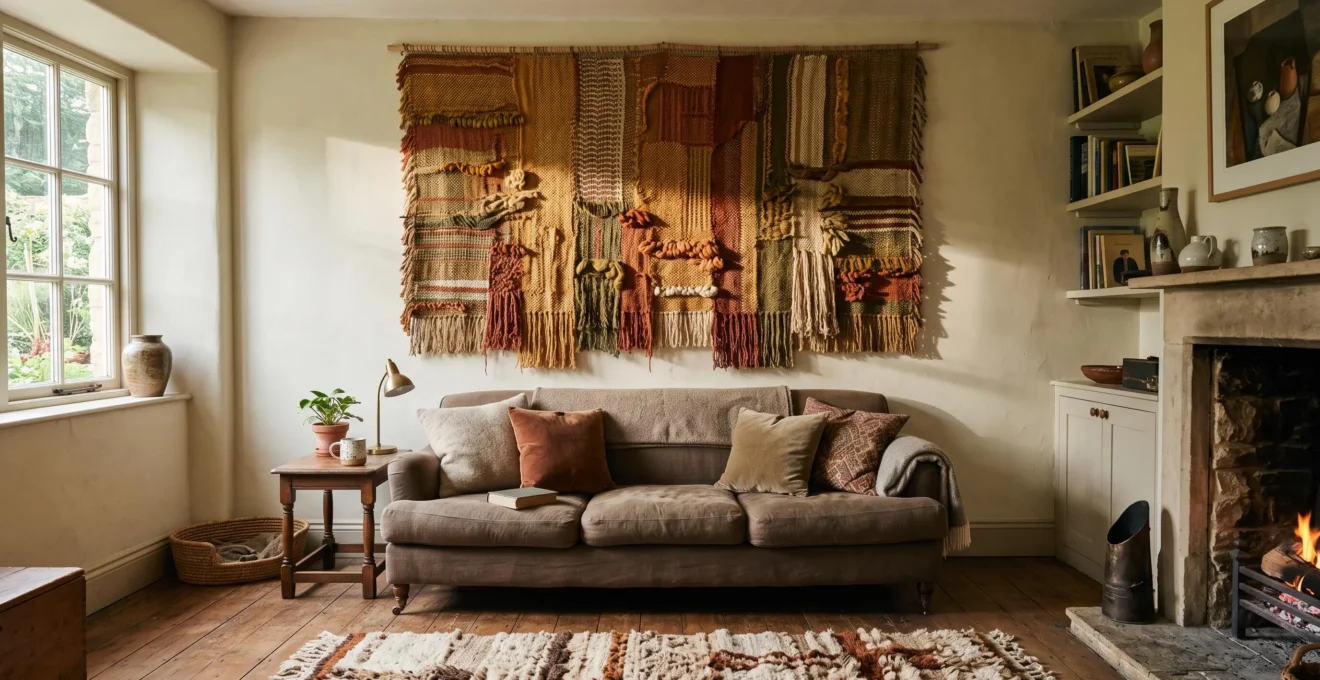
A room can be perfectly heated and still feel surprisingly cold. Picture a British living room with timber flooring, white plaster walls, generous windows and a modern sofa. The thermostat reads comfortably, yet footsteps sound sharp, conversations carry across the space and the interior feels slightly exposed.
Introduce a substantial handcrafted tapestry, and the atmosphere can change without adjusting the heating. Its woven surface absorbs and scatters some sound, its fibres invite the eye to imagine softness, and its irregular textures interrupt the visual hardness of glass, painted plaster and polished furniture.
This is not the same as increasing the air temperature. A tapestry is not a substitute for insulation or heating, and an ordinary decorative wall hanging cannot be assumed to provide measurable thermal savings. Its strongest contribution is often acoustic, tactile and psychological warmth.
Choosing the right piece means looking beyond colour or a fashionable woven pattern. Construction, wall placement, hanging hardware, daylight exposure and the relationship with existing furniture all determine whether a textile artwork feels beautifully integrated or merely decorative.
What makes handcrafted tapestries feel warmer?
- Softer acoustics: Textile surfaces can absorb some reflected sound, particularly where hard floors and bare walls create noticeable reverberation.
- Visible craftsmanship: Fibres, woven relief and subtle irregularities create a sense of depth and softness that framed prints rarely provide.
- Thoughtful presentation: The right scale, secure hanging, controlled light exposure and balanced furnishings make a tapestry feel like a lasting artwork.
- Why Can a Tapestry Reduce Echo in Hard-Floor UK Rooms More Than You Expect?
- How to Hang a Heavy Tapestry on UK Plasterboard Without Sagging or Wall Damage?
- Which Tapestry Type Works Best With Pets: Flatweave, High-Pile, or Sculptural Fibre Art?
- The Care Mistake That Can Ruin a Handcrafted Tapestry After 6 Months Near a Window
- When Should You Add a Tapestry: Before Choosing Curtains or After You Set the Rug and Sofa?
- Why Can Mixed Media Art Start Failing Within 12 Months in a Central-Heated UK Home?
- How to Check Fibre Art Build Quality Using 5 Close-Up Details Before You Buy?
- Why Does Modern Textile Art Look High-End in Galleries but « Crafty » at Home Without This 1 Choice?
Why Can a Tapestry Reduce Echo in Hard-Floor UK Rooms More Than You Expect?
A handcrafted tapestry can soften echo because its fibrous surface interacts with sound differently from plaster, glass or timber flooring. Rather than reflecting all incoming sound directly back into the room, the textile can absorb part of its energy. The result may be a less reverberant, more intimate atmosphere, even though the thermostat remains unchanged.
In a minimalist living room, sound travels between reflective surfaces. A conversation, television programme or dropped object produces waves that encounter walls, windows, ceilings and floors. When many surfaces are hard, reflected sound can persist, making the room feel lively or exposed.
A woven wall hanging introduces a different surface. Air movement through and around its fibres creates opportunities for some acoustic energy to dissipate. How much this matters depends on the textile’s construction, the frequencies involved, its coverage of the wall and the surrounding room.
Applied Acoustics research on textile acoustic properties examined the influence of fabric structure, thickness, porosity and air permeability on sound absorption. The experiments concerned textile fronts used with acoustic panel materials, however, rather than independent decorative tapestries in domestic rooms.
That distinction matters. A thick-looking artwork does not automatically qualify as an acoustic treatment, and no universal reduction in decibels can be promised for a handcrafted wall hanging.
To discover whether your room could benefit, try a simple listening exercise:
- Stand near the centre of the room when it is reasonably quiet.
- Clap once and listen for any lingering, fluttering or repeated reflections.
- Identify large, uncovered surfaces facing one another, particularly glazing and plaster walls.
- Consider positioning a substantial tapestry on a suitable reflective wall where it can also serve as a visual focal point.
- Repeat the listening exercise after installation, using the same position and similar room conditions.
This is a subjective comparison, not an acoustic measurement. Furniture, curtains, rugs and room geometry all influence the result.
Unlike a conventional framed print or canvas, a tapestry offers an exposed fibrous surface with potential acoustic absorption. A thicker, more permeable construction and a suitable space behind the textile may influence its behaviour, although the benefit of a particular air gap must not be assumed without testing.
Its visual contribution can be just as important. In a room with underfloor heating or radiators, warm-toned wool, tactile relief and softened reflections can make the space feel more inviting without generating additional heat.
Once the wall has been chosen, the next question becomes structural: a substantial woven artwork needs support that respects both its weight and the surface behind it.
How to Hang a Heavy Tapestry on UK Plasterboard Without Sagging or Wall Damage?
The safest way to hang a heavy tapestry on plasterboard is to identify the wall construction, assess the artwork’s complete hanging weight and distribute that weight across suitable fixing points. A sleeve-and-batten system can support the textile along its width, while correctly selected structural fixings reduce the risk of sagging, pull-out and gradual damage.
British homes contain several wall types that may look similar beneath paint. Many modern partitions use plasterboard over timber or metal studs. Older properties may have solid masonry or traditional lath-and-plaster. Some newer boards are reinforced, while others are standard plasterboard with very different fixing capabilities.
Before drilling, establish what is actually behind the plaster surface. A suitable detector can help locate studs and identify potential hidden services, but readings should be checked against the wall construction. Never drill where cables or pipework may be present.
Rather than relying on an arbitrary weight threshold, select the mounting approach according to the complete installation:
| Artwork and installation | Potential hanging method | Main consideration |
|---|---|---|
| Small, lightweight textile | Manufacturer-approved removable strips or adhesive hooks | Compatible paint surface, rated capacity and removable finish; adhesives may damage delicate surfaces |
| Medium-weight woven piece | Hanging rail or batten secured to appropriate structural supports | Stud location, fixing suitability and even weight distribution |
| Large or genuinely heavy tapestry | Structural fixings into suitable studs or appropriately rated cavity anchors | Wall specification, combined fixing loads, edge distances and professional assessment where necessary |
| Older masonry or lath-and-plaster | Fixings selected for the verified substrate | Wall condition, hidden services and the risk of cracking or local failure |
The difference between ordinary and reinforced plasterboard is particularly important. British Gypsum’s Gyproc Habito Product Guide documents safe working loads of 15 kg, 19 kg and 29 kg per fixing for specified fixing configurations in its 12.5 mm Habito board.
Those figures are product-specific, not universal limits for plasterboard. They must not be transferred to a conventional partition or used without checking the fixing manufacturer’s instructions.
A sewn sleeve across the upper back of the tapestry can accommodate a suitable rod or batten. Instead of concentrating tension at isolated fabric loops, this arrangement supports the upper edge more evenly. The sleeve itself must be well constructed, and the rod and wall supports must be capable of carrying the load.
Avoid placing unnecessary tension through loose fringe, delicate decorative knots or individual warp threads. Where a textile was not made for wall display, seek advice from its maker or a textile conservator before adding a sleeve.
Check the finished installation for a level upper edge, smooth fabric distribution and secure support. Reinspect it after several weeks, watching for movement, loose fixings or developing distortion. Seasonal temperature and humidity changes can affect textile tension and may expose weaknesses in the hanging arrangement.
A secure installation should protect the artwork without making its suspension the centre of attention. That becomes especially valuable in busy households where animals, furniture and everyday movement introduce additional risks.
Which Tapestry Type Works Best With Pets: Flatweave, High-Pile, or Sculptural Fibre Art?
A tightly constructed flatweave is generally the more practical choice for a home with cats or dogs because it offers fewer exposed loops and dangling fibres to catch on claws. High-pile and sculptural fibre art can still work beautifully, but their raised textures require more careful positioning and maintenance. No tapestry construction should be considered entirely pet-proof.
Pets interact with textiles differently. A dog may shed against a low-hanging work or brush past it repeatedly. A cat may investigate projecting yarn, hanging fringe or an accessible woven surface. The risk depends on the individual animal’s behaviour as much as the construction of the artwork.
A pilot study published in the Journal of Feline Medicine and Surgery examined scratching behaviour among cat-owning clients of a US veterinary practice. Among the cats represented in the survey, owners reported inappropriate scratching of furniture in 81.5% of cases and carpet in 64.1%.
The research, available through the Journal of Feline Medicine and Surgery study on feline scratching behaviour, supports being cautious with textile furnishings. It did not test decorative tapestries or compare different weave types.
The following comparison is therefore practical construction guidance, not a ranking derived from a controlled pet-damage trial.
| Consideration | Flatweave | High-pile | Sculptural fibre art |
|---|---|---|---|
| Claw snagging | Often lower risk with a compact, secure weave | Raised loops and fibres may catch | Projecting cords and loose elements can be vulnerable |
| Pet hair | Usually easier to inspect and remove gently | Hair may become lodged within the pile | Irregular surfaces can complicate removal |
| Visible damage | Snags may be noticeable, especially in fine weaves | Disturbed pile may change the surface appearance | Broken or displaced elements can alter the composition |
| Routine care | May tolerate cautious surface cleaning if approved by the maker | Requires care to avoid disturbing pile | Often needs individualised cleaning advice |
For a cat that regularly scratches upholstery, the safest placement is outside its normal climbing and jumping routes. Remember that shelves, sideboards and sofa backs can extend an animal’s reach well beyond its standing height. There is no universal hanging height that guarantees protection.
Consider the textile’s lower edge, too. Long fringe hanging behind a sofa may invite contact even when the main artwork sits relatively high on the wall.
Keep an appropriate scratching surface available for cats, inspect the artwork periodically and remove loose surface hair only with a method approved for its fibres and construction. If an animal repeatedly reaches the work, relocation is preferable to waiting for a significant snag.
Cleaning matters before purchase. Some handmade textiles contain fibres or dyes that cannot safely be machine-washed. Agitation, water and temperature changes may cause shrinkage, felting, dye transfer or distortion.
Once a suitable weave and hanging position are established, the less visible threat is often environmental. Daylight can damage a valuable textile without any contact at all.
The Care Mistake That Can Ruin a Handcrafted Tapestry After 6 Months Near a Window
The mistake is allowing a handcrafted tapestry to receive repeated direct sunlight without considering cumulative light damage. Natural dyes, synthetic dyes and fibres can respond differently, but prolonged exposure may cause fading, yellowing or weakening. Damage may only become noticeable months later, and a faded textile cannot simply be restored to its original colour through cleaning.
A sunlit wall can be tempting because directional daylight reveals every ridge, knot and subtle change in yarn thickness. Unfortunately, the same location may expose the artwork to damaging light over time.
Ultraviolet radiation is an important contributor to deterioration, but visible light can also play a role. This means that even a window with some UV protection does not make unrestricted daylight exposure harmless.
Professional textile conservation guidance from the UK’s Institute of Conservation explains that light exposure can cause fading and fibre deterioration. Its advice also addresses temperature, humidity and regular inspection.
The timeframe varies substantially according to fibre composition, dyes, light intensity, exposure duration and environmental conditions. Six months is a useful prompt to check an artwork’s placement, not a scientifically established deadline by which every tapestry will deteriorate.
Before choosing a wall, observe where sunlight falls during the morning, midday and late afternoon. Repeat the observation in another season if possible, because the sun’s changing angle can expose surfaces that appeared shaded earlier in the year.
A shaded wall or a north-facing position may offer an advantage, although orientation alone is not a guarantee. Reflected daylight, nearby windows and artificial lighting can still contribute to cumulative exposure.
UV-filtering window treatments may reduce part of the risk, depending on their specification, but cannot prevent every form of light damage. Rotating a piece can distribute exposure more evenly in some circumstances; it does not reverse fading or eliminate deterioration.
A five-step tapestry preservation check
- Map direct sunlight. Observe the intended wall at different times and record the periods when sunlight strikes it; keep a simple exposure note.
- Check heat sources. Identify nearby radiators, heating outlets and concentrated heat; mark a safer alternative position if needed.
- Record the original appearance. Photograph the tapestry in consistent, indirect light, including a close-up of its main colours, to establish a reference.
- Agree on a cleaning method. Check the maker’s care instructions and write down whether dry dusting, low-suction vacuuming or specialist attention is appropriate.
- Schedule condition checks. Add a monthly reminder to inspect for fading, distortion, dust, pests and loose fibres; keep a dated condition record.
Avoid positioning a delicate textile immediately above a radiator or close to a concentrated heat source. Use gentle, supported cleaning methods appropriate to the work, and never assume that a handwoven piece is suitable for washing.
Where the materials are unidentified, dyes appear unstable or damage is already visible, a textile conservator is a safer choice than experimenting with water, detergent or aggressive vacuuming.
Protecting the artwork is only one part of successful placement. Its relationship with curtains, the sofa and the rug determines whether its textures feel balanced or visually overwhelming.
When Should You Add a Tapestry: Before Choosing Curtains or After You Set the Rug and Sofa?
Choose the tapestry early when you want it to anchor the room’s artistic identity, colour palette and material character. If the sofa, rug and curtains are already established, choose a piece that introduces a deliberate contrast rather than simply matching everything. In either case, scale and visual hierarchy matter more than rigid decorating rules.
A handcrafted textile can do the work of a major painting while introducing a depth that paint or print alone cannot replicate. Its palette might guide the choice of upholstery, but its more distinctive contribution is usually the relationship between yarn, relief, shadow and surrounding surfaces.
When planning a room from scratch, selecting the tapestry before the final soft furnishings offers several advantages. You can leave enough wall space, establish an appropriate hanging system and choose curtains or cushions that complement rather than imitate the artwork.
When working with a furnished room, reverse the process. Identify what already attracts attention, then decide whether the tapestry should become the focal point or provide quieter textural balance.
| Existing room | Suitable tapestry direction | What to avoid |
|---|---|---|
| Patterned rug and expressive curtains | Restrained palette, confident scale and subtle woven relief | Another equally dominant all-over pattern |
| Plain sofa, neutral rug and simple curtains | Sculptural texture or stronger colour contrast | A piece so visually quiet that it disappears |
| Rich upholstery with many visible textures | Clear silhouette and a controlled range of fibres | Competing surface effects everywhere |
| Minimal interior with hard flooring | Substantial woven surface that introduces softness | A tiny textile lost on a large bare wall |
Scale deserves particular attention. Before buying, mark the intended dimensions on the wall with removable painter’s tape, provided it is safe for the finish. Step back and observe the outline from the entrance, the sofa and other normal viewing positions.
Above a sofa, the piece should relate visibly to the furniture grouping rather than float as an isolated object. A smaller tapestry can succeed when deliberately composed with negative space, but a small work placed without regard to the surrounding wall often appears accidental.
Consider the wall’s acoustic role as well. If the room has noticeable reflections between large hard surfaces, an appropriately positioned woven artwork may contribute more than the same piece placed in an acoustically insignificant corner.
The aim is not to cover every bare surface with fabric. A successful arrangement allows the rug, curtains and tapestry to occupy different positions within the room’s visual hierarchy.
Once the textile arrangement feels resolved, pay attention to the artwork’s materials. A composition combining woven fibres with rigid elements may respond differently to the environmental changes of a centrally heated home.
Why Can Mixed Media Art Start Failing Within 12 Months in a Central-Heated UK Home?
Mixed media textile art can develop problems in centrally heated homes because its components expand, contract or absorb moisture at different rates. Fibres, wood, metal, rigid supports and adhesives do not necessarily respond alike to changing humidity and temperature. Over time, this uneven movement can stress joins, distort surfaces and weaken poorly designed connections.
Imagine a sculptural wall hanging composed of wool, a timber framework and glued decorative elements. When indoor humidity falls during a heating period, the wood and fibres may change dimension differently. When conditions shift again, the assembly must accommodate another round of movement.
A soundly engineered artwork may tolerate these changes. A poorly designed one may concentrate stress where a flexible textile meets a rigid component.
Potential warning signs include:
- Warping: A panel, backing or frame gradually loses its original shape.
- Adhesive separation: An attached element begins to lift or detach at its edges.
- Tension loss: A previously taut textile develops wrinkles, slack areas or uneven edges.
- Join movement: Gaps become visible where different materials meet.
- Fibre deterioration: Local brittleness, distortion or damage develops near areas of heat or stress.
These are possible failure modes, not a prediction that every mixed media artwork will deteriorate within twelve months. That timeframe should be treated as an opportunity to review a new installation through its first seasonal cycle, rather than a proven universal failure interval.
When considering a purchase, ask the maker how the individual materials are connected. Mechanical fixings, stitching and adhesive bonding have different strengths and limitations. A mechanically fixed connection is not automatically superior in every application, but it may make inspection or future intervention easier when thoughtfully designed.
Also ask whether the backing allows natural movement, whether adhesives are suitable for the materials involved and what environmental conditions the artist recommends.
Single-material weaves can avoid some problems associated with incompatible rigid and flexible components. They are not immune to stretching, humidity changes or fibre deterioration, however.
In a typical British living room, seek a reasonably stable environment and avoid concentrated heat, persistent dampness and abrupt environmental extremes. The Institute of Conservation’s textile care advice is particularly relevant here: excessive heat and unfavourable moisture conditions can affect long-term preservation.
Document the artwork when it is first installed and inspect it periodically for changes in shape, tension and joins. If separation appears, avoid adding household glue without understanding the original construction.
Because durability is difficult to judge from a distant photograph, the next step is to examine construction details closely. A few carefully chosen observations can reveal much more than an attractive overall image.
How to Check Fibre Art Build Quality Using 5 Close-Up Details Before You Buy?
Assess handcrafted fibre art by inspecting five construction details: finished edges, knots and joins, weaving tension, colour application and the hanging interface. Together, these reveal how securely the piece is made, how evenly it carries stress and whether its materials are suited to long-term display. The goal is to distinguish intentional handmade variation from weaknesses that may worsen over time.
A photograph of an entire tapestry can communicate composition and colour beautifully while concealing construction faults. Before committing to an artwork, examine the points where fibres end, meet, change direction or transfer weight into the suspension system.
- Edge finishing and selvedge security. Look for stable edges without uncontrolled loose threads or widening gaps. Decorative fringe may be intentional, but the underlying woven structure should remain secure. Weak edges can gradually unravel when handled or placed under tension.
- Knot and join consistency. Inspect the places where yarns are tied, joined or changed. Knots should suit the construction and appear secure. Handmade irregularity is not itself a defect; unexplained loose joins and unsecured yarn ends deserve closer attention.
- Tension evenness. Look at the textile both flat and hanging, if photographs are available. Distorted edges, unexplained puckering or uneven sagging may suggest inconsistent tension. Some sculptural pieces deliberately use variable tension, so consider the maker’s intended form.
- Dye penetration and colour stability. Ask whether the design uses dyed yarns, printed surfaces, applied pigments or a combination. Printing is not inherently inferior to weaving with dyed yarn, but its durability depends on the method, materials and intended use. Look for uncontrolled colour transfer, flaking or unexplained inconsistencies.
- Hanging interface. Examine the sleeve, rod pocket, attachment loops or dedicated mounting points. The hanging arrangement should support the textile without placing concentrated strain on fragile decorative elements.
These details help predict practical longevity because everyday deterioration often begins at stressed edges, poorly secured joins or unsuitable mounting points.
Buying online calls for more deliberate questions. Request a clear photograph of the back, a close-up of both upper corners, a detail showing the main weave and an image of the hanging arrangement. A side view can also help reveal the artwork’s depth.
Ask the maker about fibre composition, colour application, cleaning restrictions, total weight and any recommended wall hardware. For mixed media work, request an explanation of how rigid and flexible elements are connected.
A reputable maker should be able to distinguish intentional irregularities from structural features and explain how the work was designed to be displayed. Lack of formal certification does not establish poor craftsmanship, just as an attractive description does not establish durability.
Finally, connect your inspection to the conditions the artwork will encounter. Strong edges matter for heavy hanging, compact construction matters around active pets, and stable connections matter in centrally heated interiors.
Once the construction passes inspection, the decisive question is how the artwork will be presented. Even exceptional craftsmanship can lose its impact when the surrounding room gives it no visual priority.
Key takeaways before styling your textile artwork
- Prioritise scale over decoration. A tapestry should relate deliberately to the wall and surrounding furniture, not simply occupy an empty patch.
- Let craftsmanship remain visible. Lighting, surrounding materials and adequate viewing distance should reveal the weave rather than compete with it.
- Protect the investment in presentation. Secure mounting, sensible environmental conditions and accessible care arrangements belong in the design decision from the beginning.
Why Does Modern Textile Art Look High-End in Galleries but « Crafty » at Home Without This 1 Choice?
The defining choice is to present the tapestry as an artwork rather than as a decorative accessory. Galleries use deliberate scale, controlled visual surroundings, suitable lighting and considered viewing positions to establish an object’s importance. The same approach can work in a British home without making the room feel like an exhibition space.
In a gallery, a woven artwork may occupy an entire wall with little competing detail. Visitors can approach it, step back and observe how fibres respond to light. Its edges, shadows and material variations become essential parts of the experience.
At home, that same work can lose its presence when squeezed between shelves, surrounded by small pictures or hung above furniture that dominates its proportions.
The issue is not that domestic interiors are less sophisticated. It is that visual hierarchy changes how craftsmanship is perceived.
Start by choosing one wall where the tapestry can command attention. Leave enough surrounding space for its outline to remain legible. This does not require a bare room; books, ceramics, timber furniture and upholstery can create a rich setting when their colours and forms support the textile.
Consider eye level from the places where the artwork will normally be viewed. A tapestry above a sofa may need to sit differently from one displayed in an entrance hall. Rather than following an inflexible height rule, assess the composition while standing and seated.
Lighting should make the material readable without putting preservation at risk. Soft, appropriately controlled directional light can reveal the ridges of handwoven yarn, while harsh glare can flatten the appearance of some fibres. Avoid intense illumination, unnecessary heat and prolonged exposure that could contribute to deterioration.
Materials surrounding the work also influence its character. A textured wool tapestry against restrained plaster, timber or stone may feel sculptural. Placing it beside several equally intricate patterns can obscure the very details that distinguish it.
Warmth comes from this combination of material presence and atmosphere. The textile interrupts hard surfaces, may moderate some reflected sound and gives the eye an intricate handmade surface to explore. None of these effects requires pretending that the room’s air temperature has increased.
Presentation should also remain practical. An artwork that must be constantly removed to avoid pets, sunlight or heating problems has probably been given the wrong position, however attractive it looks in a photograph.
Before buying or rehanging a tapestry, choose its intended wall, check the exposure and mounting conditions, and mark out its full dimensions. Then judge the room from the position where you actually live in it. The strongest result is not simply a warmer-looking interior, but a considered home where craftsmanship, acoustic softness and visual comfort work together.
Can a handcrafted tapestry replace acoustic wall panels?
Not reliably. A decorative tapestry may absorb some reflected sound and make a room feel less reverberant, but its performance depends on construction, size, placement and room conditions. Purpose-designed acoustic panels have specific assemblies and may provide tested performance information. For a significant noise problem, particularly sound transmission between rooms, obtain an appropriate acoustic assessment rather than assuming a tapestry will solve it.
Do wool tapestries actually insulate a cold wall?
A textile introduces a material layer between the viewer and the wall, but an ordinary wall hanging should not be treated as an established thermal insulation system. Any effect on heat transfer depends on its construction and installation. It will not remedy structural heat loss, dampness or inadequate wall insulation. Its most immediately noticeable contribution is usually visual and tactile comfort.
Should a valuable tapestry be hung directly against an external wall?
First check whether the wall is dry, stable and free from condensation or mould. A cold, damp external wall may present risks to textiles, especially where airflow is restricted. A suitable hanging arrangement that avoids trapping the artwork against a problematic surface may help, but persistent dampness should be addressed before installation. Seek conservation advice for a valuable or historically significant piece.
Is a handmade tapestry suitable for a rented UK property?
It can be, provided the hanging method is compatible with the wall, the artwork’s weight and the terms of the tenancy. Lightweight pieces may suit approved removable systems, although these can still damage paint or plaster. Heavy textiles require proper structural support, so obtain any necessary permission before drilling. Do not rely on adhesive fixings for a load they are not designed to carry.
What should you ask an artist before commissioning a large wall tapestry?
Ask for the proposed finished dimensions, approximate weight, fibre composition, colour and construction techniques, hanging arrangement and care instructions. Discuss the intended wall, available space, daylight and nearby heating sources. Request construction details and installation guidance so the completed work can be mounted safely and maintained appropriately in its intended setting.