
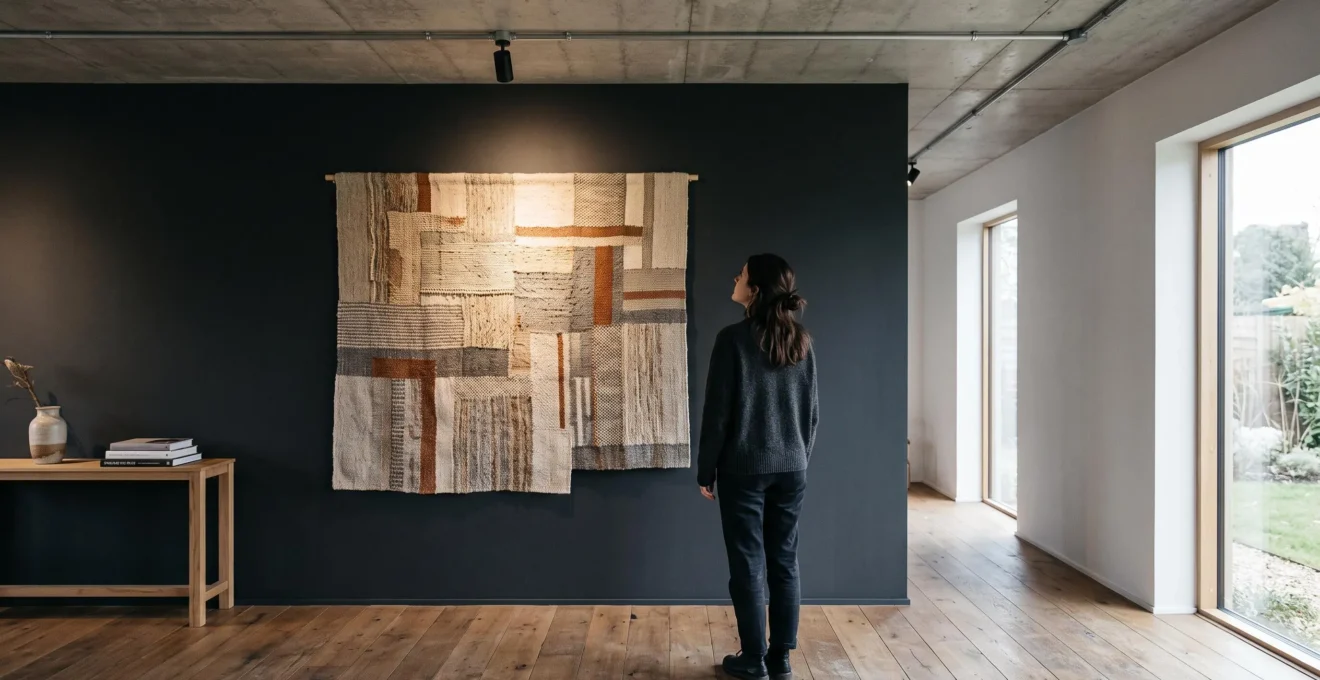
The difference between contemporary textile art that commands attention in a gallery and a similar piece that looks like a decorative craft project at home often comes down to one decision: how the artwork is separated visually from its surroundings.
In galleries, woven panels, sculptural fibre compositions and experimental tapestries are given deliberate space. Their backgrounds, lighting and mounting systems encourage visitors to examine texture, structure and artistic intention. At home, those same qualities can disappear against patterned wallpaper, crowded shelving or competing furnishings.
The solution is not necessarily an expensive frame, a larger room or a minimalist interior. It begins with controlling the relationship between the textile and its background. Once that visual hierarchy is established, construction quality, placement and preservation determine whether the piece retains its impact.
For UK buyers considering contemporary fibre art, understanding these decisions makes it easier to invest confidently in work that feels intentional rather than improvised, without sacrificing the individuality that makes handmade textiles compelling.
Modern textile art: the essential decisions
- Control the background first. Choose a wall that gives the textile clear tonal separation, enough breathing room and appropriate lighting.
- Inspect construction, not just appearance. Secure edges, stable tension, suitable mounting and material compatibility matter more than machine-like uniformity.
- Match the artwork to the room. Traffic, cooking residues, daylight, heating and humidity influence long-term preservation.
- Why Can Textile Art Lose Its Impact at Home Unless You Control the Background Colour?
- How to Check Fibre Art Build Quality Using 5 Close-Up Details Before You Buy?
- Which Works Better for High-Traffic UK Hallways: Woven Panels or Tufted Textile Pieces?
- The Placement Mistake That Can Make Textile Art Smell or Discolour Near Kitchens
- When Should You Vacuum or Rotate Textile Art: Monthly, Seasonally, or Only Before Guests Arrive?
- Why Can a Tapestry Reduce Echo in Hard-Floor UK Rooms More Than You Expect?
- Why Can Mixed Media Art Start Failing Within 12 Months in a Central-Heated UK Home?
- Why Does Mixed Media Art Age Badly in Homes Unless You Check These 4 Material Risks First?
Why Can Textile Art Lose Its Impact at Home Unless You Control the Background Colour?
Textile art can lose its impact when the background competes with its fibres, colours and irregular surfaces. A visually busy wall divides attention between the artwork and its surroundings, making even a substantial woven piece feel decorative. Choosing a background with deliberate tonal separation allows the texture, silhouette and composition to become the focal point.
Unlike a conventional framed print, textile art often has a soft or irregular boundary. Loose fibres, fringes, uneven edges and subtle changes in material density form part of the composition. These details depend on the surrounding wall to remain legible.
A patterned wallpaper or strongly contrasting decorative scheme may compete with those fine distinctions. Conversely, a completely flat background can provide the visual breathing room that makes an intricate piece appear more substantial.
The important distinction is between hue contrast and tonal contrast. A dark navy weaving against a dark burgundy wall may have contrasting colours but insufficient difference in lightness. The composition can become difficult to distinguish at normal viewing distance.
A useful first test is to photograph the intended wall and the artwork under similar lighting, then compare them in greyscale. This removes colour as a distraction and makes the light-dark relationship easier to assess. If the work blends into the background, consider a lighter or darker hanging zone. Similar grey values do not always prevent separation, however: texture, edge definition and directional lighting also influence the result.
Gallery presentation offers useful lessons, but domestic interiors need more flexibility. A dedicated painted section, recessed alcove or appropriately mounted contrasting board can isolate an artwork without requiring an entire room to be redecorated.
Warm natural fibres may look especially distinct against cooler grey or blue-grey walls, while cooler textile colours can benefit from warmer neutral backgrounds. These are design possibilities rather than universal rules: the actual lightness, saturation and room lighting should determine the choice.
Lighting deserves particular care. Directional illumination can reveal dimensional texture, but bright exposure can also harm vulnerable fibres and dyes. The Canadian Conservation Institute identifies visible and ultraviolet light as contributors to fading and fibre damage, so achieving gallery-like presentation should never mean exposing a valuable textile to unnecessary light.
A restrained wall does not make handmade work less expressive. It creates the visual space in which its deliberate irregularities become meaningful, leaving construction quality as the next consideration.
How to Check Fibre Art Build Quality Using 5 Close-Up Details Before You Buy?
Buyers can assess fibre art quality by examining five construction details: tension, yarn endings, edge finishing, fibre density and mounting stability. These features help reveal whether the artwork can support its own weight and withstand normal display conditions. Good craftsmanship means structural integrity, not perfect uniformity, so intentional irregularities should not automatically be treated as defects.
The most revealing examination often happens at close range, where structural decisions are visible rather than concealed by the overall composition.
- Weave tension. Look across the surface under angled light. Persistent rippling, sagging or unexpected distortion may indicate uneven tension, although some sculptural works deliberately incorporate these effects.
- Warp endings. Examine where structural threads terminate. They should be secured appropriately for the technique. Loose structural ends warrant questions, while intentional fringe is not inherently evidence of poor finishing.
- Edge construction. Check whether borders, selvedges or bindings are stable. Unsupported edges may be vulnerable to snagging and distortion, especially where the work is handled.
- Fibre density. Compare neighbouring areas for accidental thinning, gaps or unstable joins. Deliberate openwork is acceptable when its structural support has been considered.
- Backing and mounting. Inspect stitching, support fabric, battens or hanging mechanisms. Weight should be distributed without creating concentrated strain or visibly pulling the textile out of shape.
These checks draw on general textile-conservation principles rather than a universal grading standard. The Canadian Conservation Institute’s guidance on caring for textiles and costumes explains how textile structure, physical forces, environmental exposure and display support affect preservation.
When purchasing remotely, request photographs showing the front, reverse, corners, hanging system and any junctions between different materials. Images taken in raking light can reveal surface distortions that evenly lit promotional photography may conceal.
It is also worth asking the maker how the work was finished, whether its materials have any particular vulnerabilities and which hanging method they recommend. A knowledgeable maker should be able to explain these choices in terms relevant to the individual artwork.
However, a piece should not be labelled inferior simply because its maker cannot provide formal conservation terminology. What matters is whether the construction and display recommendations can be explained and assessed.
Your five-step pre-purchase fibre art inspection
- Request a full frontal photograph under even light and record any unexplained rippling or sagging.
- Obtain a close-up of the reverse and yarn endings, identifying where structural threads are secured.
- Inspect both outer edges and document any loose bindings, damage or intentional fringe.
- Compare detailed photographs of the textile surface and mark any areas where density or joins need clarification.
- Ask for a photograph or description of the hanging system and retain the maker’s installation instructions with your purchase records.
A carefully constructed artwork is better positioned to retain its intended form, but durability also depends on the room. This becomes especially important in hallways, where contact and dust can be difficult to avoid.
Which Works Better for High-Traffic UK Hallways: Woven Panels or Tufted Textile Pieces?
In a narrow, heavily used hallway, a relatively flat, securely mounted woven panel is often the more practical choice. Tufted textile art offers greater surface depth and softness but may be more vulnerable to brushing contact, trapped dirt and pile distortion. The better option depends on the artwork’s construction, available clearance and household traffic.
Hallways introduce risks that are less prominent in living rooms. Coats brush against walls, bags catch on protruding objects, and cleaning equipment may approach the artwork repeatedly.
This is particularly relevant in some Victorian and Edwardian UK properties, where narrow entrances, projecting radiators and inward-opening doors can limit usable wall space. The building style itself does not determine suitability; actual clearances do.
A woven panel can present a comparatively shallow profile, particularly when its surface is tightly constructed and supported by a stable backing. Tufted work often projects further into the room, creating more opportunities for contact with exposed pile.
The following comparison describes common design trade-offs, not guaranteed performance for every artwork.
| Consideration | Woven panel | Tufted textile piece |
|---|---|---|
| Surface profile | Often flatter and easier to accommodate | Usually more pronounced surface depth |
| Passing contact | Can be relatively resistant when tightly woven | Exposed pile may flatten or snag |
| Dust management | Accessible flat surfaces may be easier to inspect | Deep pile can retain embedded particles |
| Visual character | Emphasises pattern, structure and controlled texture | Emphasises relief, softness and shadow |
| Potential acoustic contribution | Depends on thickness, density and installation | May offer useful absorption where construction and size are suitable |
| Best practical setting | Narrow circulation areas with frequent movement | Wider entrances or walls outside the main traffic path |
Before choosing, walk through the hallway carrying the items normally used there: shopping bags, a backpack or a winter coat. Observe door swings and measure how far the proposed artwork and its mount would project from the wall.
For a valuable piece, a suitable protective frame or spaced glazing may reduce handling risks, provided the system allows appropriate clearance and does not compress the fibres. A projecting mount is not automatically protective: it may increase the chance of accidental contact in a narrow passage.
Tufted art should therefore not be ruled out altogether. A wide hallway with an uninterrupted wall can be an excellent setting for its sculptural qualities, particularly when direct contact is unlikely.
Physical contact is only one environmental concern. An apparently safe wall can still expose fibres to airborne residues, especially near kitchens and connected living areas.
The Placement Mistake That Can Make Textile Art Smell or Discolour Near Kitchens
The key mistake is hanging textile art where cooking vapours and airborne grease regularly travel, even when the artwork is outside the kitchen itself. Fibrous surfaces can retain deposited pollutants, which may combine with dust and become difficult to remove. Over time, this can contribute to visible soiling, discolouration and unwanted odours.
Unlike glazed pictures or ceramic objects, most textile artworks cannot simply be wiped clean. Their fibres expose a comparatively complex surface to airborne material, while certain constructions have recesses that can retain particles.
The most important factor is not just the distance from the hob. Airflow determines where pollutants travel. In an open-plan kitchen and dining room, cooking air may move into the adjacent sitting area. A nearby hallway can also receive transported residues through an open doorway.
Extractor operation, ventilation, natural draughts and the arrangement of doors all affect this exposure. A wall that remains relatively free of deposits during everyday use may be preferable to one directly in a recurring cooking-air pathway.
Other areas deserve similar scrutiny:
- Bathrooms: repeated elevated humidity and condensation increase moisture-related risks, particularly for organic fibres and vulnerable backings.
- Wood-burning stoves and fireplaces: heat and combustion-related particles can affect exposed artwork.
- Radiators: direct heating and changing local humidity may encourage dimensional movement or place unnecessary stress on sensitive materials.
- Poorly ventilated recesses: trapped moisture and limited air circulation may create conditions unsuitable for some textiles.
The Canadian Conservation Institute’s textile-care recommendations identify pollutants, heat sources, moisture and dirt as relevant preservation concerns. These are established categories of risk, although they do not establish a fixed period within which domestic cooking exposure must produce visible damage.
For an uncertain location, a light-coloured fabric swatch or clean card can provide an informal indication of visible deposits or odour accumulation after several weeks. It is not a validated conservation test, however, and an apparently clean sample cannot establish that the position is safe for valuable art.
For an investment piece, avoiding a known exposure pathway is preferable to relying on later cleaning. Where display close to a kitchen is unavoidable, seek appropriate conservation advice about protective enclosure and environmental conditions.
A clean, stable location protects the artwork’s appearance, but the owner still needs a maintenance routine that responds to actual conditions instead of arbitrary cleaning deadlines.
When Should You Vacuum or Rotate Textile Art: Monthly, Seasonally, or Only Before Guests Arrive?
Textile art should be inspected according to its exposure to dust, handling, light and environmental changes rather than cleaned on a universal monthly schedule. Regular visual checks help determine whether intervention is necessary. Vacuuming is appropriate only when the artwork’s materials and construction can tolerate it, while repositioning may help manage uneven light exposure.
A densely woven panel in a low-traffic bedroom may accumulate relatively little visible dirt. A textured hanging near a frequently opened entrance may require more frequent attention, even if both pieces were installed on the same date.
The distinction between inspection and cleaning is essential. Looking for dust, pests, loose fibres or changing colour introduces very little risk when the work is left undisturbed. Physical cleaning creates opportunities for accidental damage.
For stable textiles where the maker or a conservator considers vacuuming suitable, a low-suction vacuum with an appropriate protective screen may help remove surface dust. A soft attachment should be used only where safe for the particular fibre structure, with the nozzle kept from catching loose ends.
Fragile, loosely woven, heavily embellished or deteriorating pieces should not be vacuumed without specialist guidance. Brushing vigorously, beating the work or turning it over for aggressive cleaning can dislodge fibres and damage vulnerable attachments.
Light exposure requires a different response. The Canadian Conservation Institute’s technical note on textiles and the environment explains that light damage is cumulative and irreversible.
100 lux × 400 hours = 50 lux × 800 hours
This conservation example illustrates equal cumulative light exposure under two different intensity-and-duration combinations. It does not mean that every fibre or dye will deteriorate identically under those conditions.
Canadian Conservation Institute, Textiles and the Environment, CCI Notes 13/1.
Rotating a work may distribute exposure differently, but it cannot reverse fading or reduce the total light reaching the textile. Where practical, controlling daylight through positioning, curtains or suitable shading is a better preventive strategy.
Seasonal inspections are useful reminders in UK homes. The autumn heating switch-on, changing daylight patterns and spring ventilation provide natural opportunities to check the work’s condition and surroundings. These are practical scheduling anchors rather than prescribed conservation intervals.
Keep a dated photograph of each piece, including details of any vulnerable edges. When reviewing it, compare the surface with the original image and look for uneven fading, distortion, dust accumulation and changes to the mounting.
Preservation need not make textile art feel precious or inaccessible. Sensible care lets the work remain part of daily life, where its material properties may contribute something that conventional wall art cannot.
Why Can a Tapestry Reduce Echo in Hard-Floor UK Rooms More Than You Expect?
A tapestry can help soften sound reflections because its fibrous surface absorbs some incoming acoustic energy rather than reflecting it like a hard wall. In rooms with timber floors, plastered surfaces and limited soft furnishings, a suitably constructed textile hanging may contribute to reduced reverberation. The extent of the effect depends on its dimensions, thickness, structure and installation.
Sound travels through a room and reflects from surfaces. Large expanses of glass, plaster and hard flooring can allow repeated reflections, making conversation sound sharper or more reverberant.
Soft materials behave differently. Their fibres, pores and internal structures can dissipate some sound energy, although absorption varies by frequency and construction.
A large wall hanging therefore has a potential advantage over a purely rigid decorative surface: it introduces material with acoustically relevant properties into a part of the room otherwise occupied by a reflective wall.
Experimental research published in Materials on woven fabrics and sound absorption investigated 12 woven textile samples using impedance-tube measurements. The study examined how material properties, weave structures and increasing fabric layers affect sound absorption.
Those findings support the importance of textile construction, but they do not quantify how much a finished tapestry will reduce echo in a particular British living room.
What laboratory research reveals about textile acoustics
The 2021 research examined woven polyester fabrics incorporating different yarn types and structures, including plain, rib, sateen and twill weaves.
Using impedance-tube testing, the researchers investigated relationships between physical characteristics, fabric layering and sound absorption. The findings demonstrate that material construction matters, but the experiment did not measure completed decorative artworks installed in residential rooms.
For domestic display, greater surface area can provide more opportunity for useful absorption, while thickness, porosity, backing and the air gap behind a hanging can affect its acoustic behaviour. A deeply textured tapestry is therefore worth considering in a reverberant room, but pile alone does not guarantee superior performance.
Placement also matters. A textile near a wall receiving significant sound reflections may be useful, although the ideal location depends on the room geometry, furnishings and sound sources. Hanging work opposite a large window or along a staircase can be considered, but neither position is universally optimal.
The visual benefit remains important. A large woven artwork can soften the character of an interior through texture, depth and material contrast, while any acoustic contribution may make the room feel more comfortable.
That additional function strengthens the case for fibre art as contemporary interior artwork, provided the chosen textile is compatible with the home’s environmental conditions and any materials attached to it.
Why Can Mixed Media Art Start Failing Within 12 Months in a Central-Heated UK Home?
Mixed media art can show early signs of deterioration in a centrally heated home when its components respond differently to changes in humidity and temperature. Natural fibres, wooden supports and adhesives may expand, contract or age at different rates. However, failure within 12 months is not inevitable or scientifically established as a general timeframe; vulnerability depends on the particular artwork and its environment.
Central heating can lower indoor relative humidity during winter, especially where the incoming air contains relatively little moisture. As humidity changes, hygroscopic materials such as some natural fibres and wood exchange moisture with the surrounding air.
These changes can affect dimensions. A textile layer may respond differently from a wooden support, while a rigid adhesive joint may restrict natural movement between components.
When materials cannot move together, stresses may develop at joins, backing surfaces or points of attachment. Whether those stresses produce visible damage depends on construction, adhesive properties, material condition and the severity of the environmental changes.
Early warning signs worth investigating include:
- Edges or attached elements beginning to lift away from their support.
- Small areas of buckling or unexpected changes in surface flatness.
- Fibres separating from an adhesive line or stitched attachment.
- Cracking or unusual movement in rigid inclusions and backing materials.
- Changes in alignment around corners or points where different materials meet.
These observations do not diagnose a particular failure mechanism. A sculptural textile may have intentional movement or distortion, while an apparently stable surface can still contain vulnerable internal materials.
Repeated environmental fluctuations deserve attention because different components can respond at different speeds. Yet it would be misleading to claim that daily heating cycles always cause more damage than a consistently high temperature. Both conditions can matter, depending on the materials involved.
The Canadian Conservation Institute notes that excessively dry conditions introduce mechanical concerns for some textiles, but may also reduce certain biological and chemical deterioration risks. Low humidity should therefore be evaluated rather than automatically treated as harmful.
A simple hygrometer can help establish whether a room experiences substantial seasonal changes. Avoid positioning vulnerable art directly above radiators, close to heating vents or in locations with recurring condensation. For mixed media pieces, environmental stability is generally more useful than attempting to achieve an arbitrary temperature or humidity reading.
If lifting or separation develops, avoid flexing the piece to test it and do not apply household glue. Record the change photographically and consult the maker or an appropriate conservator.
Heating conditions explain only part of the picture. Long-term care starts earlier, with understanding which materials the artwork contains and how they interact.
What to remember before choosing a mixed media artwork
- A visually impressive combination of materials may conceal different environmental vulnerabilities.
- Construction details and attachment methods matter as much as the apparent quality of the individual components.
- A room with stable conditions can be a better match for sensitive work than a visually perfect but environmentally demanding location.
Why Does Mixed Media Art Age Badly in Homes Unless You Check These 4 Material Risks First?
Mixed media art can deteriorate prematurely when incompatible materials, unsuitable adhesives, reactive inclusions or light-sensitive components are used without adequate consideration of display conditions. These four risks do not make mixed media inherently unsuitable for a home. They make material compatibility and room selection essential parts of choosing a work intended for long-term display.
Contemporary mixed media art often combines the very qualities that give fibre work its visual authority: contrasting surfaces, unexpected textures, rigid and flexible components, and layered constructions.
In a gallery, visitors encounter the completed composition. At home, the owner must also consider how those materials respond to daylight, humidity, heating and ordinary exposure over time.
The four principal areas to investigate are:
- Incompatible material movement. Wood, paper, textiles and other components may change dimensions differently as environmental conditions vary. Rigid attachment between materials that move differently can produce stress, distortion or separation.
- Unstable adhesives. Some bonding materials may yellow, become brittle, lose adhesion or interact unfavourably with adjacent surfaces as they age. The presence of glue is not itself a defect; the suitability and longevity of the chosen adhesive are the relevant issues.
- Reactive or vulnerable inclusions. Certain metals may corrode and stain nearby fibres, particularly under unfavourable environmental conditions. Untreated organic materials may introduce additional risks involving insects, moisture or structural change.
- Light-sensitive components. Dyed yarns, paper, photographs and other coloured elements may respond differently to illumination. Uneven fading can alter the visual balance of a composition even when its underlying structure remains sound.
These risks should be understood in relation to the actual artwork. A metal element isolated from vulnerable fibres may present a different concern from one in direct contact with them. Likewise, a professionally designed adhesive assembly can behave differently from a casually bonded decorative construction.
The Canadian Conservation Institute’s basic textile-care guidance explains that textiles are susceptible to damage from light, pollution, humidity, handling and certain metals. Its broader preservation recommendations also emphasise suitable support and avoidance of damaging environmental exposure.
Before buying, ask how the layers are joined, whether any reactive materials are isolated or treated, and what environmental conditions the maker recommends. Enquire about the stability of dyes and the intended display orientation, especially when an artwork includes projecting objects or unusual support materials.
The answers need not take the form of a laboratory report. They should, however, demonstrate that the maker has considered how the materials function together and how the piece should be installed.
For display, prioritise a stable room away from direct heating, excessive humidity and strong sunlight. A quiet bedroom or living-room wall may suit a sensitive composition better than a busy, brightly illuminated entrance, although individual room conditions should guide the decision.
Once installed, photograph the artwork from the front and record vulnerable junctions, corners and material transitions. Compare those images during periodic inspections, paying attention to unexpected lifting, staining, fading or movement. This creates a useful condition record without requiring frequent handling.
When deterioration appears, early professional assessment may help identify suitable treatment options, but restoration is not always straightforward or fully reversible. Preventive decisions remain preferable to relying on repair after damage has occurred.
The next practical step is to assess the artwork and its intended location together: confirm that the background gives the composition visual authority, check the construction and material risks, then choose a supported mounting arrangement in a suitable environment. This approach preserves the individuality of contemporary fibre art while treating it with the consideration given to other original artworks.
Does modern textile art need to be framed to look expensive?
No. A textile can have a strong contemporary presence when its scale, background, mounting and lighting are carefully considered. Some pieces are designed to hang freely, while others require a supporting frame or backing. Choose the display method according to the artwork’s construction rather than assuming that conventional framing always improves its appearance.
Can original textile art be displayed safely in a sunny living room?
Sunlight creates a significant risk for vulnerable textile dyes and fibres. Even indirect daylight contributes to cumulative exposure. Choose a wall outside direct sunlight where possible, control light entering the room and ask the maker about any known sensitivity. Protective glazing may have a role in certain mounting systems, but it does not eliminate all light-related risks.
Is a handmade irregular weave a sign of poor workmanship?
Not necessarily. Irregular spacing, visible handwork and variations in texture may be deliberate artistic decisions. Quality should be assessed through structural stability, the security of joins and endings, material condition and appropriate support. Perfect regularity does not prove superior craftsmanship, just as visible irregularity does not automatically prove authenticity or quality.
Should a valuable textile artwork touch the wall directly?
The correct arrangement depends on the work’s construction and mounting requirements. Some textile pieces need a supportive backing or mounting system that distributes weight, while fragile works may benefit from a carefully designed separation from adjacent surfaces. Avoid improvised fasteners that place stress on vulnerable fibres, and follow the maker’s or conservator’s recommendations.
What information should be kept when buying contemporary fibre art?
Retain the maker’s name, the title and date of the work where supplied, its stated materials, dimensions, installation instructions and care recommendations. Keep purchase documentation and clear photographs showing its original condition. These records support future maintenance, help identify changes and provide useful context if professional conservation advice becomes necessary.