
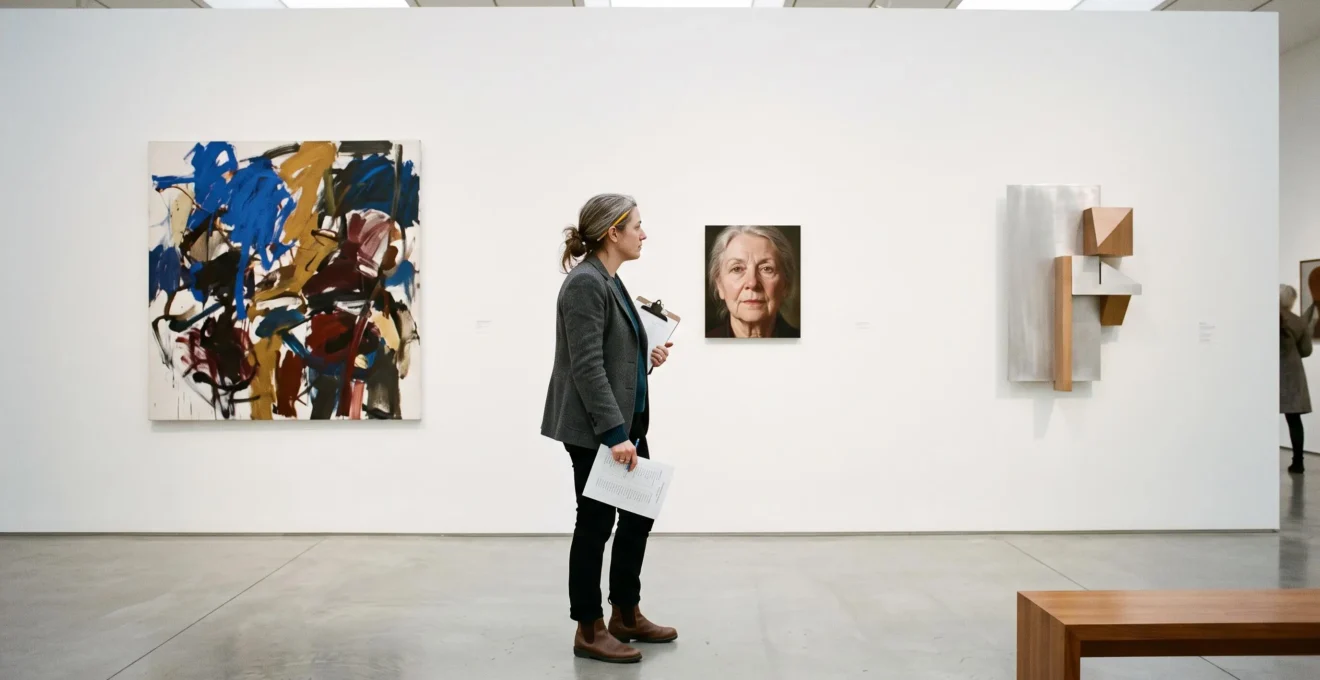
Imagine walking into a collection where an expressive abstract painting hangs beside a restrained photograph and an unconventional sculptural object. Nothing matches in colour, medium or period. Yet the arrangement feels deliberate. Each work seems to have a reason for being there.
That sense of coherence rarely comes from decorating skill alone. It comes from curatorial logic: a consistent idea about what belongs, how individual artworks relate and why another acquisition would strengthen the whole.
Museums formalise such decisions through collecting policies and curatorial assessment. Private collectors can apply a simpler version without institutional resources, expensive advisers or an art-history degree.
The essential shift is to stop asking whether a work matches the room and start asking what it contributes to the collection. A modest group of prints, paintings or objects can have a stronger identity than a much larger assortment of unrelated purchases.
Building that identity requires a collecting thesis, practical purchasing rules and enough flexibility for individual artworks to challenge expectations.
The essentials of building a coherent art collection
- Coherence comes from a shared curatorial question, not matching colours, styles or mediums.
- Three collecting rules can establish what belongs, how new works relate and when a purchase makes sense.
- Begin with manageable purchases, test your collecting thesis and assess both artistic substance and ownership costs before committing to major works.
- Why Can a Collection Look Coherent Without Matching Colours or Mediums?
- How to Set 3 Collecting Rules So You Stop Buying Random Pieces You Later Sell?
- Which Starter Strategy Works Better: Collecting by Medium, Theme, or One Artist Network?
- The Move-House Mistake: Building a Collection That Only Works With Your Current Paint Colour
- In What Order Should You Build a Collection: Anchor Piece First or Small Works First?
- How to Vet an Emerging Artist Online Without Feeling Like a Detective?
- How to Judge If a New Technique Is Genuine Innovation in 5 Minutes Without Art-School Background?
- Why Does “Modern Art Innovation” Feel Like Hype Until You Spot These 3 Signals?
Why Can a Collection Look Coherent Without Matching Colours or Mediums?
A collection can look coherent without matching because its artworks share an underlying curatorial purpose rather than a decorative appearance. That purpose might concern a historical period, a recurring subject, a particular artistic sensibility or a question explored through different materials. Coherence is therefore a relationship between works, not necessarily a resemblance between them.
Visual harmony is relatively straightforward to establish. Select similar colours, comparable formats and compatible frames, and the result may look unified. But such an arrangement reveals little about why these particular artworks deserve to be together.
Curatorial coherence works differently. Consider a hypothetical collection exploring how artists represent urban isolation. It might contain a figurative painting of a solitary commuter, an abstract work evoking crowded architecture and a photograph of an empty railway platform.
These pieces need not share a palette or technique. Their connection is the question they investigate. Each contributes a different perspective to the collection’s internal argument.
Institutional practice offers a useful illustration. MoMA’s collections management policy, approved in June 2024, requires curators proposing acquisitions to consider historical importance, relationships to existing works and contributions to the museum’s mission.
This is the significant distinction: a new acquisition is evaluated in relation to an established purpose, not merely its immediate visual appeal. The museum’s procedures are more formal than anything a private collector needs, but the reasoning is adaptable.
To discover the internal argument of your own collection, choose three artworks you own or genuinely admire. Write one sentence explaining what they investigate together. Avoid descriptions such as “they all look beautiful” or “they suit my taste”.
A more useful statement might be: “This collection examines how contemporary artists turn ordinary domestic spaces into emotionally charged environments.”
That sentence becomes a working thesis. It can accommodate photography, painting, sculpture and mixed media while still excluding works with no meaningful connection.
A thesis need not remain fixed forever. Its immediate value is making every acquisition explainable, while leaving room for styles that initially appear incompatible.
How to Set 3 Collecting Rules So You Stop Buying Random Pieces You Later Sell?
Set three collecting rules before browsing: one defining what belongs in your collection, one explaining how a candidate relates to existing works, and one determining when you can afford to buy. Together, these rules turn spontaneous attraction into a repeatable decision. They cannot guarantee good purchases, but they make weak reasoning easier to recognise.
The first rule concerns content. It identifies the subject, artistic question or sensibility your collection explores. For instance, you might collect contemporary interpretations of landscape, particularly works that challenge conventional ideas of nature.
The second concerns relationships. A new work must add something to the pieces already owned. It might introduce a different medium, contradict an established viewpoint or deepen an emerging theme. Buying another similar image simply because it is attractive may not achieve that.
The third concerns purchasing discipline. Decide your maximum expenditure for a single work, what additional expenses you can accommodate and whether you need a period of reflection before committing.
For a hypothetical collector, the rules could read:
- Only consider works addressing the relationship between people and changing landscapes.
- Every acquisition must introduce a new technique, perspective or meaningful connection to an existing piece.
- Never commit beyond the predetermined annual collecting budget, including foreseeable associated costs.
Write these rules before entering a gallery, attending an art fair or opening an online marketplace. When a work is exciting but fails your criteria, postponing the purchase preserves the opportunity to think clearly.
That discipline also has financial consequences. Resale is not necessarily straightforward or cost-free. Christie’s explanation of auction fees distinguishes the buyer’s premium from seller’s commission and identifies possible additional costs such as shipping, restoration and framing.
A work can therefore sell for an apparently satisfactory price while generating disappointing net proceeds after applicable expenses. This does not mean every resale produces a loss; it means the selling price alone is an incomplete measure of the outcome.
Create your five-part acquisition filter
- Write your collection’s central question in one sentence. Deliverable: a clear collecting thesis.
- Define the subjects or artistic approaches you will consider. Deliverable: one written inclusion rule.
- Explain what a new work must contribute beyond existing pieces. Deliverable: one relationship rule.
- Set a purchase limit that includes foreseeable additional expenses. Deliverable: one spending rule.
- Apply all three rules to a real candidate and record the decision. Deliverable: a short written buy, defer or reject verdict.
Review the rules annually. If nothing qualifies for an entire year, consider whether your boundaries are unnecessarily restrictive. If nearly everything qualifies, the rules may be too vague to guide decisions.
The rules establish discipline, but they do not choose your collecting territory. That requires deciding whether to organise your early purchases around a medium, a theme or a circle of artists.
Which Starter Strategy Works Better: Collecting by Medium, Theme, or One Artist Network?
For most beginners seeking flexibility, a theme supported by one familiar medium offers a useful starting strategy. Collecting by medium develops technical understanding, collecting by theme encourages variety, and following an artist network creates contextual connections. None is universally superior: the best option depends on your budget, access to suitable works and willingness to explore beyond familiar territory.
Each strategy creates a different kind of expertise and a different risk of becoming too restrictive.
| Criteria | By medium | By theme | By artist network |
|---|---|---|---|
| Starting approach | Focus on photography, prints, painting or another medium. | Explore one recurring subject or intellectual question. | Follow artists connected through exhibitions, influences or collaborations. |
| Budget accessibility | Depends on the medium, format and artist. | Flexible because several mediums may qualify. | Depends on prices and access within the network. |
| Learning advantage | Builds knowledge of materials, techniques and quality. | Develops interpretation and comparison across approaches. | Reveals artistic relationships and shared contexts. |
| Main weakness | Can become technically repetitive. | Can lose focus if the theme is vague. | Can concentrate attention and expenditure on a small circle. |
| Room to evolve | Expand into related techniques or formats. | Introduce new mediums and interpretations. | Follow connections into adjacent artistic communities. |
Collecting by medium is especially useful when you want to understand what distinguishes a carefully produced print from an ordinary reproduction, or how different photographic processes shape an image. Repeated comparison improves technical judgement. However, medium alone does not guarantee an interesting curatorial argument.
Collecting by theme offers greater artistic variety. A collection investigating memory might contain photographs, textiles, assemblages and paintings. Its weakness is conceptual looseness: almost any artwork can be connected to an excessively broad theme.
An artist-network strategy follows relationships among makers, exhibitions, workshops, galleries or shared influences. Its strength is contextual depth. Its limitation is that the collector may become dependent on the availability and reputation of a comparatively narrow group.
A practical hybrid combines the advantages without committing completely to any one route.
Choose a theme broad enough to remain meaningful as your interests develop. Begin studying one medium closely so that you learn to compare techniques and condition. Then allow relationships among artists to emerge through actual discoveries rather than constructing a network artificially.
For example, a collector interested in changing perceptions of the British coastline could initially study photographic works, later introduce painting or sculpture, and gradually discover artists who have exhibited together or explored related environmental questions.
The collection gains coherence through the theme, expertise through repeated engagement with a medium and depth through connections discovered over time.
Whichever strategy you choose, the collection should remain meaningful when removed from its original display setting. That distinction becomes particularly important when a home changes.
The Move-House Mistake: Building a Collection That Only Works With Your Current Paint Colour
A collection becomes vulnerable when artworks are selected primarily to suit the colours, furniture or proportions of a particular room. Change the interior, and the supposed coherence may disappear. A more resilient collection follows an artistic idea independent of decoration, allowing individual works to remain meaningful even when their display conditions change.
There is nothing inherently wrong with buying art to complement a room. The problem appears when a decorative decision is mistaken for a lasting collecting strategy.
Imagine purchasing several blue-toned prints because they complement a living room. After moving into a home with different light, wall colours and proportions, you discover that the works no longer seem connected. Their relationship was architectural rather than curatorial.
A useful way to distinguish these motivations is the plain-wall test.
Before committing to a piece, examine it against a neutral background, either physically where safe and permitted or through a suitably accurate image. Remove the influence of surrounding furniture, complementary colours and carefully staged gallery lighting.
Ask whether the artwork still holds your attention. Can you explain its value through its subject, construction, technique or relationship to your collecting thesis?
This exercise is not a scientifically validated measure of artistic quality. It is a practical method for separating the appeal of an artwork from the appeal of its surroundings.
It also helps to distinguish two legitimate purchasing categories.
- Collection works: acquired because of their independent artistic interest and contribution to an ongoing collecting direction.
- Decorative commissions or placements: acquired primarily for a particular space, with the understanding that their suitability may change when the space changes.
Both can have personal and aesthetic value. A site-specific commission may be deeply meaningful even if it cannot move easily. The distinction concerns purchasing intention, not artistic status.
For a collection intended to evolve over decades, however, evaluate core acquisitions independently of current wall colours, furnishings and display trends.
Once the collection has an identity independent of its setting, the next choice is how to build it: through one defining acquisition or a sequence of smaller works.
In What Order Should You Build a Collection: Anchor Piece First or Small Works First?
Starting with smaller works is often a useful learning approach when your collecting direction is still uncertain. An anchor piece can establish a strong standard quickly, but it commits significant resources to an early judgement. Smaller acquisitions provide opportunities to refine your eye. The most sensible sequence is to test your thesis before making a major commitment.
The anchor-first approach begins with one substantial work that establishes the collection’s direction. Subsequent purchases are evaluated against its artistic quality, subject or underlying ideas.
This can create a strong identity immediately. The disadvantage is concentration: a large share of the budget and intellectual direction may depend on a decision made before the collector has developed much comparative experience.
The small-works-first approach reverses that process. Prints, drawings, modest paintings and smaller objects provide opportunities to study different approaches while keeping individual commitments more manageable.
Such purchases can reveal patterns that browsing alone might not uncover. You may discover that you consistently respond to quiet compositions, material experimentation or particular subjects, regardless of the medium.
But small works are not automatically inexpensive, nor are they risk-free. Too many purchases can create storage problems and a collection that lacks hierarchy. If your interests change, some early acquisitions may no longer fit your direction.
There is also an ownership cost beyond the purchase price. Framing, suitable storage, insurance and conservation requirements can become more demanding as the collection grows.
MoMA‘s collections management policy, discussed earlier, explicitly addresses an institution’s capacity to care for acquisitions and identifies exceptional expenses that may arise from storage, conservation and related needs. Private collections operate differently, but the underlying obligation to consider long-term care remains relevant.
A practical sequence is to begin with a manageable number of works, use them to test your one-sentence thesis and observe whether that thesis remains useful through real acquisition decisions.
Only then consider an anchor work that deepens or challenges the established direction. Its importance should come from what it contributes, not merely from its size or price.
Once you are ready to buy, the quality of your judgement depends on more than collection structure. You also need enough information about the artist and the individual work to make an informed decision.
How to Vet an Emerging Artist Online Without Feeling Like a Detective?
Assess an emerging artist through a proportionate sequence of checks: examine the consistency of their practice, look for independently verifiable professional activity and request clear documentation about the particular artwork. You do not need to investigate every detail of an artist’s career. The aim is to identify credible evidence, understand uncertainty and match your research effort to the importance of the purchase.
Begin with the artist’s own website or professional portfolio. Look beyond a carefully curated selection of recent images. Is there a recognisable development in the work over several years? Do techniques and subjects evolve in a way you can understand?
Next, examine the exhibition history. Confirm whether listed exhibitions, residencies and collaborations appear in independent records, such as gallery archives, institutional websites or published programmes.
A consistent record of activity may be more informative than a long list of impressive but unverifiable names. Repeat involvement with curators or organisations can provide useful context, although no particular career pattern guarantees artistic quality.
Read an artist’s CV critically, without treating unconventional careers as suspicious.
- Repeated group exhibitions without solo shows are a reason to understand the artist’s stage of development, not proof of a problem.
- Unverifiable institutions or exhibition claims deserve clarification rather than automatic acceptance.
- A coherent development of work, documented activity and independent references provide stronger grounds for confidence than promotional statements alone.
Finally, investigate the specific artwork. Its provenance, condition, edition status where applicable, and documentation matter independently of the artist’s reputation.
The Getty Museum’s provenance research resource explains how ownership histories may be reconstructed through archives, sale catalogues, inventories and physical evidence. It also acknowledges that documentation can be incomplete.
For a contemporary work bought directly from an artist, the documentary trail may be comparatively short. The key is to establish what can actually be verified, rather than assuming every missing historical detail indicates wrongdoing.
Ask the artist or gallery straightforward questions: Who created the work? When was it made? Is it unique or part of an edition? What condition issues are known? What records will accompany the purchase?
Clear answers support an informed decision. Evasiveness about fundamental details is a reason to seek further clarification or reconsider the transaction.
Apply greater scrutiny to a substantial purchase than to a modest work acquired primarily for learning. This preserves both diligence and enjoyment.
Credibility checks tell you about the artist and the artwork’s background. They do not, by themselves, establish whether a supposedly innovative technique contributes anything genuinely new.
How to Judge If a New Technique Is Genuine Innovation in 5 Minutes Without Art-School Background?
You can make a useful preliminary assessment of artistic innovation in five minutes by asking what a technique changes, describing the process in ordinary language and comparing it with related work. The goal is not to prove that an invention is unprecedented. It is to distinguish an observable artistic contribution from a novelty claim supported mainly by promotional vocabulary.
When a description calls an artwork “revolutionary” or “groundbreaking”, start by setting those adjectives aside.
Ask a simpler question: What does this technique allow the artist to do?
Perhaps it makes an unusual surface possible, changes the relationship between an image and its material, or introduces a production process that shapes the finished work. A technique can also be artistically significant through a distinctive application of an existing method.
The distinction matters because technical novelty and artistic innovation are related but not identical. An established material can produce an original artistic result, while an unfamiliar process may contribute little beyond visual spectacle.
A short evaluation can begin with two questions.
- Can the method be described in one plain sentence? Replace promotional language with an account of the material, process and visible result. If the description remains unclear, seek more information before accepting the novelty claim.
- How does it compare with related practices? Look at other artists using similar materials or processes. Identify what is shared and what the particular artist handles differently.
For a hypothetical example, imagine an artist described as pioneering an innovative layered photographic process. Compare that artist’s production method and finished images with other layered photographic works. The relevant question is whether the layering produces a meaningful difference in form, interpretation or experience.
A five-minute comparison will not establish historical priority or settle a specialist debate. It can, however, reveal whether an initial claim deserves further investigation.
MoMA’s earlier article on acquisition criteria for design objects considers innovation alongside cultural impact, process and necessity. Although those criteria concern design acquisitions rather than all contemporary fine art, they illustrate why a work’s contribution cannot be reduced to the adjective used to market it.
Keep two notes: one explaining what the technique does and another identifying what appears distinctive after comparison. These are more useful than remembering the artist’s promotional description.
This evaluation becomes more useful when combined with artist verification. Together, they help distinguish a substantial practice from an attractive story about that practice.
What to carry into your next acquisition
- Separate the artist’s professional credibility from the artistic contribution of the individual work; one does not automatically establish the other.
- Require a describable difference before paying particular attention to claims of innovation, while recognising that originality need not mean inventing a new material.
- Consider who supports an artist’s practice beyond the person selling the artwork, without confusing recognition with a guarantee of future value.
Why Does “Modern Art Innovation” Feel Like Hype Until You Spot These 3 Signals?
Modern art innovation can feel like hype because promotional language often moves faster than a buyer’s ability to evaluate the work itself. Three observable signals help restore perspective: an artist whose practice develops consistently, an artwork with an identifiable creative contribution, and independent professional context beyond the seller’s claims. None guarantees quality or value, but together they support more considered judgement.
The problem is not necessarily that artists or galleries exaggerate every innovation. It is that the contemporary art market must communicate complex artistic developments in relatively concise descriptions.
Years of experimentation may be compressed into labels such as “radical”, “visionary” or “boundary-breaking”. For a collector encountering an unfamiliar practice, those labels provide little basis for independent evaluation.
The solution is to replace general adjectives with three forms of evidence.
Signal one: development across the artist’s practice.
Examine multiple bodies of work rather than one striking image. Are there recognisable questions or methods that the artist develops, revisits or challenges over time?
A coherent practice need not look identical from year to year. Meaningful change may be more interesting than repetition. What matters is whether the work demonstrates a sustained artistic enquiry rather than relying entirely on a single fashionable effect.
Signal two: a contribution visible in the artwork.
Return to the five-minute technique assessment. Identify what the artist does with the material, form or subject that deserves attention.
Innovation may lie in an unexpected combination, a distinctive treatment of a familiar technique or a new way of presenting an existing question. It does not have to mean that nobody has ever attempted anything similar.
Signal three: context beyond the seller.
Look for independently documented exhibitions, curatorial engagement, published discussion or other professional activity that helps situate the work.
Such context is informative, not definitive. Emerging artists may lack extensive institutional recognition, while established attention does not automatically make every new work artistically convincing.
Importantly, innovation and hype can coexist. A genuinely inventive artist may also receive exaggerated promotion. That is a reason to separate the artistic judgement from the asking price and commercial narrative, rather than dismissing the practice altogether.
These three signals also connect directly to the rules governing your own collection. A compelling acquisition should withstand scrutiny of the artist, the work and its relationship to your existing holdings.
For example, an experimental sculpture may demonstrate an interesting technique and credible professional development, yet contribute little to a collection centred on representations of domestic memory. You can admire its significance without deciding that you need to own it.
For your next potential acquisition, write three short statements: what the work contributes artistically, what reliable information supports your judgement, and why it belongs in your collection. If those statements are convincing without promotional language, you have a practical foundation for deciding whether to buy.
Can a small collection of just three artworks have a clear identity?
Yes. A collection’s identity depends on the relationships between its works rather than its size. Three artworks exploring a shared question through contrasting approaches may form a more coherent group than numerous purchases united only by decorative similarity. Write one sentence explaining their common purpose and test whether each piece supports it.
Do all the artworks in a collection need to be displayed together?
No. Curatorial coherence does not require permanent physical proximity. Works can belong to the same collection while being displayed in different rooms or kept in suitable storage. Their connection should remain understandable through the collection’s theme, documented relationships and acquisition rationale.
Should a beginner buy original paintings or limited-edition prints?
Neither category is automatically the better starting point. Original paintings and properly documented limited-edition prints offer different opportunities for learning about materials, artistic decisions and market practices. Evaluate the individual work, the artist, the edition details where relevant, the total ownership cost and its contribution to your collecting direction.
How should a collector document artworks purchased directly from emerging artists?
Retain purchase records, correspondence identifying the artwork, available provenance information, condition documentation and any relevant edition details. Record the artist’s name, title, date, materials and dimensions as accurately as possible. Documentation may be less extensive for newly created works than for historic objects, but clear records make future identification and ownership research easier.
When should a personal art collection change its collecting theme?
Reconsider the theme when it no longer reflects the artistic questions that genuinely interest you or when it consistently prevents meaningful acquisitions. An annual review is a practical opportunity to assess it. Before replacing the thesis, examine whether a thoughtful expansion would accommodate your developing interests while preserving connections among existing works.