
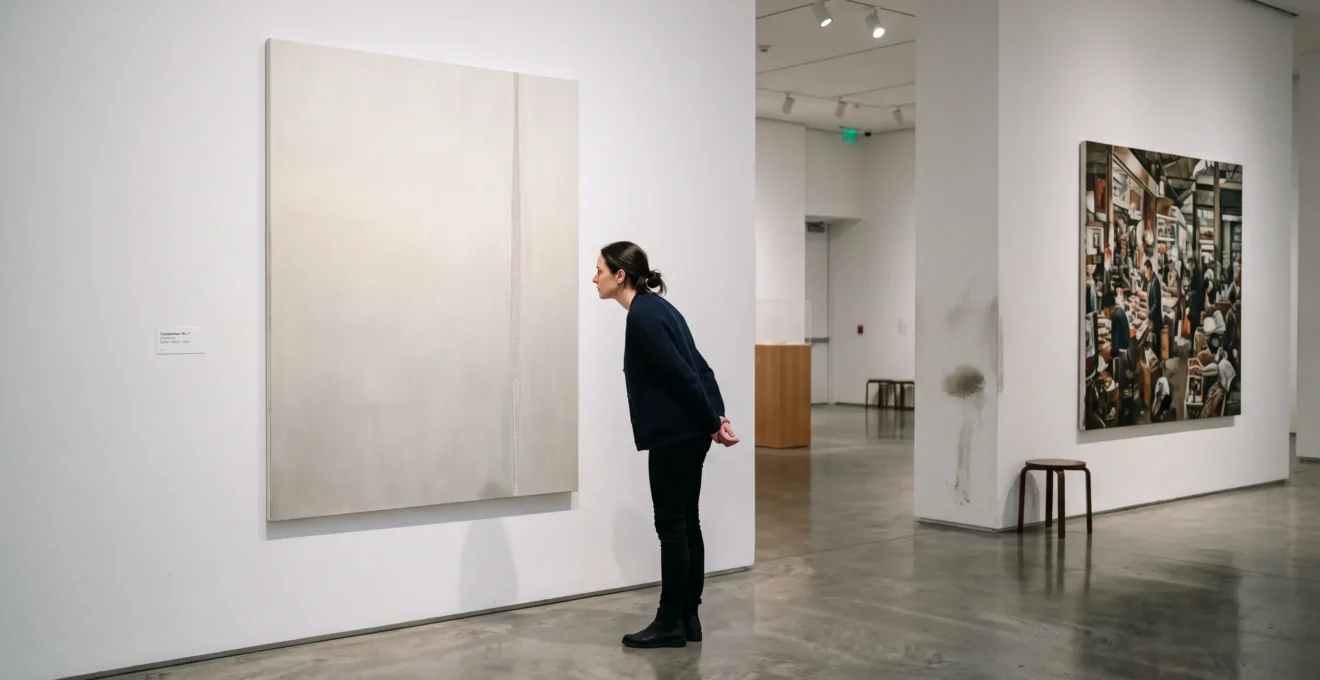
A painting made with unconventional materials, a sculpture assembled from ordinary objects, or an artwork described as a breakthrough in digital experimentation: all might be innovative. None becomes innovative simply because a gallery says so.
The difficulty with modern art innovation is that its most important qualities are not always immediately visible. An artwork can appear remarkably simple while challenging established assumptions about what art can be. Another might demonstrate extraordinary technical skill without introducing anything particularly new.
For homeowners and first-time collectors, the distinction matters beyond art history. It affects what deserves attention, what is worth paying for, and what will remain interesting when the initial excitement disappears.
Three signals offer a practical way through the noise: a meaningful shift in artistic intention, a technique that changes what becomes possible, and an innovation that remains convincing beyond its promotional explanation. They are useful indicators, not a scientific scoring system or guarantees of future value.
Modern art innovation: the essentials
- Look for a changed question. Genuine innovation often transforms what an artist is trying to achieve, rather than simply making a familiar image differently.
- Test the technique and its influence. Ask what the method makes possible and whether its significance can be independently explained or documented.
- Separate innovation from ownership appeal. Even an historically important idea may be the wrong artwork for your living room, budget or everyday preferences.
- Why Does Innovative Modern Art Look “Too Simple” Until You Understand This 1 Shift in Intention?
- How to Judge If a New Technique Is Genuine Innovation in 5 Minutes — No Art-School Background Needed
- Which Works Better in a Small UK Living Room Under 3 m Wide: Innovation-Led Art or Style-Led Art?
- The Buying Mistake That Leaves First-Time Collectors With Art They Hide After 30 Days
- When Should You Commit to Innovative Art: Before Renovation, After Moving In, or After 90 Days of Living There?
- Which Makes More Sense for a First UK Home: Original Art, Limited Prints, or High-End Posters?
- How to Vet an Emerging Artist Online Without Feeling Like a Detective
- How Can Modern Art at Home Make a Room Feel Finished Without Repainting or Buying New Furniture?
Why Does Innovative Modern Art Look “Too Simple” Until You Understand This 1 Shift in Intention?
Innovative modern art can look deceptively simple because its achievement may lie in changing the purpose of making art, rather than demonstrating technical difficulty. The crucial question is not necessarily how skilfully an object was produced, but what assumption the artist challenged and what new possibility the work introduced.
Consider Marcel Duchamp‘s readymades. Instead of creating every element through conventional artistic craftsmanship, Duchamp selected manufactured objects and presented them as art. The intervention shifted attention towards artistic choice, context and authorship.
As explained in MoMA‘s examination of Marcel Duchamp and the readymade, this approach challenged established expectations concerning originality, beauty and artistic production. Its significance came from the question being posed, not the visible difficulty of manufacturing the object.
This provides a useful distinction between technical accomplishment and conceptual innovation. A meticulously executed photorealistic painting may demonstrate exceptional skill without substantially changing its medium. A visually minimal object may introduce an influential new way of thinking about art. Neither judgement can be made from visual complexity alone.
There is also more than one meaning of the word ‘new’:
- New to the artist: a technique or material the individual has never previously used.
- New within a movement: an approach that departs meaningfully from established practices in a particular artistic community.
- New to the medium: an approach that challenges broader conventions about how that artistic medium operates.
These categories are analytical distinctions, not official classifications. They help prevent a limited personal experiment from being mistaken for an unprecedented development in art history.
Try two questions when viewing an unfamiliar work. First, what did artists working immediately before this approach normally do? Second, what does this artwork change about that practice?
Ask the artist or gallery to express the difference in one ordinary sentence. A clear answer does not establish historical originality, but it gives you a claim that can be checked. Some valuable experimental works also resist simple explanation, so difficulty summarising an intention should invite investigation rather than automatic dismissal.
Once the intended departure becomes identifiable, the next task is to determine whether the technique genuinely supports it.
How to Judge If a New Technique Is Genuine Innovation in 5 Minutes — No Art-School Background Needed
Start by identifying the problem a technique addresses, then check whether it creates possibilities beyond an unusual appearance. Look for independent documentation and evidence that the approach has informed other artistic practices. Five minutes can expose weak promotional claims, although it cannot establish an artist’s historical importance or prove that a technique is unprecedented.
A practical first-pass assessment needs only four checks:
- Define the problem. Does the technique make possible an effect, process or artistic question that conventional methods could not address in the same way?
- Identify the mechanism. What actually changes: material behaviour, production, viewer participation, distribution or another aspect of the work?
- Investigate transmission. Have other artists subsequently adopted, challenged or adapted the approach?
- Remove the jargon. Can the claimed breakthrough be explained without relying on fashionable technical vocabulary?
The third check is particularly revealing. A useful thought experiment is the reversibility test: if the technique disappeared tomorrow, would its absence remove a meaningful possibility from artistic practice, or merely eliminate one recognisable visual effect?
This is a curatorial heuristic, not a validated measurement. An emerging artist’s genuinely original experiment may not yet have influenced anyone else. Absence of adoption is therefore inconclusive, especially with recent work.
The historical comparison offers perspective. MoMA’s Marcel Duchamp exhibition documentation discusses both the readymade and The Bride Stripped Bare by Her Bachelors, Even (The Large Glass), dated 1915–1923. These are identifiable works whose significance can be investigated through institutional interpretation and historical context.
For a contemporary claim, compare two independent forms of evidence: an institutional exhibition or collection record, where available, and critical discussion from outside the selling gallery. Neither is infallible, but agreement on the actual nature of the experiment is more informative than repeated marketing copy.
Be equally careful with artistic CVs. A commercial art fair, paid participation opportunity, independently selected biennial and public collection acquisition are different kinds of credentials. A long list of appearances does not automatically amount to independent curatorial recognition.
Your five-minute art innovation screening checklist
- Write down the claim: produce one sentence stating exactly what the artist says is new.
- Describe the mechanism: identify the material, action or artistic convention that has changed.
- Find a comparison: record one earlier work or established practice against which the difference can be assessed.
- Check independent evidence: save one relevant institutional or critical reference, or explicitly note that none was found.
- Make a provisional judgement: write ‘documented departure’, ‘promising but unverified’ or ‘primarily stylistic’, with one reason.
Even when a technique passes these checks, historical interest and domestic suitability remain separate decisions. Your walls impose requirements that an exhibition space does not.
Which Works Better in a Small UK Living Room Under 3 m Wide: Innovation-Led Art or Style-Led Art?
In a living room narrower than three metres, style-led art usually offers easier visual integration, while innovation-led art can create a stronger focal point. Neither approach is inherently better. The most suitable work is one whose scale, texture and visual effect remain convincing from everyday viewing positions without overwhelming the room.
For a narrow British terraced-house sitting room, the challenge is often not the artwork’s absolute size but the interaction between viewing distance, furniture, light and visual clutter.
A piece designed to reveal intricate details at close range may lose much of its impact when viewed from a sofa across a restricted floor area. Conversely, a work with pronounced surface texture, an unusual construction or a carefully controlled colour field may communicate its character immediately.
Before choosing, compare the two approaches against the same domestic conditions.
| Decision factor | Innovation-led art | Style-led art |
|---|---|---|
| Immediate visual effect | Can introduce contrast or an unexpected focal point | Usually easier to coordinate with existing furnishings |
| Need for explanation | May require contextual information to appreciate fully | Can often be enjoyed primarily through appearance |
| Small-space suitability | Strong when material or process reads at normal viewing distance | Strong when scale, palette and composition suit the room |
| Lighting | Some materials and surface effects need careful illumination | Requirements depend on the medium and finish |
| Decorating flexibility | A dominant piece may constrain later furniture choices | Often easier to replace or rearrange within an established scheme |
The strongest practical test is straightforward: remove the explanation. If the artwork’s innovation is entirely dependent on a lengthy wall label, will you still enjoy looking at it every evening?
This does not disqualify conceptual work from domestic spaces. It simply distinguishes an intellectual reason to admire an artwork from the experience of living beside it.
There is also a hidden cost to consider. A visually forceful artwork can establish the scale, colour and character of the whole room. If everything else subsequently needs rearranging to accommodate it, the real commitment extends beyond its purchase price.
When evaluating textured or light-responsive pieces, separate aesthetic effects from conservation. Direct sunlight may make a surface look dramatic while still creating unacceptable exposure for a sensitive material.
An artwork can pass every spatial test and still become a regretted purchase if the attraction comes mainly from the story that accompanied it.
The Buying Mistake That Leaves First-Time Collectors With Art They Hide After 30 Days
The mistake is buying an artwork because its innovation story sounds impressive rather than because the work itself sustains personal interest. Once the excitement of acquiring something supposedly groundbreaking fades, the buyer must live with the physical object. A short trial at home can help distinguish lasting attraction from an initial response to persuasive marketing.
Imagine a hypothetical first-time collector who purchases an experimental work after an enthusiastic gallery conversation. The unusual material, artist biography and ambitious description make the purchase feel compelling.
A month later, the explanation is familiar. The collector no longer finds the image or object especially rewarding and moves it out of sight.
This illustrates a possible form of narrative fatigue: the acquisition was driven more by a compelling explanation than by an enduring relationship with the work. The 30-day period is a practical scenario, not a scientifically established deadline for buyer dissatisfaction.
There is a second risk. If the work was purchased to demonstrate sophisticated taste or future investment potential, its owner may feel compelled to justify it to visitors. What should be a source of pleasure becomes an ongoing argument about its importance.
Before committing, request permission to use a gallery image for a temporary domestic mock-up. Place a reproduction at approximately the intended scale and observe your reaction over a chosen trial period.
For example, over two weeks, look at the image during ordinary routines rather than deliberately staging an art-viewing session. Note whether your attention returns to it spontaneously, whether unfamiliar details emerge and whether its presence becomes more engaging or merely familiar.
This is a personal decision aid rather than a validated psychological test. A reproduction also cannot fully recreate an original’s texture, depth, reflectivity or physical presence.
If you already own a piece that feels disappointing, try changing the display before deciding the acquisition was a mistake. Different lighting, a less crowded wall or another room may alter how it reads.
Do not expose fragile originals to damaging light or unstable conditions in the process. A disappointing installation can be changed without treating the artwork carelessly.
A purchase that survives this personal test still needs to happen at the right point in your home’s development.
When Should You Commit to Innovative Art: Before Renovation, After Moving In, or After 90 Days of Living There?
Buy before renovation when the artwork must shape the room’s layout, lighting or architectural decisions. Buy after moving in when the work should complement existing furnishings. Waiting 90 days can provide more experience of how the space functions, but it is a planning option rather than a universal rule for purchasing art.
The right moment depends on whether the artwork will determine the interior scheme or respond to it.
| Purchase window | Main advantage | Main risk |
|---|---|---|
| Before renovation | Wall space, lighting and furniture can be planned around the artwork | Decisions may reflect renovation excitement rather than settled preferences |
| After moving in | Actual dimensions, furniture positions and daily circulation are visible | Pressure to make the room feel finished can encourage a rushed choice |
| After 90 days | More opportunities to observe routines, lighting and display locations | A particular available work may sell before the decision is made |
Consider two hypothetical situations. A collector planning to install a substantial sculptural work might reasonably select it before renovation so that wall support and lighting can be considered early. Someone seeking a modest framed print above an existing sofa has less reason to commit before living with the furniture arrangement.
British daylight deserves particular attention, especially when the artistic effect depends on reflective surfaces, subtle colour or material texture. A work can look very different under overcast daylight, low winter sun and evening artificial lighting.
However, appearance and preservation are separate considerations. The Canadian Conservation Institute guidance on caring for works on paper explains that exposure to light can cause irreversible fading and paper deterioration. It recommends avoiding direct sunlight and accounting for heat, humidity and framing choices.
The advice applies to conservation risks that matter in UK homes, although it does not provide a UK-specific rule about the best wall orientation or endorse any particular purchase timeline.
Before committing to a sensitive work, observe the proposed display location under at least two different lighting conditions. Check for direct sun, nearby radiators and whether artificial illumination can be adjusted safely.
A useful compromise is to enquire about a reservation or waiting list while evaluating the room. Availability, deposit conditions and cancellation arrangements depend on the seller, so confirm them before making any financial commitment.
Once the location and timing are clear, the next choice concerns what kind of artwork you actually want to own.
Which Makes More Sense for a First UK Home: Original Art, Limited Prints, or High-End Posters?
Original art is appropriate when owning a unique work matters most. Limited-edition prints offer access to an artist’s practice through a defined edition, while high-end posters can provide an appealing visual result without the same claims of rarity. For a first home, the sensible choice depends on personal attachment, documentation, budget and expectations.
These are not simply three quality grades of the same object. They represent different relationships between the buyer and the artist’s work.
An original may be a unique painting, drawing or sculptural object. A limited-edition print belongs to an edition whose production method, quantity and authentication arrangements should be identifiable. A poster generally functions as a reproduction intended for display, although its printing and presentation quality may still be excellent.
Importantly, printmaking can itself be an original artistic medium. An artist-designed print is not necessarily a reproduction of an earlier painting. The decisive question is how the artwork was conceived and produced.
For a buyer drawn to experimental art, a limited edition may provide access to an artist’s visual language without requiring the budget associated with a particular unique work. But if the innovation is fundamentally sculptural, tactile or dependent on a singular physical process, a flat reproduction may communicate only part of it.
Edition documentation matters more than premium-sounding labels. Check the stated edition size, the printing process, whether the work is numbered, who produced or published it, and how the artist’s authorship is authenticated.
Tate‘s limited-edition buying guide provides a useful UK retail example. It describes numbered editions and explains that its editions are artist-signed or accompanied by an artist-signed certificate. A separate certificate of authenticity is not automatically supplied in every case.
Those are Tate’s own selling arrangements, not universal requirements for every edition offered in Britain. Neither a signature nor a small edition automatically guarantees financial appreciation.
Before paying an edition-level price, ask the seller to identify the exact edition quantity, medium, authentication method and any known additional editions or proofs. If this information is unclear, do not assume that a description such as ‘exclusive fine-art print’ establishes rarity.
A high-quality poster, professionally framed, can be the better purchase when the primary objective is furnishing a room rather than collecting an artist’s authenticated output.
If you choose to buy from a living or emerging artist, the work’s appeal is only half the decision. The other half is whether the information surrounding the artist is credible.
How to Vet an Emerging Artist Online Without Feeling Like a Detective
Vet an emerging artist by reviewing their documented career, checking one meaningful detail independently and asking a direct question about the work or its provenance. The objective is not to prove future success. It is to establish that the artist, artwork, selling arrangements and claims of innovation are sufficiently transparent for an informed purchase.
A short investigation can follow three stages.
- Establish the career narrative. Review the artist’s website for dated exhibitions, residencies, education where relevant, identifiable artworks and a coherent description of their practice.
- Cross-check a material claim. Look for an independent gallery archive, institutional exhibition record, collection reference or substantive critical discussion. Confirm what the source actually says rather than treating a name-drop as endorsement.
- Review the commercial evidence. Ask for the artwork’s full details, current asking price, provenance information where available, and any relevant history of comparable works being offered or sold.
Why this order? It begins with readily accessible information, tests the claims most relevant to credibility and reserves detailed commercial questions for artists you are seriously considering.
For an emerging artist, price history may be sparse. Where reliable records exist, consistent explanations of price changes are more useful than social-media popularity. Sudden changes deserve questions, but they do not independently establish manipulation or future decline.
Also distinguish asking prices from completed sales. A gallery listing shows what a seller requests, not necessarily what a buyer has paid. Auction results, where available, represent a different market context and may not be directly comparable with primary-gallery prices.
Two opposite mistakes are common. One is accepting an impressive-looking CV without understanding the status of each exhibition. The other is dismissing a promising artist because they have little online visibility.
An artist’s limited digital footprint is not proof of poor quality. A stronger indicator is whether meaningful information can be supplied and checked when requested. Conversely, a highly polished promotional presence should not replace verifiable details about actual work and professional activity.
A concise enquiry can be more productive than hours of online searching. Ask the artist or representing gallery for an artwork statement, medium and dimensions, edition details if relevant, current availability and any forthcoming opportunity to see the work in person.
The response can reveal how transparently the work is represented. Its substance matters more than instant replies: independent artists may have limited administrative resources.
A clear picture of the artist makes it easier to judge the work on its own terms — and to decide what role it should play in your home.
What to remember before choosing your artwork
- Prioritise visible impact over elaborate explanation. A compelling innovation can strengthen a room without requiring visitors to understand its entire conceptual background.
- Judge the artwork from everyday positions. The sofa, doorway and normal circulation routes are more relevant than an idealised gallery viewpoint.
- Preserve flexibility. The right artwork should create a useful visual relationship with your furniture, not automatically force a costly redesign.
How Can Modern Art at Home Make a Room Feel Finished Without Repainting or Buying New Furniture?
Modern art can make a room feel finished by introducing a deliberate focal point that connects existing colours, textures and proportions. The effect comes from controlled contrast rather than simply adding decoration. An artwork should remain legible from normal viewing positions and contribute something the furniture and surrounding surfaces do not already provide.
Imagine a neutral living room with a plain sofa, wooden shelving and several similarly toned furnishings. The arrangement may be functional but visually undifferentiated.
Introducing a work with a distinct material surface, carefully concentrated colour or unexpected composition can create a point around which the surrounding elements appear organised.
The practical principle is a controlled contrast relationship. Compare the proposed artwork with the room across three characteristics:
- Scale: does it establish a focal point without dominating the entire visible wall?
- Colour: does it create a purposeful difference or connect selected colours already present?
- Texture: does its surface add a quality not otherwise supplied by the furniture and finishes?
Not every dimension needs strong contrast. An artwork with dramatic texture might work best in restrained colours. A vivid colour-field painting may require very little additional material complexity.
This connects directly to innovation-led art. A work that changes familiar expectations about materials or processes may also create a visually distinctive relationship with standardised domestic furnishings.
That relationship does not prove the artwork is historically innovative. It means the work’s particular character has a useful role in the space.
Before purchasing, create a scale-accurate mock-up using a photograph of the intended wall. Compare it from the sofa, the entrance and any other position where the room is normally experienced. Observe the composition under daylight and evening lighting.
If the room already contains strong patterns, closely spaced furniture and numerous competing objects, another dramatic focal point may increase visual congestion. Consider a smaller monochrome work, a drawing on paper or a restrained composition with thoughtful framing.
The test is not whether the artwork matches everything. It is whether the room gains a clearer visual hierarchy without losing comfort or coherence.
Choose one wall, photograph it from your usual seat and test two contrasting artworks at realistic scale. Keep the one that rewards repeated looking and improves the space without requiring an elaborate explanation or a new roomful of furniture.
Can an artwork be genuinely innovative if nobody else has copied its technique?
Yes. Artistic influence may take time to develop, and some meaningful experiments remain isolated. Adoption by other artists is supporting evidence when it exists, not a necessary condition for originality. Judge the specific artistic problem, the mechanism of the experiment and the available historical context before drawing conclusions.
Does digital or AI-assisted art automatically count as modern art innovation?
No. Using a recently developed tool does not automatically introduce a new artistic idea. Examine how the artist uses the technology, what creative decision remains distinctive and whether the resulting work expands an existing practice or primarily reproduces familiar outcomes through a different production process.
Is a certificate of authenticity essential when buying a limited-edition print?
Not every edition is supplied with a separate certificate. Authentication arrangements can involve an artist’s signature, an artist-signed document or other edition-specific records. Tate’s buying guide illustrates why buyers should establish exactly which documents and identifiers accompany the particular work rather than assume a universal format.
Should innovative artwork be displayed in direct sunlight to reveal its texture or colour?
Not without considering the medium’s conservation requirements. Works on paper can suffer irreversible fading and deterioration from light exposure, while other materials have their own vulnerabilities. Assess the artwork’s specific needs and favour suitable controlled illumination over potentially damaging direct sunlight.
Can a visually attractive artwork still be a good purchase if it is not innovative?
Absolutely. Historical originality is only one possible reason to value art. A piece may offer aesthetic pleasure, emotional significance, craftsmanship or a strong relationship with your home without introducing a new artistic movement or technique. The important distinction is between knowing why you value it and paying a premium for an innovation claim that has not been substantiated.