
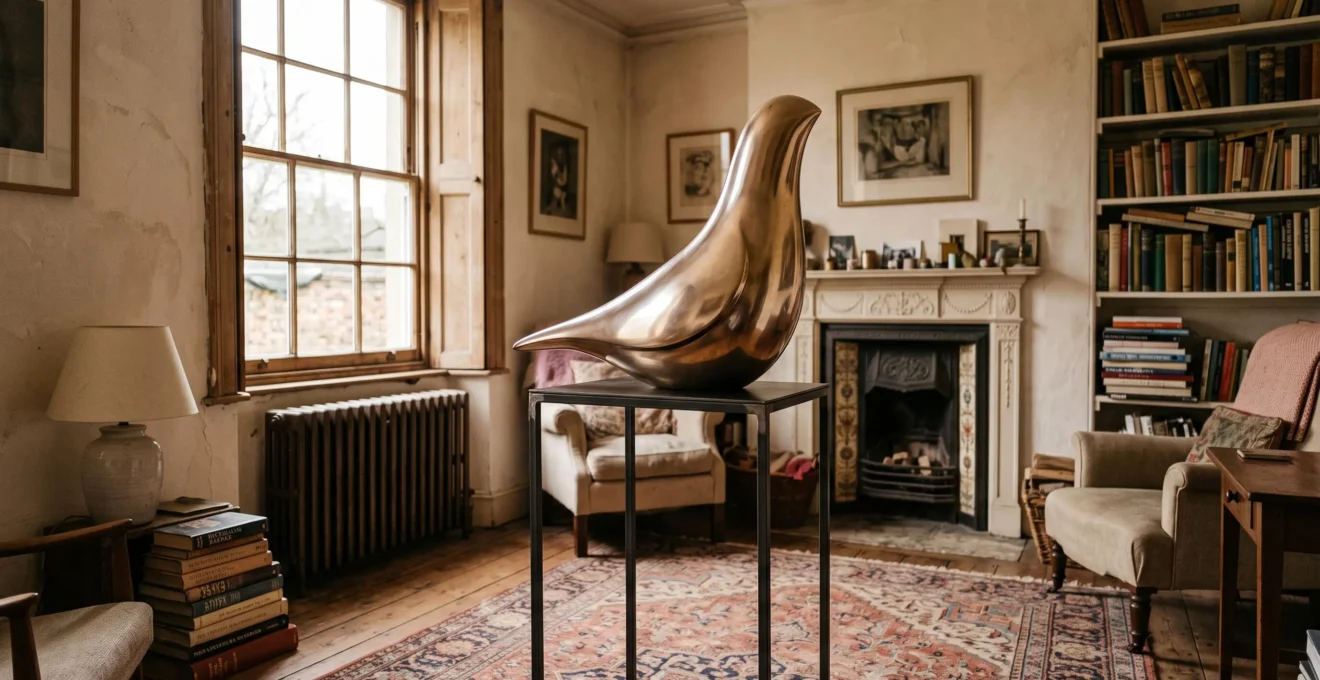
A streamlined sculpture can command a room without a carved pattern, elaborate surface or recognisable subject. Its effect comes from the relationship between the outline, the surrounding space and the light that meets its surface. When those elements agree, the sculpture appears deliberately chosen rather than merely decorative.
That distinction matters in British homes, where a living room may already contain bookshelves, radiators, patterned flooring, furniture and architectural details. Another intricately detailed object can add to the visual activity. A restrained sculptural form can instead establish one clearly defined point of attention.
The result is often described as quiet luxury, but neither a high price nor a prestigious material guarantees it. An inexpensive sculpture with a convincing profile and carefully considered placement may look more refined than a costly piece positioned against competing reflections.
The practical question is not simply which sculpture looks attractive in a showroom. It is whether its silhouette remains convincing from everyday viewpoints, whether its finish works with the available light and whether its support makes the installation appear intentional.
What makes streamlined sculpture look luxurious?
- Silhouette comes first: a clear, balanced outline can create more visual authority than decorative complexity.
- Light determines presence: polished surfaces reflect their surroundings, while matte finishes depend more heavily on form and directional illumination.
- Placement completes the effect: sightlines, plinth proportions and a stable installation determine whether the sculpture feels curated or accidental.
- Why Can a Streamlined Sculpture Feel More Luxurious Than a Detailed One in a UK Home?
- How to Test a Sculpture Silhouette From 3 Doorway Angles Before You Buy?
- Which Finish Works Better in UK Homes: Matte Streamlined Sculpture or High-Polish Metal?
- The Plinth Mistake That Makes Streamlined Sculpture Look Like « Something Left on the Floor »
- When Should You Add a Streamlined Sculpture: Before Mirrors and Chrome, or After the Lighting Plan?
- How to Choose a Sculpture Size and Plinth for a UK Home Without Scratched Floors or Wobbles?
- Which Feels More Timeless at Home: Polished Metal, Brushed Metal, or Stone Streamlined Sculpture?
- Why Does Bird in Space Look Different Every Hour Until You Control 1 Lighting Variable?
Why Can a Streamlined Sculpture Feel More Luxurious Than a Detailed One in a UK Home?
A streamlined sculpture can feel more luxurious than a detailed one because its outline gives the eye a clear form to recognise without competing with the surrounding room. In an interior already rich in texture, this restraint creates visual separation. The impression of luxury depends on the quality of that silhouette, its materials and its presentation, not necessarily its price.
Consider a period sitting room containing a patterned rug, books, picture rails and a cast-iron radiator. Each element introduces another contour or texture. A sculpture with intricate ornamentation may contribute additional visual noise; a continuous, confident curve offers a point of contrast.
Research on aesthetic processing provides a useful, though limited, explanation. Reber, Schwarz and Winkielman’s research on processing fluency and aesthetic pleasure discusses how perceptual features and ease of processing influence aesthetic appreciation. It does not establish that simple objects are universally preferred or appear more expensive.
For a homeowner, the distinction is practical: expensive-looking is not the same as expensive. Three characteristics deserve attention before the price tag:
- Silhouette quality: does the curve remain coherent from several directions, without awkward changes in thickness or balance?
- Material honesty: does the surface look appropriate to the substance beneath it, rather than imitating another material unconvincingly?
- Reflective behaviour: does the finish create useful highlights, or does it reproduce distracting objects and bright patches?
A quick showroom check is to view the piece at eye level against an uncluttered background, then move sideways. Inspect the profile against a light area of wall. A poorly resolved transition between curves may become apparent when surface detail no longer distracts from the outline.
At home, identify a position where the sculpture can be seen clearly without sharing equal prominence with a large mirror, a busy gallery wall or several decorative accessories. A relatively quiet wall beside a doorway or at the end of a living-room sightline is often a useful candidate.
Once the outline looks deliberate in isolation, the next test is whether it survives the changing viewpoints of a room in everyday use.
How to Test a Sculpture Silhouette From 3 Doorway Angles Before You Buy?
Test a sculpture from the main entrance, the position where you normally sit and the route by which you approach it through the home. These three viewpoints reveal whether the silhouette remains convincing in ordinary use. The number is a starting method, not a fixed rule: unusually open or complicated rooms may require additional viewing positions.
First, identify the view through the principal doorway. This often establishes the initial impression of the room. Observe whether the sculpture presents a recognisable outline or merges with furniture, wall features or window frames behind it.
Next, sit in the chair or sofa used most frequently. A piece that looks impressive while standing may become partially hidden behind a table or lose its characteristic curve when seen from a lower eye level.
Finally, approach through the hallway or connecting space. This moving perspective matters because sculptural forms are not flat images. A taper, opening or asymmetric curve can change considerably as the viewer moves.
Distance changes legibility. A slender form may look elegant from five metres but appear awkward at two metres, or the reverse. Test both the longer approach and the closer, everyday viewing position. These distances are illustrative, not universal standards.
When buying from a gallery, ask to see the sculpture against a plain background and photograph the angles corresponding to your room. When buying online, request photographs from the relevant directions rather than relying on one carefully lit product image.
For the thumbnail test, reduce a silhouette photograph until it resembles the size at which the sculpture might register from across your room. Look for an uninterrupted, legible outline. The technique is a useful personal screening exercise, not a scientifically validated prediction of aesthetic preference.
Record which views work and which do not. An excellent entrance view cannot compensate entirely for an unconvincing profile seen every evening from the sofa. The purpose is to select a piece that rewards everyday attention rather than a single staged photograph.
Five checks to complete before purchasing
- Mark the main entrance viewpoint. Photograph the proposed display position and retain one reference image.
- Record seated eye level. Take a second photograph from your usual chair, showing any furniture that obstructs the view.
- Walk the hallway approach. Identify the least convincing viewing angle and save a third reference image.
- Run the thumbnail test. Save a reduced silhouette photograph and note whether the outline remains recognisable.
- Compare the views. Produce a short three-view assessment stating which positions work, which fail and whether repositioning could resolve the problem.
A sculpture that passes this test has earned consideration as a focal point. Its finish must then be assessed under the light conditions it will actually encounter.
Which Finish Works Better in UK Homes: Matte Streamlined Sculpture or High-Polish Metal?
Neither matte nor high-polish metal is inherently better for a British home. The appropriate finish depends on available light, adjacent materials and the role of the sculpture. Polished metal can create strong reflected highlights, while matte surfaces reveal form more quietly. The better choice is the one that remains legible without introducing unwanted visual competition.
A north-facing sitting room with limited direct sunlight may benefit from a carefully positioned polished surface that catches the window or a lamp. In a glass-heavy extension, the same finish may reproduce multiple windows, furniture edges and reflections, making the outline harder to appreciate.
Matte sculpture avoids mirror-like reflections, but this does not guarantee visual strength. Against a similarly toned wall, especially under diffuse overcast daylight, a matte object may lose contrast and appear flat. Directional lighting can recover the curve by creating controlled differences between illuminated and shaded surfaces.
Use the following grid as a starting point for judging conditions, not as an inflexible prescription.
| Room condition | Matte finish | High-polish metal |
|---|---|---|
| North-facing room with diffuse daylight | May need a directional lamp to reveal the form | Can catch useful highlights if a suitable light source is reflected |
| Bright room with large glazed areas | Usually provides a calmer surface | Can reproduce windows and distracting reflections |
| Mirrors, chrome and glass nearby | Can establish contrast with reflective accessories | May compete with existing reflections |
| Textured brick or lime-plaster wall | Needs tonal or lighting contrast to remain distinct | Can separate visually through reflected highlights |
| Quiet focal point rather than supporting detail | Relies strongly on outline, contrast and illumination | Can draw attention through changing light and reflection |
Finish also determines maintenance. Highly polished metal tends to reveal fingerprints, fine scratches and settled dust under certain lighting conditions. Matte surfaces may be less revealing of fingerprints but can show rubbed patches or require material-specific cleaning. Neither should be treated with abrasive products without appropriate care guidance.
Before making a decision, inspect the proposed material beside the room’s existing finishes. A polished form beside chrome furniture may create an excess of competing highlights; a dark matte sculpture against exposed brick may need a lighter backing or controlled side lighting.
Judge the surface in its intended environment, ideally at different times of day. A finish chosen solely because it looks dramatic under gallery spotlights may behave quite differently beneath an overcast British sky.
Even a successful finish cannot rescue an installation that sits at the wrong height or appears disconnected from the surrounding architecture.
The Plinth Mistake That Makes Streamlined Sculpture Look Like « Something Left on the Floor »
The common plinth mistake is choosing a support without considering where the sculpture sits in the viewer’s sightline. A low, poorly proportioned base can make a small piece appear abandoned beside furniture. An excessively tall plinth can make it feel detached from the room. The correct arrangement gives the sculpture a deliberate visual position and stable support.
Start with the room’s horizontal reference lines: a sideboard top, radiator, windowsill or the visual level established by nearby furniture. These do not provide rigid height rules. They help reveal whether the artwork sits within a coherent composition or appears randomly placed.
A small sculpture on a short block beside a substantial sofa may be visually overwhelmed. Raising it can make its silhouette visible above adjacent furniture. Conversely, placing a tall sculpture on a high pedestal may push the most interesting curve beyond the seated viewing angle.
The aim is to position the important portion of the silhouette where it can be appreciated from the actual viewpoints tested earlier. Use temporary cardboard blocks or a stable mock-up to judge height before commissioning a plinth. Do not place a heavy sculpture on an improvised support to conduct the test.
Physical stability deserves equal attention. The Canadian Conservation Institute‘s mount-making training identifies weight distribution, stability, gravity and material suitability as central considerations in designing supports for objects. Those principles are relevant to domestic displays, although the training is not a UK residential installation standard.
In older UK properties, floorboards may be uneven or vulnerable to concentrated pressure. Felt pads can help prevent surface abrasion where compatible with the flooring and loading, but they are not necessarily sufficient to distribute the weight of a heavy sculpture. Suitable load-spreading arrangements and floor protection should be assessed separately.
Where underfloor heating is installed, avoid assuming that any fixing or load-bearing arrangement is appropriate. The floor construction, heating system and manufacturer’s requirements matter. Very heavy installations, particularly in upper-floor period conversions, may require a qualified professional to assess structural capacity.
A plinth is not always necessary. A substantial floor-standing sculpture with a broad, stable base may look more intentional without one. Compare the outline at floor level with a raised mock-up: if the work already carries enough visual mass, raising it may diminish rather than improve the composition.
Once the sculpture and support occupy a convincing position, the next task is controlling what the room reflects onto them.
When Should You Add a Streamlined Sculpture: Before Mirrors and Chrome, or After the Lighting Plan?
In a room where the lighting can be adjusted, establish the sculpture’s position and principal sightline first, then develop the lighting around it. Introduce mirrors and chrome accessories afterwards. This sequence prevents secondary reflections from competing with the artwork. Where lighting cannot be altered, reverse the practical emphasis: choose a position that works with existing daylight and lamps.
Position is often more troublesome to change than a lamp angle or the direction of an adjustable spotlight. A suitable display corner must accommodate the sculpture’s dimensions, the plinth and the room’s circulation. Changing that location later may require reorganising furniture.
Once the outline works from the important viewing angles, examine the dominant light source. A window may produce a moving highlight on polished metal, while an adjustable lamp can create a more consistent evening appearance. The objective is not maximum brightness; it is a readable silhouette with controlled reflections.
Mirrors complicate this relationship. A mirror opposite a polished sculpture can introduce duplicate images of the work alongside reflections of windows, doors or furniture. That may be desirable in a deliberately theatrical installation, but it often weakens the quieter effect sought in restrained residential interiors.
A practical sequence for restyling is:
- Choose the sculpture and establish its strongest everyday viewing position.
- Confirm the plinth or floor-standing arrangement and its safety.
- Observe the natural light before adjusting or adding artificial illumination.
- Introduce mirrors, chrome or other reflective accessories individually.
- Recheck the entrance, seated and approach views after each significant addition.
In a rented property, or a room without suitable ceiling lighting, the order may need to adapt. Instead of designing a new lighting installation, observe which locations naturally catch window light or receive useful illumination from existing lamps. A movable sculpture may offer more flexibility than electrical alterations.
There is also a distinction between controlling light and eliminating change. Some reflective sculptures benefit from subtle variations throughout the day. The aim is to prevent the most important view from becoming visually confused, not to freeze every reflection.
With location and illumination resolved, measurements and stability checks determine whether the installation is genuinely practical for the home.
How to Choose a Sculpture Size and Plinth for a UK Home Without Scratched Floors or Wobbles?
Choose sculpture size by measuring both the available display area and the route needed to bring the piece into the property. Then assess the combined sculpture-and-plinth installation for stability, balance and floor compatibility. A work can fit visually yet remain unsuitable because it obstructs movement, cannot negotiate a staircase or places excessive pressure on vulnerable flooring.
Begin with a floor plan or marked-out footprint. Measure the intended display position and include clearance for people to pass without brushing against the sculpture. In a narrow hallway, a sculpture with a projecting curve may create an obstruction even when its base occupies little space.
Delivery access matters particularly in terraces, converted houses and upper-floor flats. Record the relevant doorway openings, staircase widths, landings and tight turns. Account for packaging and the orientation in which the artwork can safely travel. A sculpture that fits through a doorway in principle may not negotiate the turn immediately beyond it.
Visual scale is not merely physical fit. Compare the sculpture’s apparent mass with the sofa, the height of the room and nearby furniture. A very small piece on a broad pedestal may appear disconnected, while a substantial sculpture in a cramped corner can dominate circulation rather than provide a composed focal point.
Stability requires considering three related factors: the artwork’s centre of gravity and proportions, the support’s mass and base dimensions, and any suitable restraint against tipping. There is no universal height-to-base ratio or plinth-weight formula applicable to every sculpture.
The Canadian Conservation Institute’s advice on caring for carvings highlights the importance of balance, weight distribution and avoiding locations where objects may be knocked or affected by vibration. Its guidance concerns carvings specifically, but these display risks are pertinent when assessing sculptures in domestic circulation areas.
Homes with children or pets call for particular care. A heavy or top-heavy sculpture may require a purpose-designed restraint, a secure installation or a less accessible location. Do not assume that the plinth’s weight alone prevents tipping.
Floor protection depends on the surface and loading:
- Wooden floorboards: assess abrasion, localised pressure, uneven boards and the compatibility of protective pads or wider load-spreading supports.
- Tile or stone flooring: check for a level bearing surface and suitable non-abrasive interfaces; do not assume that a hard floor is immune to concentrated loading.
- Floors with underfloor heating: confirm installation compatibility before introducing fixings or unusually heavy concentrated loads.
For substantial pieces, professional advice may be necessary to establish whether the floor and support are suitable. A visual inspection cannot establish hidden structural capacity.
Only after those practical constraints are satisfied does it make sense to choose the material that will continue looking appropriate as the room changes.
Which Feels More Timeless at Home: Polished Metal, Brushed Metal, or Stone Streamlined Sculpture?
Stone often feels timeless because its visual appeal can rest on material character and silhouette without depending on reflections. Brushed metal offers a restrained alternative that accommodates varied interior textures. Polished metal can be equally enduring as an artwork, but its appearance interacts more strongly with changing lighting and decorative fashions. None of these materials is automatically timeless.
The useful distinction is between physical durability and stylistic longevity. A sculpture can remain structurally sound while feeling closely associated with the room for which it was selected. Conversely, a piece with a distinctive material character may accommodate several changes of furniture and wall colour.
Polished metal suits an interior where reflections are already intentional and controlled. Its shifting highlights can animate a simple form, but fingerprints, visible marks and changes in surrounding décor may alter its presentation. Surface care depends on the metal, coating and fabrication.
Brushed metal often provides a middle ground. Its directional surface texture can make minor handling marks less conspicuous than on a mirror finish, although scratches across the grain may remain noticeable. Strongly characteristic surface treatments can also connect a piece to a particular design fashion.
Stone places greater emphasis on the underlying outline and the character of the material. Depending on the stone and its finish, wear, staining or changes in surface appearance may either add character or undermine the intended presentation. Stone is not maintenance-free simply because it looks permanent.
Rather than selecting one universal winner, match the material to the role:
- Choose polished metal when controlled reflection is an essential part of the composition.
- Consider brushed metal for layered interiors where the sculpture should coexist with timber, fabric and textured surfaces.
- Consider stone when a strong silhouette and material character should carry the work without relying on mirror-like reflections.
Think about relocation as well. A neutral stone form or subtly finished metal sculpture may integrate readily into a different room. A highly polished piece selected to reflect one particular window or wall may require more careful repositioning after a move. This is a matter of visual adaptability, not a guaranteed resale advantage.
Any potential resale value depends on factors beyond material alone, including the maker, authenticity, condition, provenance and market demand. A general claim that one finish holds value better would be unjustified.
The clearest illustration of how material and silhouette interact is a celebrated modernist sculpture whose polished surface makes its surroundings part of the artwork’s appearance.
Key takeaways before assessing light
- A stable, clearly positioned silhouette is the foundation; surface effects should reinforce it rather than conceal it.
- The best finish depends on how light travels through the room and what the sculpture reflects.
- Observe an existing light source before deciding whether additional illumination is necessary.
Why Does Bird in Space Look Different Every Hour Until You Control 1 Lighting Variable?
Constantin Brancusi‘s Bird in Space demonstrates how a polished sculptural surface can change its visual character as the surrounding light changes. The most useful lighting variable to control at home is the direction of the dominant light source. Establishing a consistent direction can make reflections easier to manage, although daylight, background and viewing position will still influence what the viewer sees.
The Philadelphia Museum of Art documents a 1924 version of Bird in Space in polished bronze with a black marble support. Its Bird in Space collection record explains that the sculpture reflects the surrounding room and can appear to merge with its environment.
This is important because Brancusi’s simplified form does not rely on detailed feathers or a literal representation of a bird. The elongated contour and reflective surface carry much of the visual experience. Rather than adding detail, the work makes the interaction between form, light and space unusually apparent.
A documented example: Bird in Space, 1924
The Philadelphia Museum of Art identifies its Bird in Space as a sculpture by Constantin Brancusi made in 1924. The work combines a simplified abstract form with polished bronze and a black marble support.
The museum describes the bronze as reflecting its surroundings, sometimes making the form appear almost to disappear into the room. This directly illustrates the importance of environmental reflection, although the museum record does not document hourly lighting measurements or establish a single-variable lighting rule.
In a domestic setting, a similarly reflective streamlined sculpture might show a broad, soft highlight in overcast daylight, a narrow bright reflection when sunlight enters from one direction, or a more sharply defined highlight under a lamp. These are possible visual outcomes, not observations documented for particular hours of Brancusi’s work.
To understand the effect in your own room, begin by observing rather than purchasing more lights. View the sculpture from one consistent position at several points across a day. Note where the dominant light originates and whether its reflection clarifies or interrupts the silhouette.
Identify the condition in which the form looks most balanced. If the best result comes from light entering through a side window, try to reproduce a comparable direction with an existing adjustable lamp in the evening. If the strongest reflection comes from an overhead fitting, consider whether its angle can be controlled without creating glare.
Dominant light direction is the first variable to adjust, not the only factor influencing appearance. Light intensity, source size, surface finish, background colour and the viewer’s position also matter. Adding several bright lights can create competing reflections instead of a clearer form.
The lesson extends beyond polished bronze. Even a matte sculpture benefits when illumination reveals the intended transitions between its surfaces. With a polished piece, the relationship is especially visible because the surface incorporates its surroundings into the perceived form.
Before buying another accessory or spotlight, examine your preferred sculpture from its everyday viewing position, record the light direction that makes its outline most convincing and use that observation to guide the final placement. The most refined result may require adjusting one existing lamp rather than adding anything new.
Can an inexpensive streamlined sculpture look convincing in a refined interior?
Yes. A convincing silhouette, appropriate materials and careful placement can create an assured visual effect without a high purchase price. Inspect the profile from multiple angles, particularly where curves join or change thickness, and ensure the finish does not appear inconsistent with the underlying material. Cost alone is not a reliable guide to how well a sculpture will work in a room.
Should a streamlined sculpture match the colour of the surrounding furniture?
Not necessarily. Some contrast can help separate the silhouette from its background. A sculpture matching the adjacent wall and furniture too closely may become difficult to distinguish, particularly with a matte finish. Judge colour alongside surface texture and lighting rather than treating a matching palette as the only route to a coherent room.
Is a narrow hallway suitable for a floor-standing sculpture?
Only where the installation leaves adequate circulation space and is not exposed to frequent accidental contact. Check the full projected shape, not merely the footprint of the base. If people must turn sideways to pass, or routinely carry objects near the sculpture, a different location or a safely positioned smaller piece is generally more sensible.
Can a polished sculpture be displayed successfully without dedicated spotlights?
Yes, provided existing window or lamp light produces a useful reflection. Observe how the surface behaves throughout the day before making changes. A carefully chosen position beside a window or within the reach of an adjustable lamp can sometimes provide sufficient visual definition without a separate lighting installation.
What should be checked before placing a heavy sculpture in an upstairs room?
Establish the combined weight of the sculpture and plinth, their footprint, the distribution of the load and the floor’s condition and construction. Confirm that the support is stable and that protective materials are compatible with the flooring. Where structural capacity is uncertain, particularly in an older converted property, seek a qualified assessment rather than assuming the installation is safe because the object occupies little space.