
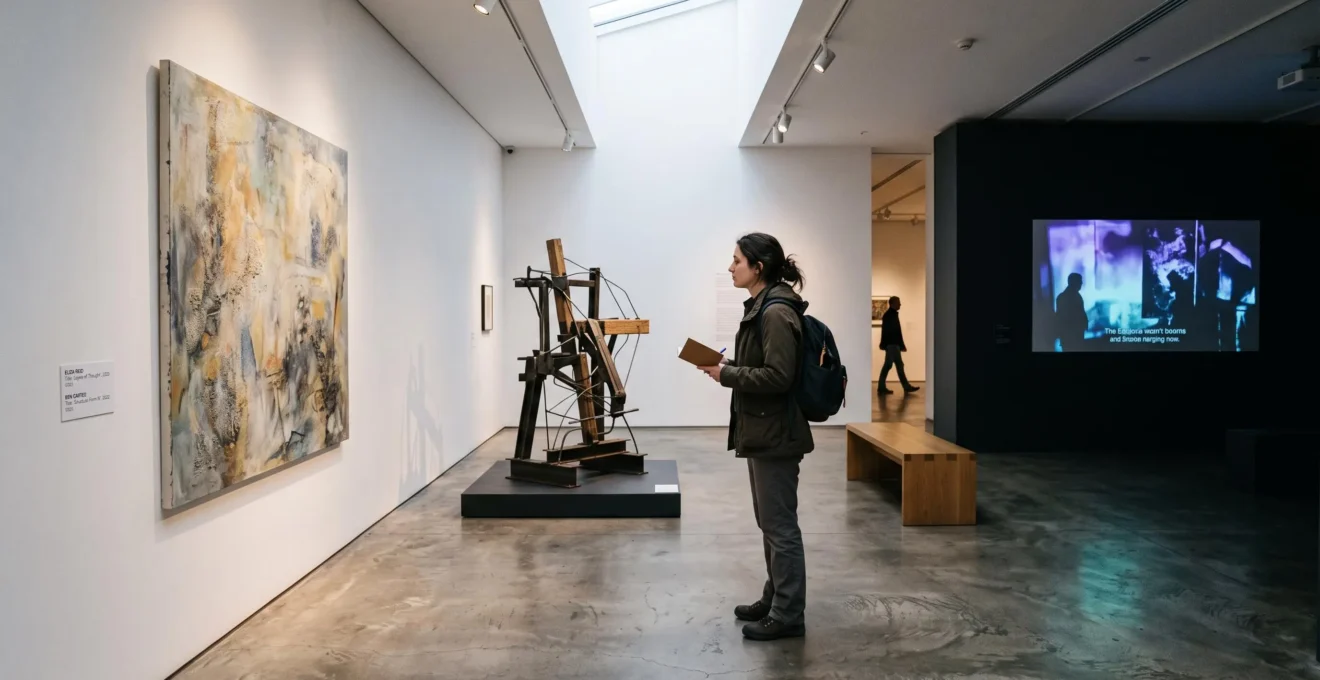
A painting occupies one wall. Across the room, a film plays beside an arrangement of unfamiliar objects. Somewhere behind you, a sound installation begins again. Each artwork might be interesting individually, yet the exhibition feels strangely disconnected.
The difficulty often lies in the way visitors are trying to connect the works. Painting invites close looking, film asks for time, sculpture changes how a body moves, and sound can occupy an entire space. Comparing their appearances alone rarely explains why they belong together.
A more useful approach is to ask what each work does with time, your body and what remains unseen or unsaid. These three questions form a cross-medium lens: a practical way to recognise relationships without needing specialist vocabulary or detailed knowledge of every artist.
For UK gallery visitors and collectors, this method turns a seemingly unpredictable combination of media into an opportunity to understand how different artistic forms investigate the same ideas. It does not guarantee that every exhibition will make sense. It does, however, give you a reliable way to decide whether a connection exists and where to look for it.
Understanding multidisciplinary collections at a glance
- Look for the shared question connecting artworks rather than expecting them to share a style or subject.
- Compare different media through three transferable criteria: time, bodily experience and omission.
- Give unfamiliar media deliberate attention, then observe how exhibition design shapes the relationships between works.
- Mixed-Media Rooms Feel Like a Junk Drawer Until You Spot the Shared Question?
- How to Compare Film, Sculpture, and Painting Using 3 Shared Criteria Without Art Jargon?
- Which Should You Start With in a Multidisciplinary Room: The Loudest Work or the Quietest One?
- The Skipping Mistake That Makes Multidisciplinary Exhibitions Feel Incomplete
- When Should You Give Time-Based Works a Chance: At the Start of Your Visit or After You’ve ‘Warmed Up’?
- Which Helps More With Ai Weiwei: Reading the Wall Text First or Looking for 60 Seconds in Silence?
- How to Read an Exhibition’s ‘Argument’ by Tracking 3 Design Clues as You Walk?
- Why Does Innovative Exhibition Design Change What You Think the Art Means in Under 2 Minutes?
Mixed-Media Rooms Feel Like a Junk Drawer Until You Spot the Shared Question?
A mixed-media gallery can appear disorganised when visitors expect artworks to look alike. Its coherence may instead come from a question that painting, sculpture, film and sound approach differently. Rather than asking why the objects share a room, ask what problem each artwork investigates and how its chosen medium changes the answer.
Imagine entering a hypothetical exhibition containing a painted portrait, a recording of someone speaking and a sculpture assembled from discarded clothing. The three works have little obvious stylistic resemblance. One seems concerned with representation, another with language, and the third with materials.
Now consider the question: What remains of a person’s identity when their physical presence disappears? The portrait preserves an appearance, the recording preserves a voice, and the clothing suggests a body that is no longer there.
Nothing about their physical resemblance has changed. What changes is the relationship you can recognise between them.
This distinction separates two useful curatorial approaches:
- Thematic curation brings together artworks concerned with a recognisable subject, such as migration, landscape or family life.
- Problem-based curation brings together artworks exploring a shared uncertainty, such as what counts as an image, how memory survives or whether sound can represent absence.
The distinction is not absolute. An exhibition may combine both approaches. Problem-based displays can initially be harder to recognise because the works need not depict the same subject or use similar materials.
Curator Sojin Kim describes exhibition-making as a process of connecting distinct elements through underlying relationships in a Smithsonian interview with curator Sojin Kim. Her account offers a useful curatorial perspective, although it does not establish a universal rule for how mixed-media exhibitions are organised.
Before leaving a confusing room, try completing this sentence: « These artworks are all asking whether… » If the sentence works for two pieces but not the third, test another formulation rather than immediately dismissing the display.
If no question emerges, examine the opening wall text. Does it identify a tension, contradiction or boundary being tested? A phrase such as « the instability of memory » may explain more than the broad category « memory ».
Do not automatically assume that the largest projection or centrally positioned sculpture contains the exhibition’s main idea. Sometimes two smaller works offer a clearer comparison because their differences are easier to isolate.
Once you can express that question in ordinary language, the next challenge becomes more precise: comparing how different media respond to it.
How to Compare Film, Sculpture, and Painting Using 3 Shared Criteria Without Art Jargon?
Compare film, sculpture and painting by asking three questions: How does the work use time? What does it ask your body to do? What does it leave you to imagine? These criteria apply across media without requiring specialist terminology. Their value comes from identifying meaningful differences in experience rather than superficial similarities in appearance.
Consider a painting showing two people meeting and a film depicting a similar encounter. The painting allows the viewer to examine a selected moment for as long as desired. The film controls the order in which gestures become visible.
Both works address an encounter, but their treatment of time changes what can be experienced.
Bill Viola‘s The Greeting provides a documented example. According to the Whitney Museum collection record for Bill Viola’s The Greeting, the 1995 video installation was inspired by Jacopo Pontormo’s painting Visitation, dating from 1528–1529.
Viola extended an encounter filmed in less than a minute into a ten-minute video sequence through extreme slow motion. The Whitney’s interpretation explains how the altered duration makes small gestures and glances especially significant.
The comparison demonstrates why medium matters: an image can convey a relationship almost immediately, while a moving image can make the development of that relationship part of its meaning.
| Shared criterion | Questions to ask | What the comparison reveals |
|---|---|---|
| Time | Does the work unfold, repeat or remain still? | Whether meaning depends on sequence, duration or prolonged observation. |
| Body | Where must you stand, sit or move? | How distance, physical scale and movement influence the encounter. |
| Omission | What information, event or sensation is absent? | What the viewer must remember, infer or imagine. |
For sculpture, bodily experience might involve walking around an object to discover surfaces hidden from the original viewpoint. For sound, it could involve crossing a room and noticing that the volume or clarity changes with position.
Omission is equally transferable. A portrait leaves out the sitter’s voice; a sound recording might preserve a voice while revealing nothing about the speaker’s appearance.
These questions work across media because they concern the visitor’s experience rather than the artist’s technique. Terms such as brushwork, camera movement or modelling can be useful, but they do not provide the same immediate basis for comparison.
A five-step cross-medium comparison checklist
- Select two works in different media and write down their titles or brief identifying descriptions.
- Describe how each handles time in one short phrase, producing two contrasting observations.
- Record where your body needs to be for each work, producing a simple comparison of position or movement.
- Identify one element each work leaves out, producing two statements about what you must supply mentally.
- Finish with a single sentence explaining which difference matters most to the exhibition’s shared question.
The framework has limits. An ambient sound installation may offer no obvious beginning, while a text-based work may deliberately resist conventional interpretation. That resistance is worth noticing rather than forcing the work into an unsuitable category.
With that method established, even the order in which you approach artworks becomes a meaningful choice.
Which Should You Start With in a Multidisciplinary Room: The Loudest Work or the Quietest One?
Start with the quietest work when a large projection or sound installation already dominates the room. It provides a comparatively stable reference before the most intense sensory experience takes over. In more evenly balanced displays, begin with the artwork that changes your viewing pace most noticeably. Neither strategy is universally preferable.
A loud installation can establish an immediate emotional atmosphere. Its sound, scale or movement may change how you interpret everything nearby. That can be useful if the exhibition depends on immersion, but it can also make smaller artworks seem insignificant before you have examined them.
Starting with a quiet work reverses the relationship. A modest drawing or small object gives you details to remember and compare once you approach the larger installation.
Imagine a hypothetical gallery containing a small charcoal drawing and a wall-sized video installation showing a rapidly changing city. Looking at the video first might establish an impression of urban energy and fragmentation. The drawing could subsequently appear unusually restrained.
If you examine the drawing first, its delicate marks and empty spaces may become the reference against which the moving image feels crowded or urgent.
Neither sequence produces the only valid reading. Instead, each makes a different relationship easier to notice.
A practical decision depends on the room’s physical arrangement:
- If sound travels throughout the space, begin with a quieter work. You are already experiencing the soundtrack while looking elsewhere.
- If the exhibition provides a clear directed route, follow it initially to understand how the sequence has been constructed.
- If the works have similar visual prominence, begin with whichever requires the greatest change in attention, such as sitting down or moving around an object.
One important caution concerns first impressions. A powerful video or sound environment may initially feel overwhelming because its sensory demands are unfamiliar. An immediate judgement can describe that first encounter without adequately describing the work.
Try returning briefly after examining another piece. Notice whether you now distinguish details that were previously overshadowed by volume, scale or movement.
The order you choose matters less than making a deliberate choice. The more serious difficulty arises when one medium is excluded from your visit altogether.
The Skipping Mistake That Makes Multidisciplinary Exhibitions Feel Incomplete
The most consequential skipping mistake is repeatedly avoiding the medium you find least approachable. Visitors who enjoy painting and sculpture may pass films or sound installations without meaningful engagement. If those works contribute an essential perspective to the exhibition’s central question, the remaining objects can appear disconnected even when the curatorial relationship is carefully constructed.
Unlike a painting, which can be glanced at before closer examination, a video may require you to remain in place for several minutes. A sound installation can demand a different kind of concentration, especially when its meaning depends on changing rhythms or repeated phrases.
These demands make time-based works tempting to skip during a busy gallery visit.
Consider a hypothetical exhibition about memory. One room contains photographs of abandoned houses, a sculpture made from household objects and a film featuring people recounting their childhood homes.
Without the film, the photographs and sculpture might seem primarily concerned with architecture or domestic possessions. Hearing personal recollections could instead establish the relationship between physical spaces and remembered experience.
The film would not necessarily be the most important artwork. It could, however, provide a missing connection between the others.
This creates a possible chain of misunderstanding: an early omission removes a useful interpretive reference, later artworks seem less connected, and the entire exhibition begins to feel arbitrary.
The solution is a deliberate commitment threshold. When a work demands time, choose one of two responses:
- Watch or listen to a short, intentional sample and make a note to return if it appears relevant.
- Commit to a fuller encounter when the duration, seating and your available time make that practical.
An accidental few-second glance rarely tells you much about a work that unfolds through time. A deliberate sample, by contrast, can reveal whether it uses speech, repetition, narrative or changing sound.
This does not mean every film deserves a complete viewing. Gallery visits involve limited attention and energy. Prioritisation is reasonable, particularly in larger exhibitions.
When deciding where to invest time, consider whether the work occupies a transition between rooms or introduces a new section. Such placements can indicate curatorial importance, although exhibition layouts also reflect practical constraints.
If the show still feels incomplete, ask which medium you have consistently avoided. Returning to one representative work may help test whether its absence affected your interpretation.
Once you decide to engage with time-based art, a further question remains: when should that engagement happen?
When Should You Give Time-Based Works a Chance: At the Start of Your Visit or After You’ve ‘Warmed Up’?
View time-based works early when they establish the pace or central ideas of an exhibition. Otherwise, consider allowing yourself a short warm-up with static artworks before settling into film or sound. The decisive factors are the work’s duration, whether it loops, whether screenings are scheduled and how its position relates to the exhibition route.
There are two reasonable approaches.
The warm-up approach begins with paintings, drawings or objects. These allow you to adjust to the gallery environment, notice recurring themes and become familiar with the exhibition’s visual language before committing to a longer experience.
The start-first approach treats film and sound as the foundations of the visit. A slowly unfolding artwork can help you adopt a different pace from the outset, making subsequent encounters with static works more attentive.
Neither approach guarantees better understanding. Their usefulness depends on how the exhibition is constructed and how the visitor responds to different forms of attention.
| Exhibition condition | Practical approach | Reason |
|---|---|---|
| Fixed-duration film with scheduled screenings | Plan around the screening time. | The programme determines when a complete viewing is possible. |
| Continuously looping video of unknown duration | Sample it, then return if useful. | Entering mid-cycle may make its structure difficult to recognise immediately. |
| Time-based work positioned at the exhibition entrance | Consider viewing it early. | Its placement may establish ideas that recur later. |
| Dense exhibition with several film installations | Alternate time-based and static works. | This can make sustained attention more manageable. |
For a looping work, identifying the restart can be especially informative. If the duration is manageable, remain until you observe a repeated sequence or the point where the cycle begins again.
The transition may reveal whether the work has a clear beginning and ending, uses continuous repetition or deliberately frustrates narrative expectations.
However, the loop boundary does not automatically disclose the artist’s central intention. Some works are designed to be entered at any moment, while others depend on a carefully constructed sequence.
Consider the distinction between a ten-minute video installation and a brief repeated sound fragment. Both involve duration, yet the attention required to understand their structures is substantially different.
Finally, consider revisiting an early moving-image work after exploring the exhibition’s remaining rooms. A film that initially seemed documentary might acquire a different emotional meaning after you have encountered related objects or images.
Such a change can suggest that the exhibition’s sequence is doing interpretive work. It is evidence of a relationship worth exploring, not proof of a single intended reading.
Attention and timing are only part of the process. Contextual information presents another decision: whether to read an explanation before looking at the artwork itself.
Which Helps More With Ai Weiwei: Reading the Wall Text First or Looking for 60 Seconds in Silence?
For many works by Ai Weiwei, begin with approximately 60 seconds of silent observation, read the wall text, then look again. This sequence lets material details register before contextual information directs your interpretation. It is particularly useful when familiar-looking objects carry historical, political or cultural meanings that cannot be identified through appearance alone.
Ai Weiwei often works with recognisable objects and materials whose significance changes when their origins or methods of production become known.
Looking without context can reveal the immediate visual experience, but it may miss essential references. Reading first can provide those references while encouraging you to treat the object as a straightforward illustration of an already supplied explanation.
A two-stage encounter offers another possibility: observation generates questions, and the text supplies information that can be tested against what you have seen.
The approach can be expressed as a simple sequence:
- Look silently for roughly one minute, noting a material and a physical detail that seem unusual.
- Read the label for information about the work’s materials, production and historical context.
- Look again and decide which of your initial observations has become more significant.
This is a practical interpretive exercise, not a scientifically established optimal viewing duration.
Ai Weiwei’s Sunflower Seeds (2010) offers a particularly revealing example. At first glance, the installation presents what appears to be an enormous accumulation of ordinary sunflower seeds.
Closer examination and contextual information establish that the objects are individually handcrafted porcelain pieces rather than agricultural seeds.
According to the Google Arts & Culture record of Ai Weiwei’s Sunflower Seeds, credited to Ai Weiwei Studio, the work involved porcelain production in Jingdezhen, China, and was first exhibited in Tate Modern‘s Turbine Hall in London in 2010.
The record describes a production process involving approximately 1,600 artisans over two years and an installation comprising more than 100 million seeds. Those figures concern this historical artwork, not Ai Weiwei’s practice generally.
Material and meaning in Ai Weiwei’s Sunflower Seeds
The installation uses individually handcrafted porcelain seeds that appear largely uniform from a distance. Their manufacture draws on the historical craft traditions of Jingdezhen.
The artwork’s documented context connects questions of individuality, collective identity, labour and Chinese cultural history. Recognising that each apparently ordinary seed is handmade changes the interpretation of the installation’s scale and repetition.
The crucial interpretive shift occurs between the first impression of countless identical objects and the knowledge that each object required individual labour.
The material is not simply a vehicle for a political message. Its appearance, production and historical associations participate in constructing that meaning.
A comparable slow-looking approach appears in a National Gallery of Art educational activity centred on Do Ho Suh. The activity encourages a quiet minute of observation and attention to materials and construction before broader interpretation. That educational guidance does not establish a universal method for reading Ai Weiwei, but it supports the practical value of noticing before explaining.
For collectors, the same sequence can help separate an artwork’s immediate material qualities from the historical narrative supplied by a catalogue or gallery representative.
There are exceptions. An abstract or formally opaque work may require basic contextual information before its visible elements become intelligible. Accessibility information and interpretive guidance should also be consulted whenever needed.
Applying that sequence across several artworks leads to a broader curatorial question: how does the exhibition itself guide the order in which interpretations develop?
How to Read an Exhibition’s ‘Argument’ by Tracking 3 Design Clues as You Walk?
An exhibition’s argument can often be traced through three spatial clues: the route that walls and doorways establish, the artworks placed within shared sightlines, and the areas where seating, darkness or sound slow visitors down. Together, these decisions suggest how curators want relationships between artworks to emerge across rooms rather than within a single display.
An exhibition is not only a collection of individual works. It is also a sequence of encounters, each influenced by what visitors have already seen and what they can anticipate ahead.
Recognising that sequence requires attention to the gallery’s physical design.
First, look at changes of direction. A doorway may lead directly into a new room, or a partition might force visitors to turn before encountering the next artwork. Such choices can separate competing ideas or delay the appearance of a significant piece.
At each junction, ask whether another route was possible. If not, consider why the exhibition might benefit from the sequence that has been established.
Second, examine sightlines. When two artworks can be seen simultaneously, their relationship becomes available before either has been examined individually.
For example, imagine a hypothetical exhibition in which a landscape painting is visible through a doorway beyond a sculpture made from industrial materials. Their simultaneous visibility might invite questions about landscape, human intervention and environmental change.
The pairing need not provide an explicit answer. Its importance lies in the comparison it makes possible.
Third, notice where the exhibition changes your pace. A bench invites sustained looking. A darkened room encourages visitors to adjust to moving images. Sound can pull attention towards an artwork before it becomes visible.
These features function like punctuation in an argument. They suggest moments of emphasis, transition or reflection.
However, not every design decision is purely interpretive. Lighting levels may respond to conservation requirements, while partitions and circulation routes can reflect architecture, accessibility and practical exhibition constraints.
The most useful reading therefore treats spatial design as evidence to examine rather than a code with one guaranteed solution.
The underlying skill is the same one used to interpret a mixed-media room. Instead of asking what question connects two artworks, ask what question connects successive rooms.
At the end of the exhibition, compare the final room with the first. Does the ending change how you understand the opening? Does an apparently isolated object now seem connected to a later film or installation?
A satisfying connection can indicate that the exhibition has developed an argument through its sequence. If no connection becomes apparent, the problem may lie partly in the display’s communication rather than the visitor’s ability to interpret it.
Once these spatial clues become visible, exhibition design stops feeling like a neutral container and becomes another element through which artistic meaning is produced.
Key takeaways before your next gallery visit
- Separate what an artwork communicates from what its placement makes you expect.
- Notice which interpretations change when you encounter a work from another direction or after a different room.
- Treat shifts in meaning as observations worth investigating, while allowing for practical and curatorial constraints.
Why Does Innovative Exhibition Design Change What You Think the Art Means in Under 2 Minutes?
Exhibition design can change your first interpretation of an artwork almost immediately because lighting, neighbouring objects, sound and viewing position establish context before detailed analysis begins. A sculpture approached in a bright open gallery may suggest different ideas from the same object encountered in darkness beside documentary material. The artwork stays the same; its interpretive surroundings change.
Imagine a hypothetical sculpture consisting of a worn wooden chair.
In a white-walled alcove, isolated under even lighting, it might initially appear as an exploration of everyday form, craftsmanship or the boundary between furniture and art.
Place the same chair in a darkened room with a recorded voice, and the encounter could feel personal or theatrical. The object might begin to suggest an absent speaker.
Present it beside archival photographs of domestic interiors, and visitors may interpret it through the histories of particular places and the people who occupied them.
These are illustrative possibilities, not experimentally established responses. Actual interpretations will vary with the work, its context and the experience of individual visitors.
The broader point is that context contributes to the artwork’s perceived meaning. Curatorial design can activate different associations without physically changing the object itself.
Even the entrance angle matters. Approaching a sculpture from the front might emphasise symmetry, while seeing it first from behind could reveal construction methods or concealed details.
Sound complicates the relationship further because it can extend beyond the physical boundary of a particular installation. A visitor may hear one artwork while looking at another, creating an encounter that neither medium produces independently.
For a practical test, choose an artwork that can be viewed from more than one position. Record your first impression, then move to an alternative permitted viewpoint or revisit the piece after exploring a contrasting room.
Ask what changed. Did the work appear more intimate, monumental, unsettling or documentary? Did another artwork supply a missing association?
This is especially useful for collectors evaluating multidisciplinary displays. An object’s presentation can influence the qualities initially noticed, but those impressions should be separated from documented information about its materials, history and artistic context.
The cross-medium lens now returns at a larger scale:
- Time: exhibition design determines when and for how long particular encounters are encouraged.
- Body: architecture and placement influence where visitors stand, move, sit and direct their attention.
- Omission: sightlines, partitions and sequencing control which relationships remain unavailable until later.
These are the same three criteria used to compare painting, sculpture, film and sound. The difference is that they now describe the exhibition as a constructed experience rather than any individual artwork.
At your next multidisciplinary exhibition, select two works in different media and compare them through those three questions. Then look around the room and ask how the curatorial design has influenced your answers. The goal is not to find a single correct interpretation, but to build a connection you can explain, test and reconsider.
Do you need art history knowledge to understand a multidisciplinary exhibition?
No specialist qualification is necessary to begin comparing works meaningfully. Observation of time, bodily experience and missing information provides a practical starting point. Art historical knowledge can deepen an interpretation, particularly when artworks refer to specific traditions, political events or earlier works.
What if two artworks seem to have nothing in common?
Start by identifying what each work does rather than what it depicts. They may share an interest in repetition, absence, movement or memory despite using different materials. If no persuasive connection emerges after considering the display and its accompanying information, it is reasonable to question the curatorial relationship.
Can you understand a sound installation without listening to the entire work?
Sometimes. A short intentional encounter may reveal the installation’s spatial arrangement, sonic character or use of repetition. However, work built around gradual changes, extended recordings or a defined narrative may require more time. Check for duration information and distinguish a preliminary impression from a complete encounter.
Should you follow the curator’s intended route or explore freely?
Following a clearly signposted route initially can help reveal intended sequences and connections. Where free movement is permitted, revisiting works in a different order can provide useful comparisons. Respect access restrictions and any viewing arrangements required for particular installations.
How can collectors apply cross-medium thinking when considering an artwork?
Collectors can compare how works in different media address a shared artistic concern without assuming that stylistic similarity is necessary for a coherent collection. The framework can help articulate conceptual relationships, but it does not replace research into provenance, condition, authenticity, conservation needs or the specific history of an artwork.