
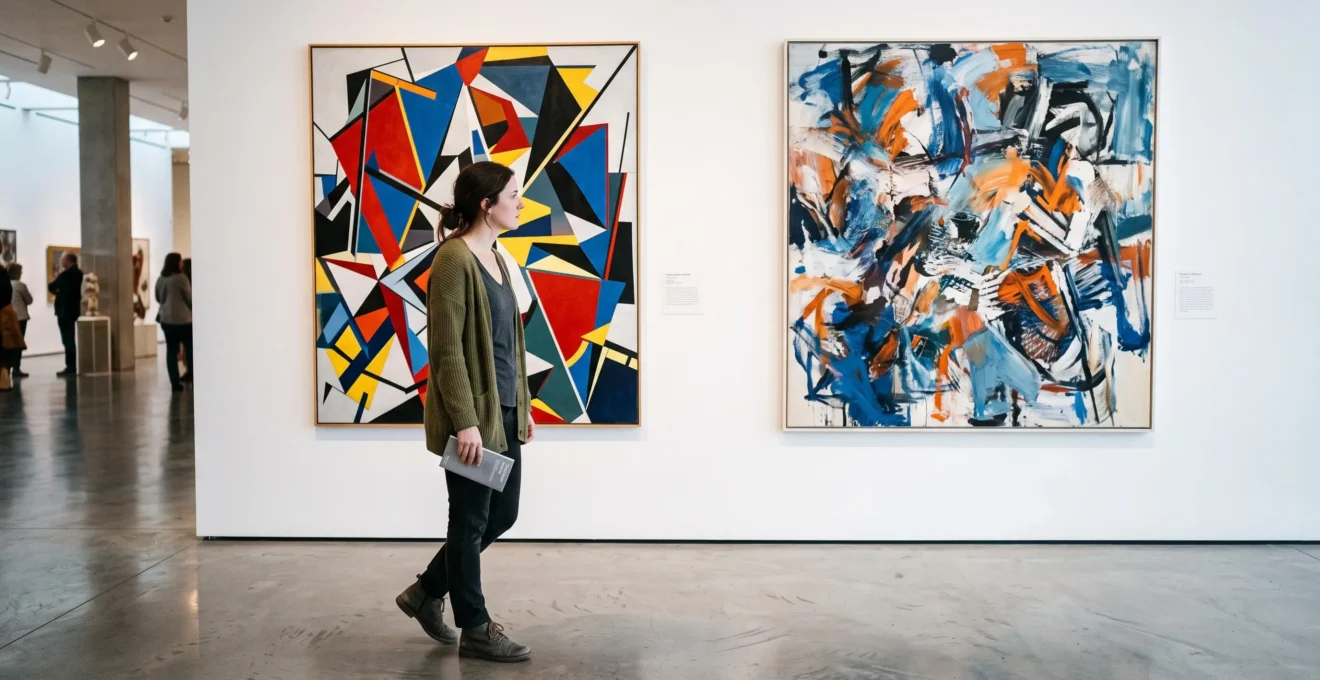
Modern art history can feel like an endless parade of movements with strange names. Impressionism gives way to Cubism, Futurism appears, Dada questions the whole enterprise, and Minimalism eventually strips almost everything away. Just when a style seems to have established its rules, another group of artists starts breaking them.
But what if the constant rule-breaking is the point? Avant-garde movements are easier to understand as attempts to solve artistic problems than as competing visual styles. A painter questions how perspective works. Another challenges the need to represent recognisable objects. Someone else asks whether making an object is necessary for something to count as art.
These experiments do not form one tidy family tree. Movements overlap, influence one another and sometimes pursue contradictory aims. Yet tracing the assumptions they question gives you something far more useful than a chronological list: a working map of artistic ideas.
Once you can identify the problem a movement was addressing, unfamiliar artworks become easier to compare, interpret and remember.
Avant-garde art: the essential mental model
- Each movement can be understood by identifying the artistic assumptions it challenged, even when several conventions changed at once.
- Three questions reveal more than memorised dates: what was rejected, what was retained, and what problem was being explored?
- Start with artworks that interest you, then connect them through emotion, structure or politics to build a flexible map of influence.
- Why Does Every Avant-Garde Movement Start by Rejecting One Specific Assumption?
- How to Identify Any Avant-Garde Movement in 3 Questions Without Memorising Dates?
- Which Avant-Garde Path Should You Start With: Emotion-Driven, Structure-Driven, or Politics-Driven?
- The Labelling Mistake That Makes People Misread Avant-Garde Art as One Style
- In What Order Should You Learn Avant-Garde Movements: Key Works First or Movement Logic First?
- How to Decode a Cubist Painting in 4 Passes Without Knowing the Artist’s Backstory?
- Why Can Socially Engaged Art Feel Personal Even When It Isn’t About You?
- Why Does Ai Weiwei’s Work Spark Arguments at Dinner Even When It’s ‘Just Objects’?
Why Does Every Avant-Garde Movement Start by Rejecting One Specific Assumption?
Avant-garde movements often begin by challenging an artistic assumption that earlier practitioners treated as essential. The useful starting question is not simply which rules artists broke, but which expectations their experiments put under pressure. Reducing a movement to one rejected assumption is a learning shortcut, however, not a literal description of its entire history.
Consider three different artistic problems. Impressionist painters questioned conventions of polished studio finish and developed approaches that foregrounded changing light and visible brushwork. Cubist painters challenged the idea that convincing representation depended on a stable viewpoint and conventional perspective. Later, Minimalist artists explored geometric forms, industrial materials and systematic arrangements that differed markedly from the expressive approaches associated with Abstract Expressionism.
Each intervention becomes easier to remember through a simple template:
Movement X asked: what if we dropped assumption Y?
- Futurism: What if a static image could suggest the energy and movement of modern life? Futurist artists used fragmentation and repeated forms to evoke dynamism.
- Duchamp’s readymades: What if an artist’s selection and presentation of an existing object mattered more than traditional manual craftsmanship?
- Abstract Expressionism: What if non-representational painting could make gesture, scale, colour or the material experience of painting central to the work?
The last example needs care: Abstract Expressionism encompassed different artistic approaches, not a single doctrine of gestural painting.
This problem-based reading fits the institutional distinctions documented in MoMA‘s glossary of modern and contemporary art terms, which describes movements with substantially different artistic aims.
Now comes the important consequence. An artistic experiment can establish new possibilities that later artists question. Yesterday’s innovation may become tomorrow’s convention.
That does not mean every movement replaces its predecessor or rejects precisely one rule. Artists retain techniques, materials, genres and influences while revising particular assumptions. The history is closer to a branching conversation than a straight line of destruction.
Once that question becomes automatic, the next challenge is recognising the logic of an unfamiliar movement without relying on a timeline.
How to Identify Any Avant-Garde Movement in 3 Questions Without Memorising Dates?
You can begin identifying an avant-garde movement by asking three questions: which artistic assumption does it challenge, which conventions does it retain, and which visual or conceptual problem does it explore? These questions provide a practical interpretation method, although they cannot identify every artwork conclusively without historical context or supporting information.
Instead of starting with a movement’s name, begin with what you can actually see.
- What assumption is under attack? Look for a convention being challenged: realistic perspective, expressive brushwork, traditional craftsmanship or the distinction between artwork and everyday object.
- What has been retained? Identify surviving conventions. A highly experimental painting might still depict a portrait, landscape or ordinary object.
- What problem is being explored? Translate the visible experiment into a question the artist appears to investigate.
Try the method on De Stijl, even if you have never studied its history.
Its simplified geometric compositions question whether painting needs to imitate visible reality. They retain deliberate composition, relationships between forms and carefully organised colour. Their central artistic enquiry concerns the possibility of visual order and harmony through a restricted vocabulary of lines and planes.
You now have a meaningful description without first memorising when the movement emerged.
Test the method against two movements that share an obvious characteristic: Cubism and Futurism. Both can fragment recognisable forms, but their experiments point in different directions.
| Diagnostic question | Cubism | Futurism |
|---|---|---|
| Which assumption is challenged? | Conventional pictorial perspective and stable spatial representation | The expectation that a static image should depict a single arrested moment |
| What remains? | Recognisable subjects, compositional structure and the painting surface | Recognisable forms and pictorial composition |
| What is explored? | Form, space and contrasting viewpoints | Speed, energy and modern movement |
Both movements used fragmentation. Fragmentation alone therefore cannot distinguish them. The relevant clue is the problem that fragmentation helps each movement address.
Dates still matter when establishing influence, causation or direct historical contact. The diagnostic simply gives those dates a conceptual framework.
Once you can recognise different artistic problems, you can choose the route through modern art history that best matches your interests.
Which Avant-Garde Path Should You Start With: Emotion-Driven, Structure-Driven, or Politics-Driven?
The best starting path is the one connected to a question you already find interesting. Emotion-driven art investigates how expression shapes experience. Structure-driven art investigates how visual relationships construct meaning. Politics-driven art examines how artistic practices engage with society and power. These routes overlap, and none represents a complete or independent history.
Think of them as three ways into a complicated network rather than three rigid categories of art.
| Path | Suggested route | Central question | Common blind spot |
|---|---|---|---|
| Emotion-driven | Romanticism → Expressionism → Abstract Expressionism | How can artistic form communicate or intensify feeling? | Reducing movements to mood labels |
| Structure-driven | Cézanne → Cubism → De Stijl | How can artists reconstruct visual reality through form? | Ignoring historical meaning and artistic intention |
| Politics-driven | Dada → Situationism → socially engaged art | How can art challenge institutions, social conventions or spectatorship? | Treating artworks as illustrations of manifestos |
These are suggested conceptual routes, not claims that each movement directly produced the next. Romanticism, for example, belongs to an earlier historical context, while socially engaged art encompasses practices rather than one unified movement.
To find your natural entry point, consider three hypothetical artworks:
- A painting uses distorted figures and intense colour to convey anxiety.
- A painting reorganises a familiar object into overlapping geometric planes.
- An installation asks visitors to participate in a public discussion about a shared social problem.
Which one makes you most curious? The first suggests an emotional entry point, the second a structural one, and the third a political or social one.
Each path has a predictable interpretative trap. Emotion-first viewers can mistake every artistic experiment for a feeling; the three-question diagnostic helps them identify formal decisions. Structure-first viewers may admire geometry while overlooking meaning; socially engaged art provides a useful counterexample. Politics-first viewers can overlook material and visual invention; the Cubist decoding exercise restores attention to what an artwork actually does.
The real payoff comes from moving between paths. Expression and politics can coexist, while formal experimentation can challenge social expectations.
Having several routes also exposes a major problem with the label most people use for all of them: modern art.
The Labelling Mistake That Makes People Misread Avant-Garde Art as One Style
The biggest labelling mistake is treating modern art as one aesthetic style rather than a broad category containing movements with conflicting goals. Once everything unfamiliar is described as abstract, strange or deliberately difficult, the differences between artistic experiments disappear. The result is a misleading impression that modern art repeatedly produces variations of the same visual idea.
Consider Abstract Expressionism and Minimalism.
Some Abstract Expressionists made gestural painting central to the artistic encounter, creating surfaces in which mark-making and material presence became especially significant. Minimalist artists often explored simplified geometric forms, industrial fabrication and systematic relationships between objects and space.
Calling both approaches simply abstract misses a fundamental difference in what their respective practices emphasised.
A shared visual label is not evidence of a shared artistic problem.
This mistake has practical consequences. If every artwork belongs to one vague category, you cannot explain why artists disagreed, why some techniques appeared provocative or how one experiment challenged conventions associated with another.
Take a hypothetical encounter with an Analytic Cubist portrait. At first glance, its fractured face might seem merely distorted. Ask instead which assumption the artist is examining. The overlapping planes and shifting spatial cues begin to look like deliberate attempts to rethink how a three-dimensional subject can exist on a flat surface.
The painting has not changed. Your interpretative question has.
There is another complication: movement labels are imperfect historical tools. Some artworks sit across several classifications, and critics have influenced the names through which later audiences understand artistic developments. Cubism itself acquired its familiar name through critical discussion rather than a universally agreed classification established from the outset.
Artistic boundaries are therefore fuzzy, and sometimes usefully so. Labels help organise evidence but cannot replace close looking.
That shift suggests a better approach to learning: neither collecting movement names nor studying theories in isolation, but connecting concrete works to the problems they explore.
In What Order Should You Learn Avant-Garde Movements: Key Works First or Movement Logic First?
Start with a small number of artworks that genuinely attract your attention, then connect each one to the artistic problem it explores. Studying key works first provides memorable examples, while studying movement logic provides a framework for comparing them. Combining the two avoids the weaknesses of learning isolated masterpieces or abstract movement definitions.
Both sequences offer something useful, but neither is sufficient on its own.
| Learning criterion | Key works first | Movement logic first |
|---|---|---|
| Immediate advantage | Memorable visual examples | Clear conceptual relationships |
| Main weakness | Artworks can become disconnected style examples | Concepts can feel abstract without images |
| Best use | Finding personal reference points | Explaining experiments and influences |
A practical starting group might include three to five works representing markedly different questions. One could explore Cubist space, another non-representational expression and another the status of the everyday object.
Then investigate the relevant artistic assumptions rather than simply filing each example under its movement name.
The historical relationship between Cézanne and Cubism illustrates why this matters. Cézanne’s experiments with form and pictorial construction helped shape the development of Cubism, although other influences were also important. The The Metropolitan Museum of Art‘s essay on Cubism documents these influences and explains how Cubist painters reconsidered conventional perspective, modelling and spatial representation.
If you encounter a Cubist painting only as a strange arrangement of geometric forms, that historical enquiry remains invisible.
A museum visit offers an opportunity to practise this combined approach. Collections often place artworks within galleries organised by chronology, subject or curatorial interpretation. Those arrangements can help, but neighbouring works are not necessarily linked by direct influence.
Build your avant-garde map during one museum visit
- Choose an anchor artwork. Record its title and one visual feature that caught your attention. Your deliverable is a two-line observation.
- Name a possible assumption. Write one sentence beginning, “This artwork questions whether…” Your deliverable is a testable interpretation.
- Find a related earlier work. Use gallery information to identify a relevant precedent. Record one similarity and one difference.
- Find a contrasting experiment. Look for a work that approaches the problem differently. Record the new question it raises.
- Draw a small connection map. Link your chosen works with arrows labelled “reworks”, “challenges” or “shares a problem with”. Your deliverable is a three-work concept map, with documented influences distinguished from your own comparisons.
The aim is not to manufacture a direct historical relationship between every object. It is to develop a disciplined habit of comparing artistic questions and checking proposed connections against evidence.
Cubism offers a particularly useful test because its central formal experiments can be examined directly, even before exploring an artist’s biography.
How to Decode a Cubist Painting in 4 Passes Without Knowing the Artist’s Backstory?
Decode a Cubist painting by examining its subject, viewpoints, spatial construction and challenged assumptions in four separate passes. This method directs attention towards the artwork’s visible organisation rather than an artist’s personal history. It is particularly useful for recognising Cubist techniques, although difficult paintings may still require labels or historical context.
Imagine standing in front of a Cubist portrait. The face appears broken into planes, the space is shallow, and the relationship between features is unfamiliar.
Instead of immediately searching for biographical explanations, follow this viewing protocol.
- Pass 1 — Find the subject. Look for recognisable features such as an eye, an instrument, a bottle or part of a human figure. Some Analytic Cubist compositions make recognition particularly difficult, so uncertainty is normal.
- Pass 2 — Locate contrasting viewpoints. Look for forms that appear to offer different angles or spatial interpretations within the same composition. Do not assume that every fragment represents a separate viewpoint.
- Pass 3 — Examine depth and lighting. Notice overlapping planes, compressed space and the way conventional modelling may be disrupted. Ask how the painting makes its flat surface visible rather than hiding it behind illusionistic depth.
- Pass 4 — Identify the assumption being questioned. Consider whether the work challenges the expectation that convincing representation must follow conventional perspective and a unified viewpoint.
This is an editorial viewing method built around documented Cubist characteristics, not a formal test developed by the artists or a museum.
Its strength becomes clear when you compare the painting with the problem of representing three-dimensional objects. Cézanne’s experiments contributed to the development of Cubism, while Picasso and Braque explored increasingly complex approaches to form and pictorial space.
The transition is not a simple formula in which Cézanne invented one problem and Cubism solved it completely. It involved additional influences and multiple artistic decisions.
Still, the relationship gives the fragmented image an intelligible purpose.
A common decoding error is to conclude that distorted forms indicate an inability to draw. Analytic Cubist compositions instead show systematic choices about how subjects, planes and space interact.
You need not like the result to recognise that the departure from conventional representation is deliberate.
This approach demonstrates how a formal experiment can become understandable without a long biography. Yet other avant-garde practices shift the central question away from depiction altogether and towards the viewer’s role in society.
Why Can Socially Engaged Art Feel Personal Even When It Isn’t About You?
Socially engaged art can feel personal because it asks viewers or participants to confront issues involving collective life, responsibility or social relationships. Rather than treating the audience solely as observers of a finished object, some practices involve people in the work’s development or meaning. The experience may become personally significant even when its subject is shared.
The important shift concerns the relationship between artwork and audience.
Traditional gallery expectations often position visitors as spectators who observe and interpret. Participatory artistic practices can complicate that separation by inviting visitors to perform actions, follow instructions, contribute material or interact with other people.
MoMA’s resource on participation and audience involvement documents artistic practices that alter the relationship between creators, artworks and spectators.
Participation does not automatically make art political. Nor does political engagement always require participation. Those are overlapping possibilities, not interchangeable definitions.
Consider a hypothetical artwork that invites visitors to record their experiences of public housing and places those accounts alongside documentary material about housing policy.
One visitor might respond through a personal memory. Another might question how the experiences were selected. A third might focus on the responsibilities of public institutions.
What makes the encounter artistically interesting is not simply whether the material resembles the viewer’s own life. It is the relationship the work constructs between individual testimony and a collective issue.
Replace “Does this speak to my experience?” with “What conversation does this work ask its audience to enter?”
That question also connects the emotional and political pathways introduced earlier. An artwork can make a public problem emotionally immediate without reducing it to private expression.
A familiar objection is that politically engaged art is merely propaganda. A useful first test is to ask whether a work invites interpretation, complexity and disagreement or primarily instructs its audience to accept a predetermined message.
That distinction is not absolute. Art can advocate a position and still allow substantial interpretation, while apparently open-ended participation can be carefully controlled.
This provides a bridge to an artist whose use of familiar objects repeatedly brings visual form, cultural meaning and political questions into the same encounter.
Key takeaways before exploring contemporary art
- An everyday object can become an artwork’s central question when its selection, context or transformation changes how viewers interpret it.
- Aesthetic and political interpretations need not compete; examine how material choices contribute to wider meanings.
- Apply the three-question diagnostic to contemporary works, but distinguish documented artistic intentions from your own interpretations.
Why Does Ai Weiwei’s Work Spark Arguments at Dinner Even When It’s ‘Just Objects’?
Ai Weiwei’s artworks can provoke disagreement because familiar materials and objects become vehicles for questions about cultural heritage, authority and social responsibility. Viewers may disagree over whether to prioritise the object’s appearance, historical significance or political implications. The controversy is not necessarily separate from the artistic experience: interpretation depends on recognising what the object has been made to question.
Ai Weiwei works across sculpture, photography, public art and other media. His practice often incorporates materials associated with Chinese cultural traditions, including historical pottery and reclaimed wood.
Those materials carry meanings beyond their physical appearance. A vessel can be admired for its form and craftsmanship while also raising questions about cultural value, historical preservation and the authority to transform inherited objects.
There is a conceptual connection to Marcel Duchamp‘s readymades. Duchamp challenged the assumption that traditional artistic craftsmanship was necessary for an object to become art. Ai Weiwei’s transformations of culturally significant materials can be interpreted through a related question: how does an artist’s intervention change what an object means?
The connection is an interpretative comparison, not evidence that every Ai Weiwei work is a Duchampian readymade.
Consider Ai Weiwei’s Dropping a Han Dynasty Urn, a photographic work depicting the artist deliberately dropping a historical vessel. The visible action offers a particularly clear example for the three-question diagnostic.
- Which assumption is challenged? The expectation that a culturally valuable historical object should remain protected from deliberate destruction.
- What is retained? The recognisable vessel, the photographic record and the object’s association with cultural history remain central to interpretation.
- What problem is explored? The relationship between cultural value, artistic intervention, destruction and the authority to redefine inherited meaning.
This reading does not establish one definitive interpretation of the artwork. It demonstrates how the diagnostic can organise a discussion without pretending that complex art yields a single answer.
The deliberately ordinary presentation of objects in contemporary art can encourage sharply different reactions. One viewer may admire the formal restraint of a work. Another may see criticism of institutions. Someone else may question whether the object’s transformation is justified.
These positions are not necessarily mutually exclusive. The interesting question is how an artwork’s material decisions create room for competing interpretations.
The broader relationship between Ai Weiwei’s artistic practice and political engagement is documented in Art21‘s profile of Ai Weiwei, which discusses his use of historical materials, cultural references and public communication.
What the source does not establish is that every object the artist uses is intended to produce conflict or force viewers into one of two opposing positions.
The more useful conclusion returns to the original question: avant-garde experimentation persists because artistic assumptions remain open to revision. What counts as representation, artistic labour, cultural value or legitimate participation can become the subject of a new work.
On your next museum visit, choose an artwork that initially seems puzzling. Identify one assumption it challenges, one convention it retains and one question it raises. Compare your answers with the gallery’s information. That small exercise can turn an apparently disconnected collection of artistic styles into a map of ideas worth exploring.
Does avant-garde always mean abstract art?
No. Avant-garde describes artistic innovation and departures from established conventions rather than one visual appearance. Some experimental movements pursued abstraction, while others used recognisable figures, objects, photography, performance or everyday materials. The relevant question is what established expectation a work challenges.
Can two avant-garde movements exist at the same time?
Yes. Artistic movements frequently overlap, develop in different locations and respond to shared historical circumstances. Their relationships cannot always be described as one movement replacing another. Studying their contrasting artistic problems helps reveal both simultaneous developments and possible influences.
Is avant-garde art the same as contemporary art?
No. Contemporary art generally refers to art associated with the present or relatively recent periods, whereas avant-garde describes an experimental relationship to artistic conventions. A contemporary work can be avant-garde, but not all contemporary art is organised around challenging established artistic expectations.
Do you need to know an artist’s biography to understand an artwork?
Not always. Visual analysis can reveal important formal decisions, particularly in work involving perspective, abstraction or composition. However, biography, historical context and information about artistic intentions can become essential when interpreting cultural references, political significance or the conditions in which a work was produced.
How can you tell whether an unconventional artwork is genuinely innovative?
Unusual appearance alone is insufficient. Compare the work with established artistic practices, identify the conventions it modifies and investigate the historical context of those decisions. Innovation is a contextual judgement: a technique that was radical in one setting may be familiar in another.