
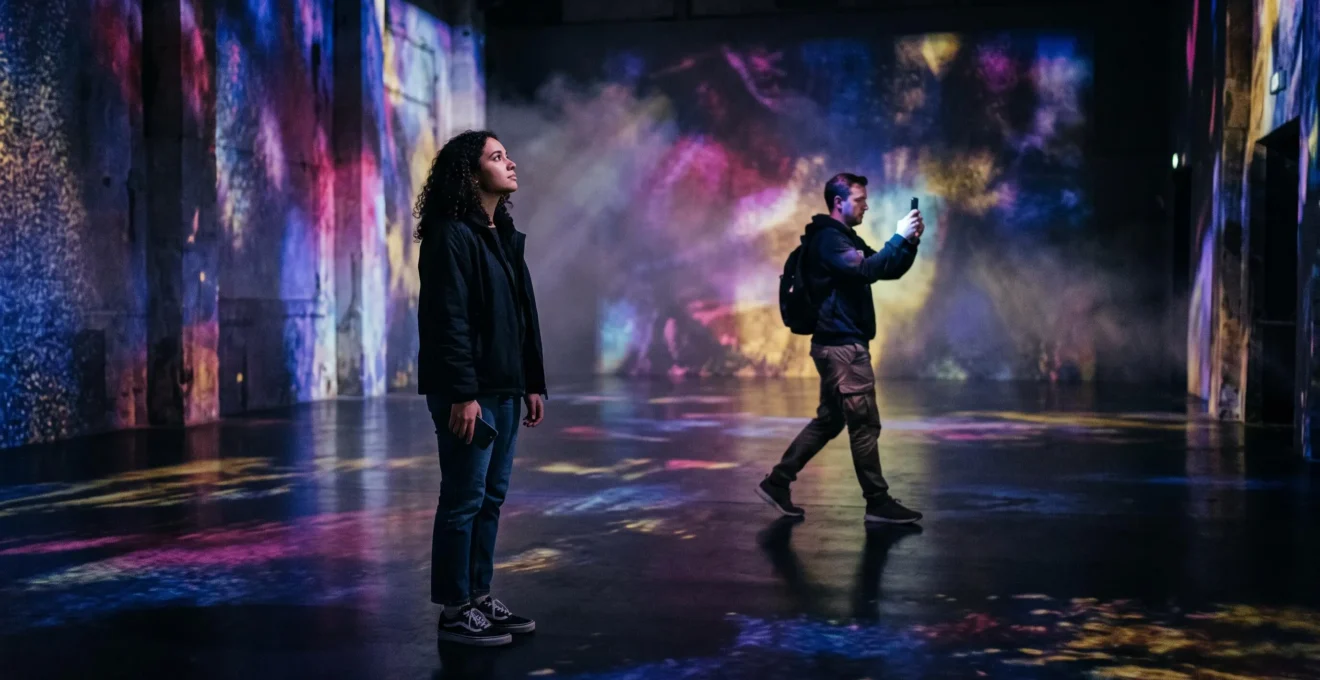
You’ve paid for an immersive art exhibition, walked into a room filled with enormous projections, taken a few photographs and moved on. Five minutes later, you’re wondering what the fuss was about. There were lights, perhaps dramatic music, but surprisingly little that stayed with you.
That disappointment is understandable. It is also sometimes preventable. Immersive installations often reveal their meaning through time, position and participation rather than an immediate visual spectacle. Walking through one as though it were a conventional gallery can mean leaving before its most interesting qualities become apparent.
The answer is not necessarily to spend an hour in every room. Some works are designed for brief encounters. Others unfold over lengthy sequences, and interactive pieces may depend on what visitors actually do. The useful skill is recognising which kind of experience you’re entering, then adjusting your attention accordingly.
For first-time visitors to immersive exhibitions in the UK, a few deliberate choices can make the difference between expensive photographs and a memorable encounter.
How to get more from an immersive installation
- Stop moving before you start judging. Choose one position and watch for a meaningful change in light, sound or interaction.
- Match your behaviour to the artwork. Some installations reward waiting; others require touching, moving or experimenting.
- Plan for comfort and attention. Sensory intensity, crowding and entry times can affect how much of the work you actually experience.
- Why Does Immersion Collapse When You Treat an Installation Like a Photo Background?
- How to Move Through an Immersive Installation in 4 Phases Without Missing the “Payoff”?
- Which Is Better if You Get Sensory Overload: Audio-Heavy Immersion or Visual-Only Installations?
- The Expectation Mistake That Makes People Think an Installation “Did Nothing”
- When Should You Book Immersive Shows in the UK: First Entry, Last Entry, or Midweek Afternoons?
- Why Do You Remember Less From Museums When You’re Constantly Navigating Around People?
- Why Do People Freeze at Interactive Art Even When There’s A Sign Saying “Touch”?
- Why Do Interactive Art Exhibits Feel Awkward Until You Know the 1 Unspoken Rule?
Why Does Immersion Collapse When You Treat an Installation Like a Photo Background?
Immersion can collapse when photography becomes your main activity because you begin evaluating the room as an image rather than experiencing it as an environment. You notice striking colours and compositions, but may overlook gradual transitions, spatial sound and changes that only become apparent when you stop moving. Taking photographs is not inherently the problem; allowing photography to dictate your attention is.
Consider two hypothetical visitors entering the same projection room. One immediately searches for the best photograph, moves towards an illuminated wall, captures several images and leaves. The other finds a comfortable position, watches the projection evolve and notices how the sound shifts across the space. Both have seen the installation, but they have attended to different aspects of it.
The distinction matters because an immersive environment is not always designed to be understood through individual visual highlights. A slowly changing colour field, for example, may have little impact in a still photograph. Its effect depends on noticing what changes, what remains constant and how the surrounding space contributes.
There is relevant research, although it should not be stretched into a universal claim about immersive art. In Linda Henkel‘s Psychological Science study on museum photography and memory, participants who photographed entire museum objects subsequently remembered fewer objects and details than participants who simply observed them. Importantly, photographing specific details did not produce the same impairment.
That distinction challenges the simplistic advice to put your phone away completely. Focused photography can encourage looking closely. Rapidly collecting images without sustained observation is the less promising approach.
The type of installation also matters. Continuous environments, including projection-mapped rooms and evolving soundscapes, reward attention to gradual change. Sequential works may have distinct scenes or developments that visitors can miss by entering halfway through or leaving early. A photograph freezes both formats, but neither necessarily works as a frozen image.
Crowds introduce another complication. When several visitors are filming, photography can become the dominant social behaviour. Remaining still may feel awkward, even when the artwork rewards exactly that. Visitors can end up moving with the flow rather than responding to the work.
A practical compromise is to spend the first moments observing without recording. Once you’ve noticed something specific, photograph that detail if photography is permitted. The resulting image may become a reminder of an experience you actually had, rather than a substitute for one.
How to Move Through an Immersive Installation in 4 Phases Without Missing the “Payoff”?
Move through an immersive installation in four phases: orient yourself, settle into one position, watch for a complete change and reconsider the work from another viewpoint. This approach reduces aimless wandering and increases your chances of noticing how the installation develops. The important variable is not a universal minimum viewing time but the rhythm of the particular artwork.
The method begins before you decide whether the installation is interesting. Instead of immediately approaching the brightest wall, take a moment to understand the space and how people are using it.
- Orientation: Pause near the entrance without obstructing access. Identify the sources of light, the direction of sound, the main viewing areas and any signs explaining how the work operates.
- Settling: Choose a position and remain there. This gives your attention a stable reference point instead of forcing you to process a new visual scene with every step.
- Deep attention: Watch or listen for a recognisable change. It might be a transition between projected scenes, a recurring musical passage or a shift in the relationship between light and space.
- Re-orientation: Move deliberately to another viewpoint, if permitted and comfortable. Compare what you notice from the centre, the edge or a different distance from the projection.
The third phase is particularly important. Many immersive works loop or evolve according to a sequence, but those sequences vary considerably. Look for repeating images, colours, sound cues or transitions that suggest a cycle has returned to an earlier stage.
There is no reliable five-minute rule. At London’s Lightroom, for example, the official information for Lightroom‘s official Larger Than Life exhibition information describes an approximately 50-minute presentation that runs continuously without a fixed beginning or end. Visitors enter through half-hourly ticket slots and may remain for another cycle when capacity allows.
That does not mean every visitor must watch the full presentation to appreciate it. It does demonstrate why judging every installation after the same arbitrary duration makes little sense.
Position matters as much as duration. Standing centrally may emphasise the sensation of being surrounded, while standing near an edge may reveal how projections align with architectural surfaces. A sound installation may also feel noticeably different at different points. These are possibilities to investigate, not guarantees of a particular effect.
Some works have an identifiable climax; others deliberately avoid one. The payoff may be a dramatic transition, a subtle pattern you finally recognise or the discovery that your position changes the experience.
If the room is crowded or you have fewer than five minutes, simplify the method. Skip prolonged orientation, select a suitable place and remain there long enough to identify one change. Settling is usually a better use of a short visit than continuous wandering.
Your five-action immersive room checklist
- Find the entrance guidance and identify one instruction about viewing or participation. Outcome: you know whether the work expects observation, movement or interaction.
- Select a viewing position that does not block circulation. Outcome: one stable place from which to assess the installation.
- Identify one changing element in the light, imagery or sound. Outcome: a specific observation you can describe.
- Look or listen for a repetition or transition. Outcome: an informed impression of the work’s rhythm, even if you cannot complete its cycle.
- Change viewpoint once, if practical, and note one difference. Outcome: a concrete comparison between two positions.
Remaining attentive does not require enduring discomfort or completing every sequence. A useful viewing method should make the experience more accessible, which means knowing when the room’s sensory conditions call for a different approach.
Which Is Better if You Get Sensory Overload: Audio-Heavy Immersion or Visual-Only Installations?
Visual-only or visually dominant installations may be easier for visitors whose main sensitivity is sound, because looking away or reducing visual exposure offers some control. Audio-heavy installations may be more difficult when loudness, bass or spatial sound is the trigger. However, neither format is automatically comfortable: flashing imagery, motion effects and crowding can make visual environments equally challenging.
The distinction is about controllability, not artistic quality. You can often turn towards a quieter visual area, close your eyes briefly or reduce the amount of projection entering your peripheral vision. You cannot simply look away from sound that fills the room.
However, closing your eyes does not eliminate every visual discomfort, and some audio-based installations are quiet, carefully moderated experiences. The intensity and combination of stimuli matter more than the category label.
Use your known triggers to decide which type of experience deserves more advance investigation.
| Primary trigger | Potentially easier choice | What to check before booking |
|---|---|---|
| Loud or layered sound | Visual-only or low-volume installations | Sound levels, bass, sudden audio effects and whether hearing protection is permitted |
| Flashing lights or visual motion | Static, slowly changing or primarily audio-based works | Strobe effects, flicker, rapidly moving projections and accessibility warnings |
| Crowding or unpredictable movement | Reduced-capacity or relaxed sessions | Session capacity, quiet areas, seating and re-entry arrangements |
For audio-heavy rooms, suitable hearing protection may reduce the intensity of some sounds, although its effectiveness depends on the environment. Standing near an exit may make leaving easier where venue rules allow, but it does not guarantee lower sound exposure. Ask staff about particularly loud passages or whether an installation follows a predictable sequence.
For visually intense rooms, consider a position close to a wall, away from the central flow of projections. Sitting, when seating is available, may reduce the need to navigate while processing moving imagery. If flashing effects are a known health concern, check the venue’s specific warnings rather than relying on improvised coping tactics.
UK venues sometimes provide more useful accessibility information than their promotional images suggest. FRAMELESS London‘s Chilled Sessions accessibility information describes reduced-capacity sessions with lower sound volumes, adapted lighting and a dedicated quiet space. Staff can also provide information about artworks and running orders.
This is an example of one venue’s published arrangements, not evidence that every immersive gallery offers comparable adaptations.
Promotional photographs are poor indicators of sensory intensity. They cannot reliably communicate bass, volume, floor vibration or how rapidly imagery moves. Recent visitor accounts and official accessibility guidance are better starting points, although individual reactions will still differ.
Comfort is not a reward for enduring the most intense room. It is a condition that can make sustained attention possible. Once the environment feels manageable, the next question is whether you’re expecting the artwork to deliver something it was never designed to provide.
The Expectation Mistake That Makes People Think an Installation “Did Nothing”
The expectation mistake is assuming that immersive art must deliver an immediate, dramatic effect without requiring anything from the visitor. Some installations develop gradually through repetition or subtle environmental changes. Others respond to participation. When visitors expect an instant spectacle from either type, they may conclude that nothing happened, even though they never encountered the conditions that make the work meaningful.
There are two fundamentally different ways this mismatch can occur.
In a duration-dependent installation, the work may change while the visitor remains passive. Light shifts, imagery develops or a sound pattern accumulates. Someone who leaves before observing a meaningful progression has experienced only part of the work.
In a participation-dependent installation, the visitor may need to touch a permitted surface, move through a sensor area or make a choice. Without that input, the piece may genuinely appear inactive.
The solutions are different. Waiting longer helps with the first problem. Understanding how to participate helps with the second. Neither approach can rescue an installation that simply does not appeal to you, and not every disappointed response reflects visitor error.
A brief introduction can change how an ambiguous room becomes legible. Read the artist’s description, identify the work’s central idea or ask an attendant, « What should I be noticing? » For an interactive piece, a more useful question may be, « What is this installation designed to respond to? »
These questions provide context without dictating an emotional reaction. Knowing that a work explores repetition, for instance, may encourage you to notice recurring elements rather than search for a conventional beginning and ending.
Imagine two hypothetical reviews of the same installation. One visitor describes it as unexpectedly moving after observing several changes. Another describes an empty room with projections and no discernible point. Their different behaviours could explain part of the disagreement, although artistic preferences, expectations and exhibition conditions may also contribute.
For a visit that has already felt disappointing, try three diagnostic questions:
- Did I remain long enough to notice one meaningful change?
- Did I try a different viewpoint or position?
- Did I respond to anything the installation explicitly invited me to do?
A « no » suggests a useful experiment for a second pass. It does not prove that the artwork was successful or that your initial judgement was wrong.
Sometimes the work still disappoints after careful engagement. That is a legitimate critical response. The aim is not to excuse every exhibition but to ensure you’re evaluating what was actually presented, rather than an incomplete encounter with it.
When Should You Book Immersive Shows in the UK: First Entry, Last Entry, or Midweek Afternoons?
First entry can be useful if you prefer arriving before visitors accumulate, while last entry may offer a quieter atmosphere but less freedom to linger before closing. Midweek afternoons can be a promising compromise outside school holidays, although attendance varies by venue. For visitors seeking predictable sensory conditions, an advertised relaxed or reduced-capacity session is generally a more reliable choice than guessing when crowds will be smallest.
Booking time influences more than queues. A crowded installation can make it difficult to settle in one place, observe a full sequence or move deliberately between viewpoints. A quieter session may make those choices easier, but no ordinary entry slot guarantees an empty gallery.
Consider the practical trade-offs before choosing your ticket.
| Entry option | Potential advantage | Potential drawback | Best suited to |
|---|---|---|---|
| First entry | Possibility of entering before visitor numbers build | Opening procedures, briefings or arriving groups may affect the atmosphere | Visitors who prefer an early start and potentially less accumulated traffic |
| Last entry | Possible reduction in new arrivals towards closing | Limited viewing time, clearing procedures or restrictions on completing another loop | Visitors who can enjoy a shorter visit without feeling pressured |
| Midweek afternoon | Potentially less busy than popular weekend periods | School groups, holidays, special events or local demand may change occupancy | Visitors with flexible schedules seeking a possible balance of comfort and time |
| Relaxed or reduced-capacity session | Published adaptations may address crowding or sensory needs | Limited availability and venue-specific conditions | Visitors who benefit from more predictable environmental arrangements |
Large UK immersive venues frequently use timed-entry ticketing, but a timed ticket does not necessarily indicate how many visitors will share the space. Lightroom’s published arrangements illustrate the distinction: half-hourly entry slots organise arrivals, while the presentation itself runs continuously.
Weekend afternoons and school holidays are sensible periods to investigate carefully because they can attract family visits. Yet a particular exhibition may have unusual demand patterns, and a popular midweek session can still be busy.
Rather than treating a suggested booking time as a guarantee, check the actual exhibition’s guidance about arrival, session length, capacity and when galleries begin clearing.
For visitors sensitive to sound, lighting or crowds, the venue’s accessibility arrangements deserve particular attention. FRAMELESS London’s published Chilled Sessions demonstrate that some operators offer structured adjustments rather than simply recommending a quieter time of day. Availability and dates still need checking before booking.
Recent visitor reviews can also reveal recurring complaints about queues, bottlenecks or pressure to move on. Treat individual accounts as indications rather than reliable occupancy measurements, particularly when they do not identify the day or session attended.
The most useful booking question is therefore not « Which slot is always best? » but « Which session gives me the best chance of experiencing this particular exhibition at my own pace? »
Choosing a suitable session can make the four-phase viewing method easier to apply. It may also reduce a less obvious source of disappointment: spending so much attention navigating other visitors that little remains for remembering the art.
Why Do You Remember Less From Museums When You’re Constantly Navigating Around People?
You may remember less about individual artworks during a crowded museum visit because navigating around people competes with the attention needed to observe and remember details. Avoiding collisions, finding a route and monitoring movement all demand mental effort. This is a plausible explanation for weaker recollection, although the size of any memory effect depends on the individual and the situation.
A busy exhibition creates two related but distinct problems: physical friction and attentional competition.
Physical friction occurs when visitors must repeatedly stop, change direction or move before they are ready. It can prevent someone from remaining in front of a work long enough to understand it. A bottleneck near an entrance, for example, may push people towards the next room before they have chosen where to look.
Attentional competition is different. Even when you can stand still, conversations, passing silhouettes and the movement of other visitors may repeatedly draw your attention away from the artwork.
These problems call for different responses. Adjusting your route or booking time can reduce physical friction. Choosing a stable viewing position, facing away from the busiest circulation route or taking a seated pause may help with competing distractions.
Research on museum circulation provides useful context, without directly proving the memory mechanism. A study of visitors at the Louvre, using anonymised Bluetooth tracking, found that short-stay and long-stay visitors tended to visit similar key locations, while longer-stay visitors generally spent more time at them. The researchers also examined uneven visitor distribution and crowding.
That research concerned movement patterns rather than memory performance. It should not be interpreted as experimental evidence that crowds directly reduce recall.
Immersive projection rooms may add another difficulty: visual landmarks can become less stable when walls and floors are covered with changing imagery. Visitors who do not establish a viewing position can drift from place to place, devoting attention to finding their way rather than noticing a sequence.
One useful post-visit exercise is to recall three specific works or moments. Can you describe a particular image, transition, interaction or change in sound? Or do you mainly remember broad locations, such as « the blue room near the entrance »?
This is a personal reflection exercise, not a validated memory test. Vague recollection can have several explanations, including fatigue, unfamiliarity with the subject or the work’s intentionally abstract character.
Still, the distinction can reveal whether navigating dominated your attention. If you remember spending most of the visit finding routes around people, trying a quieter session or a more deliberate viewing position may be worthwhile.
Reducing unnecessary movement creates more opportunity for observation. Yet some installations demand action rather than stillness, and the challenge then becomes something else: overcoming the hesitation to interact in public.
Why Do People Freeze at Interactive Art Even When There’s A Sign Saying “Touch”?
People may hesitate to touch interactive art because museums have traditionally taught visitors to keep their hands away from exhibits. A sign granting permission does not automatically erase concern about damaging something, breaking an unspoken rule or looking foolish. Watching another visitor participate, or receiving a clear explanation from staff, can make the first interaction feel easier.
Picture a room containing a wall that changes colour when touched. A visitor approaches, reads the instruction and stops. They may understand perfectly well what the sign says but remain uncertain about how firmly to touch, which part of the surface responds or whether the activity is genuinely intended for adults.
There is also a social dimension. The visitor may feel watched by others who are equally reluctant to try. Nobody wants to be the first person who appears to misunderstand the artwork.
Once someone successfully interacts with the installation, that example can provide practical information and social reassurance. Other visitors may then feel more comfortable participating.
This permission cascade is a useful way to describe the situation, not a guaranteed behavioural law or a measured outcome established by the supplied sources.
For a hesitant visitor, watching a successful interaction can be a legitimate first step. Notice where someone stands, what they touch and how the artwork responds. Then try the permitted action yourself, provided the instructions are clear and the interaction is accessible to you.
However, hesitation is not always psychological. An interaction may be poorly explained, difficult to access or temporarily unresponsive. Motion sensors can be hard to locate, interfaces may lack feedback and some gestures may not work as visitors expect.
This distinction matters because social hesitation and usability failure require different solutions. Encouragement may help with the first. The second calls for clearer instructions, working equipment or an accessible alternative.
Ask an attendant to demonstrate the interaction if it remains unclear. Do not repeatedly touch surfaces beyond those explicitly permitted, and do not assume that every illuminated object is designed to respond to visitors.
Interactive art also challenges the assumption that observation alone is sufficient. In some works, participation generates the visible or audible response. Someone who never performs the required action may encounter very little of the intended experience.
Nevertheless, interaction should remain voluntary. Accessibility needs, hygiene concerns or personal discomfort can be valid reasons not to participate, and a well-designed experience should communicate its expectations clearly.
Once permission and usability are clear, there is one final obstacle: the belief that interacting with art is something you must perform correctly in front of everyone else.
What matters before your next visit
- Use the artwork’s instructions to distinguish between observation and participation; neither approach is automatically appropriate for every installation.
- Choose conditions that support your attention, including manageable sensory intensity and enough freedom to remain in one place.
- When interaction is permitted, approach it with curiosity rather than trying to impress other visitors or achieve a perfect response.
Why Do Interactive Art Exhibits Feel Awkward Until You Know the 1 Unspoken Rule?
Interactive art often feels awkward because visitors assume they must perform the interaction correctly while other people watch. The most useful unspoken rule is simple: treat interaction as an experiment, not a performance. You can test an allowed action, observe the response, adjust what you do and try again. Participation is an opportunity to explore, not an examination of artistic competence.
That change of mindset resolves several problems that can make immersive exhibitions disappointing.
First, it makes beginning easier. A visitor no longer needs to understand the entire system before touching a permitted surface or entering a clearly marked interaction area. One small attempt can reveal what happens next.
Second, it makes repetition feel legitimate. If a responsive wall changes when you move, trying a second movement is not necessarily redundant. The comparison may reveal which aspect of the interaction matters.
Third, it changes how you interpret other visitors. Rather than treating them as an audience judging your behaviour, you can recognise them as people exploring the same unfamiliar environment.
The sense of awkwardness is also understandable within traditional museum culture. Visitors are familiar with instructions telling them not to touch, cross barriers or interfere with objects. Permissions to experiment can be less familiar, particularly when the artwork’s interaction rules are understated.
Of course, experimentation does not mean ignoring boundaries. Follow the venue’s instructions, respect other visitors’ space and avoid actions that could damage equipment or disrupt someone else’s experience. When participation is unclear, ask before trying.
The principle also applies beyond interactive art. A visitor observing a looping projection can experiment with viewpoint and duration. Someone entering an audio-based environment can compare how the work feels from a comfortable position, without needing to search for the supposedly correct place to stand.
Combined with the earlier guidance, the approach becomes straightforward: choose conditions you can comfortably manage, settle before judging, notice how the work changes and participate when invited.
This does not guarantee a moving encounter. Some installations will still seem repetitive, superficial or poorly executed. The difference is that your judgement can be based on a meaningful engagement with the work rather than a hurried glance.
At your next immersive show, try one practical experiment: spend your first few moments without taking a photograph, choose a position, notice one change and follow one clear invitation to participate. You may still decide the artwork is not for you. But you’ll have given it a genuine opportunity to show what it does.
Is five minutes ever enough to appreciate an immersive installation?
Yes. Some works are designed for short encounters, while others unfold through longer sequences or repeated interactions. Five minutes may be sufficient to notice a meaningful response in one installation and far too little to understand another. Check whether the work loops, develops over time or depends on participation before judging it by a fixed duration.
Should you avoid taking photographs at immersive art exhibitions?
Not necessarily. Focused photography can encourage careful observation, and research on museum objects suggests that the way photographs are taken matters. When photography is permitted, try experiencing the room before reaching for your phone. Photograph something you have already noticed rather than allowing the search for images to control your entire visit.
Can you leave an immersive installation and return to the same room?
That depends on the exhibition’s rules, capacity and ticket conditions. Some venues allow visitors to remain for additional loops, while others restrict movement or re-entry. Check the official booking and visitor guidance before assuming you can return. If you’re unsure whether a room has a longer sequence, ask an attendant.
Are relaxed immersive exhibition sessions only for disabled visitors?
Eligibility and arrangements vary by venue. Some relaxed or chilled sessions are designed for disabled and neurodivergent visitors while also accommodating people who prefer less crowded environments. FRAMELESS London, for example, describes Chilled Sessions with reduced capacity and sensory adaptations. Always check the venue’s own description, booking requirements and available support.
What should you do if an interactive installation does not respond?
Read the instructions carefully and check whether the artwork requires a particular gesture, position or sequence. If the expected response still does not occur, ask an attendant for guidance rather than assuming you have misunderstood it. The system may be difficult to use, inaccessible through the expected method or temporarily malfunctioning.