
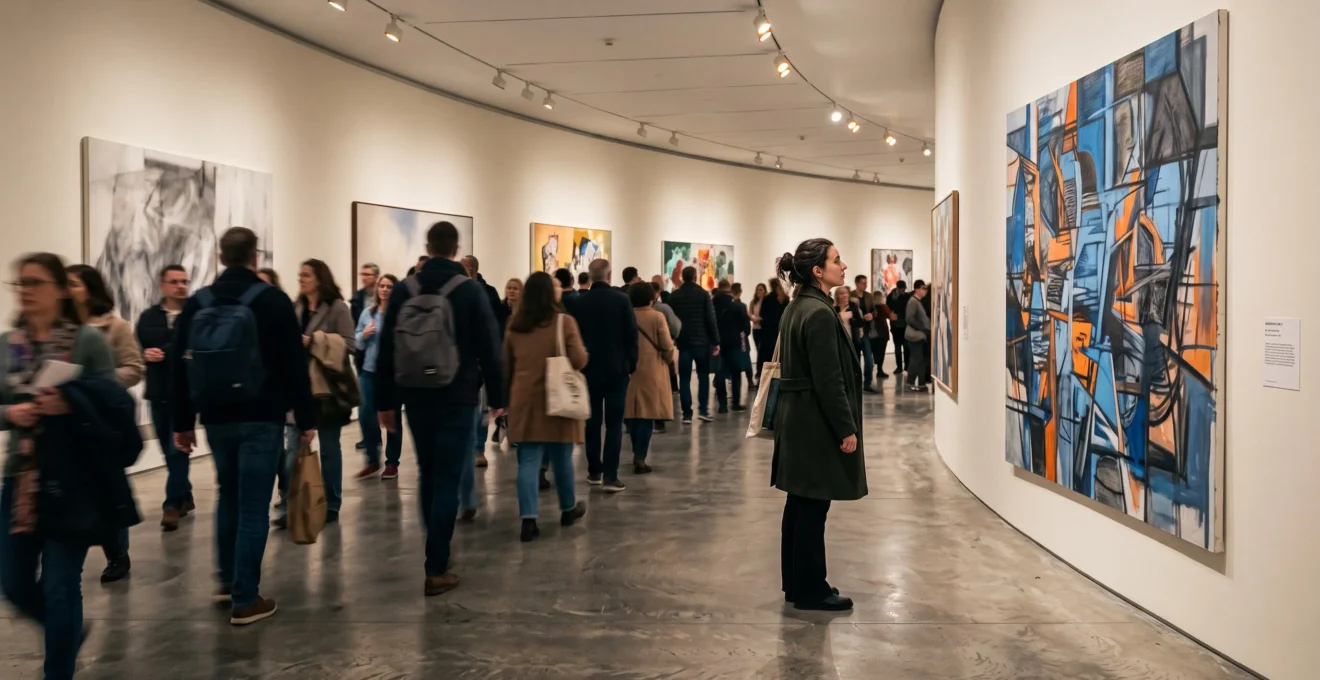
You have booked the exhibition, travelled across London, waited for your entry slot and finally stepped into an immersive gallery. The room looks extraordinary. Yet, by the time you reach the exit, you struggle to explain what actually moved you.
The problem may not be the exhibition. It may be the way you travelled through it.
Following the crowd gives you a route, but not necessarily a meaningful experience. Your attention becomes divided between finding the next room, avoiding other visitors, checking your phone and keeping pace with the people ahead. Even spectacular installations can become a succession of spaces you pass through rather than places you genuinely encounter.
A richer museum visit does not require an empty gallery, specialist art knowledge or an expensive private tour. It requires a few deliberate decisions: where to go, which works deserve your attention, when to pause and where to stand.
These practical techniques help you make those decisions, even in Britain’s busiest cultural venues.
How to make a crowded museum visit feel immersive
- Choose your attention before choosing your route. Plan around one question and three meaningful artworks, not every room in the building.
- Control your pace and position. Slow down, look before photographing and experience installations from more than one viewpoint.
- Stop before your attention collapses. Take deliberate breaks and accept that seeing fewer works can make the visit more rewarding.
- Why Do You Remember Less From Museums When You’re Constantly Navigating Around People?
- How to Build an Immersive Museum Route in 20 Minutes Without a Map Obsession?
- Which Creates More Immersion: Audio Guide, Guided Tour, or Self-Led Viewing With 3 Anchors?
- The Mistake That Makes People Miss Non-Digital Immersion in Museums
- When Should You Take Breaks in a Museum: After 45 Minutes or Only When You Feel Tired?
- How to Experience an Infinity Mirror Installation Without Turning It Into a Photo Session?
- How to Experience Large-Scale Installation Art Using the 3-Position Walk Without Missing the Main Effect?
- Why Do Large-Scale Installations Feel Underwhelming Until You Stand in the Right 2 Spots?
Why Do You Remember Less From Museums When You’re Constantly Navigating Around People?
Constant navigation competes with the attention you need to remember art. When you are watching other visitors, choosing corridors and searching for the next gallery, you have fewer opportunities to concentrate on what you are seeing. A crowded museum visit can therefore feel busy and visually stimulating while leaving surprisingly few clear memories.
Consider the difference between standing in front of a painting and trying to examine that painting while simultaneously wondering whether your group has moved on. Both situations involve seeing the same artwork, but they place different demands on your attention.
Working memory has limited capacity. Route-finding, avoiding collisions and making frequent decisions occupy some of that capacity. These demands can interfere with sustained observation, although the precise effect on artwork memory varies with the visitor and circumstances.
The important distinction is between incidental looking and intentional looking.
Incidental looking happens when you encounter artworks because they are along your path. You notice them, perhaps read a label and continue. Intentional looking begins with a decision: this work is worth stopping for, regardless of whether the crowd continues walking.
Research published in Annals of Tourism Research examined how museum routes, visit duration and expectations relate to visitor satiation. The researchers reported greater satiation among visitors following an ordered route and diminished emotional responses in some longer visits. The research on museum routes and visitor satiation does not establish that crowds directly cause poorer memory, but it challenges the assumption that a longer, more comprehensive route necessarily makes a visit more satisfying.
In a busy UK exhibition, look for the route being offered to you during the first five minutes. Signs, barriers, timed-entry groups and corridor layouts may guide visitors towards a particular sequence. A shop near the exit or a popular installation along the route may further influence how the visit unfolds.
Not every route is compulsory. Where visitors are free to explore, ask yourself: Did I choose this room, or did the queue choose it for me?
After your next visit, try a simple memory test. Without opening your camera roll or searching online, describe three works. Include a physical detail, something you noticed and a question the work raised.
If you remember the queue and gift shop more vividly than the exhibition, treat that as a useful signal to reconsider your visiting habits, not proof that the museum failed.
Once you recognise how much attention navigation consumes, the next decision becomes simpler: reduce the number of route choices you need to make without turning the visit into another rigid itinerary.
How to Build an Immersive Museum Route in 20 Minutes Without a Map Obsession?
Build your museum route around one question, two or three rooms and a flexible exit. Spend 20 minutes identifying what you want to explore rather than plotting every corridor. This creates enough structure to avoid aimless crowd-following while preserving the freedom to stop, change direction and discover something unexpected.
A complete room-by-room itinerary can recreate the very problem it is supposed to solve. Instead of looking at art, you keep checking whether you are on schedule.
The alternative is route intention: a small number of meaningful choices that guide attention without controlling every movement.
Imagine a hypothetical visit to Tate Modern with an interest in how contemporary artists use light. Rather than attempting to see every available gallery, you could build the visit around light as a single question.
Use this 20-minute planning exercise:
- Minutes 0–5 — Choose one question. Write something specific, such as “How can light change the apparent size of a space?” Avoid the vague objective of seeing as much art as possible.
- Minutes 5–10 — Choose one floor or area. Use the museum’s current gallery information to identify a manageable part of the building.
- Minutes 10–15 — Identify two or three anchors. Choose rooms or artworks that might help answer your question. They become destinations, not compulsory stops.
- Minutes 15–20 — Decide where to begin and finish. Confirm the entrance, any booked exhibition slot and a convenient exit. Leave the intervening route open.
This approach gives you an entry point, a purpose and an ending. The spaces between remain flexible.
On arrival, observe how other visitors move. Beginning in a less popular accessible wing, visiting close to opening time or exploring a permitted route in the opposite direction may provide a different experience. These are options to test, not reliable guarantees of quieter galleries.
Ticketing rules matter. Tate’s official ticketing terms and conditions specify that tickets are valid for the stated date and time and that visitors cannot re-enter an event or exhibition after leaving. Exhibition-specific instructions should always take precedence over a personal route.
For a timed exhibition at Tate Modern or another UK venue, make your admission slot the fixed point. Place flexible exploration before or after it where permitted. Never assume a booked exhibition allows re-entry, route reversal or unrestricted movement.
If a gallery requires one-way circulation, work with the restriction. You can still choose which permitted works receive more attention and which deserve only a brief glance.
Your five-action museum route checklist
- Write one question your visit should explore. Deliverable: one sentence in your notes.
- Select one manageable floor, wing or exhibition area. Deliverable: one named starting area.
- Choose three anchor works or rooms. Deliverable: three names or descriptions saved before arrival.
- Check entry, movement and re-entry restrictions. Deliverable: your confirmed admission time and applicable access rules.
- Choose a natural finishing point and possible break location. Deliverable: one exit plan and one place to pause.
Once your route has a purpose, the next question is how much guidance you actually need. A museum’s audio guide, a knowledgeable tour leader and your own curiosity can each support a different kind of visit.
Which Creates More Immersion: Audio Guide, Guided Tour, or Self-Led Viewing With 3 Anchors?
Choose an audio guide for selective context, a guided tour for expert interpretation and self-led viewing for personal exploration. None automatically produces greater immersion. If your priority is understanding unfamiliar art, guidance can help. If you want to notice your own reactions and spend time with particular works, a self-led visit organised around three anchors may fit better.
These approaches ask you to distribute your attention differently.
An audio guide provides information while you look, but listening can sometimes compete with sustained visual attention. A guided tour gives you an expert’s interpretation and often a useful narrative, although its pace may limit how long you remain with an individual work.
Self-led viewing offers the most freedom but can feel directionless without a little preparation.
The choice is therefore less about which format is superior and more about what you want the visit to achieve.
| Consideration | Audio guide | Guided tour | Self-led with 3 anchors |
|---|---|---|---|
| Best suited to | Selective explanations and background | Expert context and unfamiliar subjects | Independent observation and personal responses |
| Main advantage | Information available on demand | Structured interpretation and opportunities for questions | Control over pace and attention |
| Potential limitation | Pressure to complete every recording | Fixed route or group pace | Less interpretation without additional research |
| Practical approach | Listen only at chosen works | Use the tour as an introduction | Spend unstructured time between anchors |
The three-anchor method is particularly useful when the surrounding crowds make independent decisions difficult.
Before entering, select three works you genuinely want to encounter. They might share a subject, material or artistic question, but they do not need to belong to the same exhibition.
Visit the first anchor without rushing. Notice what attracts your attention before reading the label. Then allow yourself to explore between anchors without trying to cover every neighbouring room.
Repeat at the second and third works. The anchors form the backbone of the experience; the spaces between them allow spontaneous discovery.
There is also a less obvious problem with audio guides: the completion reflex. Once recordings are numbered, visitors can feel they should listen to all of them. The guide then becomes a checklist rather than a resource.
Try reserving the audio guide for your three anchors. Listen where additional context genuinely changes your understanding and skip recordings that do not serve your question.
For contemporary art that feels unfamiliar, a hybrid visit can work well. Join an available introductory tour, then revisit selected works independently afterwards, subject to ticketing and access arrangements. Expert explanations may provide the vocabulary that makes your later observations more meaningful.
These are practical visiting strategies, not methods established as superior by controlled comparisons.
Whichever format you choose, the most important opportunity comes after the explanation ends: the moment when you stop receiving information and begin paying sustained attention to what is physically in front of you.
The Mistake That Makes People Miss Non-Digital Immersion in Museums
The mistake is treating artworks as content to consume rather than physical experiences to explore. Moving past paintings, sculptures and installations at the speed of a social media feed can make them seem flatter than they are. Non-digital immersion often depends on slowing down enough to perceive texture, scale, material and the relationship between an object and your body.
A painting is not merely an image displayed on a wall. It is a physical surface with dimensions, edges, layers and a particular relationship to the surrounding light.
Likewise, a sculpture changes as you move around it. Its apparent weight, balance and negative spaces may be difficult to understand from a single viewpoint.
Yet visitors often approach these works with a rapid sequence of actions: glance, identify, photograph, move on.
This is a problem of pace, not technology.
Research on slow looking explores whether longer contemplation can deepen aesthetic engagement. The scientific article Slow-looking enhances aesthetic experience, published in 2025, examines the relationship between extended observation, emotional engagement and cognitive understanding.
It does not establish a universal optimum viewing time or prove that non-digital artworks are inherently more memorable than digital ones.
For your next visit, try a practical exercise with one physical artwork.
- Choose a work that initially appears straightforward, perhaps a painting or sculpture.
- Stay longer than you normally would, provided you are not obstructing others.
- Look first at its surface and material rather than immediately identifying its subject.
- Change position once or twice to observe the edges, scale and relationship to light.
- Finally, step back and ask what you can now see that was invisible during your first glance.
You might discover thick brushwork, a subtle change in colour, marks left by a manufacturing process or an unexpected relationship between the object and its surroundings.
None of these observations requires a screen or a dramatic sensory effect.
The same distinction matters in digital installations. Bright projections, surrounding sound and moving images can create intense stimulation without necessarily producing sustained engagement.
Ask yourself two questions: What am I noticing? And what is changing in my understanding?
If the only answer is that the room looks spectacular, spend a little more time exploring how it works.
Photography presents another choice. Looking at a composition through your phone may direct attention towards the picture you want to take instead of the space you are occupying. That does not make photography inherently harmful, but it changes the task you are performing.
Once you begin looking more carefully, you may notice that meaningful attention is also tiring. Protecting it requires knowing when to stop, not just knowing how to begin.
When Should You Take Breaks in a Museum: After 45 Minutes or Only When You Feel Tired?
Take a break when your attention begins to deteriorate, rather than waiting until you feel physically exhausted. Forty-five minutes can be a useful reminder to check in with yourself, but it is not a scientifically established limit for everyone. The right interval depends on crowding, walking demands, sleep, exhibition content and the effort required to concentrate.
Museum fatigue is not always experienced as obvious tiredness. Sometimes its first sign is a change in behaviour.
You may start reading labels more quickly, passing works without stopping or checking how many rooms remain. The artworks have not necessarily become less interesting; your capacity or willingness to engage may have changed.
This matters because the final part of a museum visit can become a completion exercise. Instead of choosing where to focus, you try to finish the route before leaving.
A fixed break after 45 minutes is one possible planning aid, but it should remain flexible. Someone exploring a quiet gallery may comfortably concentrate longer, while a visitor navigating a crowded exhibition may need a pause sooner.
Use behavioural signals rather than the clock alone.
- You are moving faster without consciously deciding to.
- You read labels but struggle to retain their meaning.
- You repeatedly look for exits, benches or the next room.
- Works that would normally interest you receive only a glance.
- You feel compelled to continue mainly because there is more to see.
One signal does not automatically mean you need to leave. Several appearing together may suggest that a pause would help.
The best break often comes after an important anchor work rather than in the middle of an encounter. Find a permitted bench, quiet seating area or café and give yourself a moment to think about what you have seen.
Instead of immediately checking messages, try describing one detail you remember. You can note a question to explore later or simply allow the experience to settle.
A break does not have to be long to be useful. Its purpose is to interrupt automatic movement and give you a chance to decide whether you are ready to engage again.
There is a genuine trade-off: stopping means covering less ground.
In a short booked exhibition, a long café break may be impractical, and leaving a restricted exhibition could prevent re-entry. Plan accordingly, using available seating or pausing between exhibition areas where allowed.
Do not automatically reserve the most demanding room for the end. If one installation matters particularly to you, experience it while you still have enough energy to concentrate.
The value of managing fatigue becomes especially clear in immersive installations, where admission slots can be brief and the instinct to photograph everything can consume much of the available experience.
How to Experience an Infinity Mirror Installation Without Turning It Into a Photo Session?
Enter an infinity mirror installation with a viewing intention before reaching for your phone. If the rules and available time permit, keep your phone away for the first part of the experience. Stand still, observe the reflections and notice how the space changes as you move. Consider a photograph only after you have experienced the installation directly.
Infinity mirror environments can create unusual relationships between the viewer, reflected light and apparent depth. Repeated reflections may make the space seem much larger or less bounded than its actual dimensions.
These effects depend partly on your position and the time you spend noticing what changes.
If your first task is to photograph the room, your attention shifts towards framing. You begin deciding what should appear inside a rectangular image, where to stand for the picture and whether another visitor is blocking the shot.
That may be a worthwhile creative activity, but it is different from allowing the installation to shape your perception.
A study by psychologist Linda A. Henkel, published in Psychological Science, investigated photography and memory during museum visits. In two experiments, participants who photographed whole objects remembered fewer objects and details than participants who simply observed them. The same impairment was not observed when participants photographed a specific detail using a closer view.
Linda Henkel’s museum photography and memory study suggests that how visitors use a camera matters. It does not demonstrate that every photograph damages memory or that cameras necessarily prevent emotional immersion in mirror installations.
For a timed mirror-room visit, try the following approach:
- Before entering: check the room’s rules, including whether photography is allowed and how long your slot lasts.
- During the first part: keep the phone away and let your eyes adjust to the reflections and light.
- While observing: remain still briefly, then make a small permitted movement to notice changes in apparent depth or perspective.
- Near the end: if time and rules allow, decide whether one deliberate photograph would add something to your experience.
- After leaving: write one sentence describing the most distinctive detail you noticed.
For a very short slot, there may be no useful final minutes to reserve for photography. In that case, prioritise whichever experience matters most rather than trying to complete every step.
The written sentence is an optional personal memory cue, not a scientifically proven replacement for a photograph.
What if the room is crowded and visitors are being moved through quickly?
Rather than repeatedly changing position, choose one permitted spot with a clear view and stay there for the available time. An edge position may work, provided it is accessible, safe and does not obstruct circulation.
Follow staff instructions and respect other visitors’ viewing space. Some installations have strict movement restrictions, and many have capacities or time limits that leave little scope for improvisation.
The broader principle applies beyond mirrored rooms: begin by experiencing where your body is in relation to the artwork. Large-scale installations make this relationship even more important because changing viewpoint can change what the work reveals.
How to Experience Large-Scale Installation Art Using the 3-Position Walk Without Missing the Main Effect?
The three-position walk is a practical way to explore a large installation from its threshold, a middle-distance viewpoint and an interior position where access is allowed. Each location answers a different question: what is the overall composition, how do its parts relate to the surrounding space, and what does the work feel like when your body becomes part of the experience?
Large installations are not always best understood as individual objects. Their scale, sound, light and arrangement may depend on where the viewer stands.
From one angle, separate components can appear disconnected. From another, they may align to reveal a particular relationship. Entering the work can introduce sensations that are difficult to appreciate from outside.
The three-position walk helps you explore these differences deliberately without turning the experience into an exhaustive search for a perfect viewpoint.
Begin at the entrance threshold.
Before following people into the gallery, pause in a safe, permitted location and observe the work as a whole. Notice the proportions, dominant forms, visible boundaries and arrangement of light.
Ask: what is the relationship between this installation and the room containing it?
Then move to a middle-distance position, ideally one that provides a different relationship between the elements. It does not have to be the exact centre.
Look for overlapping forms, changes in apparent size and the way sound or light varies across the space.
Finally, if the installation allows entry or closer access, take an interior or near-work position. Notice how the work changes when you are surrounded by it or standing closer to its materials.
For an installation that cannot be entered, use the nearest permitted viewing position instead.
The aim is to compare three experiences, not to assume every artwork has three officially designated viewing points.
Looking from the threshold before entering is particularly useful because it preserves your first encounter with the complete composition. Once you move inside, the work may become harder to perceive as a single arrangement.
This does not mean entering first permanently diminishes the artwork. It simply offers a different sequence of observation.
In an unfamiliar exhibition, clues such as seating, floor markings, available sightlines and openings in barriers may suggest useful viewing positions. However, these features are not proof of an artist’s intended viewpoint.
If curatorial documentation or the artist’s installation video is available, it may show a deliberate approach angle. Treat that as one interpretation rather than a universally correct place to stand.
Avoid stepping outside barriers, blocking entrances or entering areas not intended for visitors.
Even a short comparison between two accessible viewpoints can be valuable. The next challenge is recognising which positions reveal the strongest aspects of a large work when the surrounding crowd encourages you to keep moving.
What to remember before entering a large installation
- Look before joining the flow. The threshold can reveal a composition that becomes less obvious once you move inside.
- Choose viewpoints according to what they reveal. A central position is not automatically better than a side or approach view.
- Allow the work to change your pace. Moving less, changing position deliberately and staying with one sensation may reveal more than completing the perimeter.
Why Do Large-Scale Installations Feel Underwhelming Until You Stand in the Right 2 Spots?
Large installations can feel underwhelming when your viewpoint hides the relationships that give the work its impact. Two useful positions to seek are an approach viewpoint, where you understand the overall scale and arrangement, and an immersion viewpoint, where you experience the work more directly. These are practical viewing categories, not fixed positions that every artist necessarily designed.
Scale is relational. A large object may look impressive from a distance but reveal something different when your body moves closer. A field of suspended objects may appear scattered from one angle and visually connected from another.
Sound can also change depending on the room, nearby surfaces and your location. Light installations may produce different visual effects as you move between bright and dark areas or look across overlapping elements.
The experience therefore depends not only on what the artwork contains but also on where you are in relation to it.
Consider two complementary positions.
The first is the approach viewpoint. This is where you can understand the installation’s overall arrangement and its relationship to the surrounding architecture.
The second is the immersion viewpoint. This is a permitted location closer to or within the work where its scale, sound, material or light becomes more immediate.
Not every installation offers both. Some works are experienced from outside a barrier, some are designed to be walked around, and others require a prescribed route. In these cases, compare whatever viewpoints are actually available.
The point is not to search obsessively for a secret location. It is to stop assuming that the position chosen by the visitors ahead of you must be the most revealing one.
In popular exhibitions, visitors may naturally gather along the main circulation path or at convenient photography points. Those places are not necessarily the most rewarding locations for sustained observation.
When permitted, moving slightly away from that path can give you a different perspective. You may notice the relationship between objects, the way sound occupies the room or a subtle effect that is less apparent from the most crowded viewing position.
Always distinguish this from obstructing circulation or ignoring staff directions. Attention can be protected without interfering with anyone else’s visit.
A useful final question is: Have I experienced the installation, or have I mainly followed other people’s movements through it?
If the answer is the latter, stop at a safe viewpoint and give the work another moment. Instead of trying to discover what everyone else is photographing, notice what changes when you remain still.
The same principle brings the entire museum visit together.
Route intention reduces unnecessary decisions. Three chosen anchors make the visit personally meaningful. Slower observation creates opportunities to notice physical detail. Breaks protect attention. Deliberate viewpoints make large installations easier to explore.
These techniques do not guarantee an emotional response, and an underwhelming exhibition is not necessarily the visitor’s responsibility. Artistic preferences, exhibition design, access conditions and personal circumstances all influence the experience.
What these choices provide is a greater opportunity to encounter the work on your own terms.
Before your next museum visit, choose one question, identify three anchor works and leave room for a deliberate pause. When you reach a major installation, look from the threshold before moving inside. At the end, see whether you can describe three things that genuinely held your attention. That is a more useful measure of a rewarding museum day than the number of rooms you managed to complete.
Can a crowded museum still provide a genuinely immersive experience?
Yes. Crowding can introduce distractions and movement restrictions, but it does not eliminate the possibility of meaningful engagement. Choose a small number of works, find permitted places to pause and concentrate on what you notice rather than how much of the exhibition you complete. Particularly crowded or sensory-intensive environments may still make sustained attention difficult.
Is it better to visit a museum alone or with friends?
Both can be rewarding. Visiting alone gives you more freedom to control your pace, while visiting with others creates opportunities to discuss different interpretations. If you attend as a group, consider agreeing on a few shared meeting points and allowing independent viewing between them. This reduces pressure to move through every room together.
Should you read the artwork label before looking at the work?
There is no universal rule. Looking first can help you notice your immediate response before receiving an interpretation. Reading first may be more useful when the work has an unfamiliar cultural or historical context. Try observing briefly, reading the label and looking again to discover which details become more meaningful.
What if an immersive exhibition only allows a short viewing slot?
Choose one priority before entering. You might focus on the spatial effect, a particular material or a change in light. Confirm photography and movement restrictions, then spend the available time on that experience instead of attempting every possible activity. Short slots may require sacrificing photographs or detailed observation of every feature.
How can you tell whether a museum visit was meaningful without relying on photographs?
After leaving, try describing three artworks or moments from memory. Record a detail you noticed, a feeling you experienced or a question that remains unanswered. The exercise is a personal reflection tool, not a validated measure of learning or emotional engagement. Photographs can complement these memories when taken thoughtfully.