
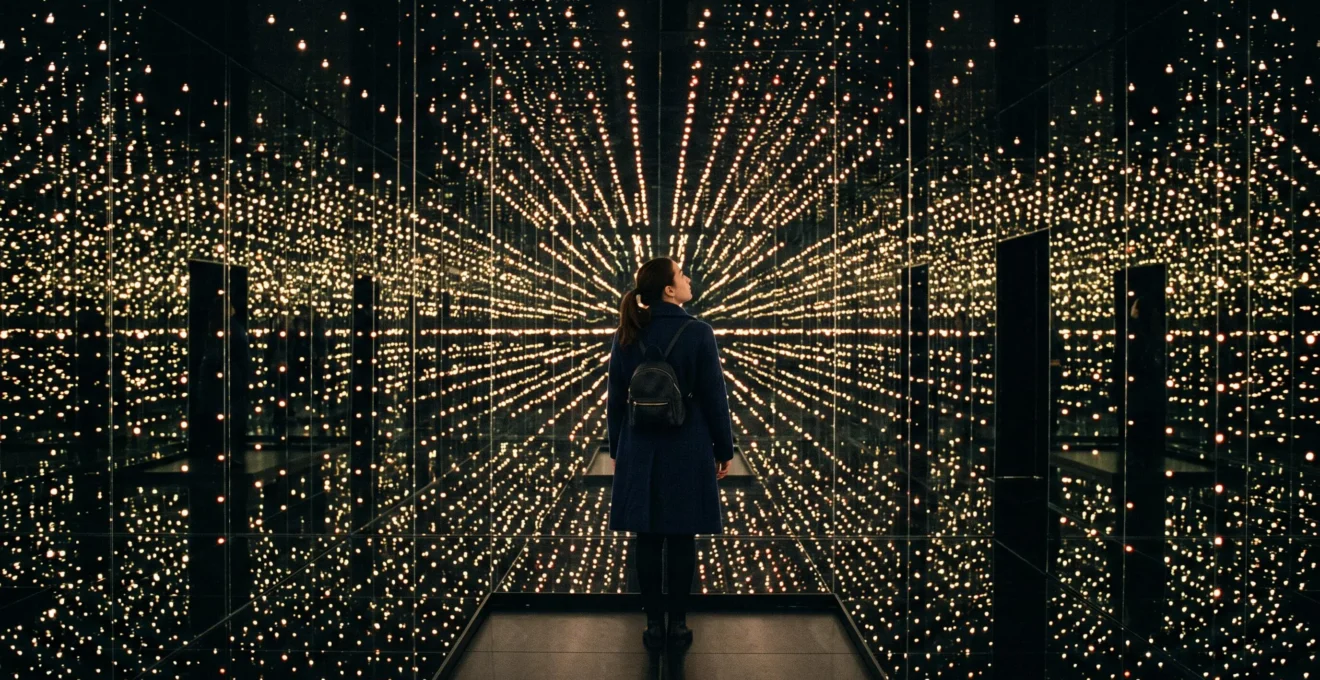
You step into a dark room. A handful of lights seems to become thousands. The walls appear to retreat beyond their physical boundaries, and for a moment it is difficult to work out where the room ends or where you stand within it.
You might feel peaceful, exposed, overwhelmed or unexpectedly moved. None of those reactions requires an interest in contemporary art. An infinity mirror room can challenge your ordinary sense of space before you have decided whether you like the installation.
That is part of the appeal of immersive environments associated with Yayoi Kusama. Their impact is not simply that they look spectacular. They change the relationship between your body, your attention and the space you believe surrounds you.
But a striking photograph is not necessarily evidence of a meaningful encounter. Understanding the optical illusion, giving yourself time to notice your response and resisting the pressure to document everything can make a short visit more rewarding.
The same principles can inspire a restrained micro-immersive corner at home, provided the lighting, reflections and physical safety receive more attention than decorative spectacle.
Infinity mirror rooms: the essential points
- The emotional effect begins with perceived space. Repeated reflections can make a physically small room feel enormous, creating calm, wonder or discomfort without requiring artistic expertise.
- Attention matters more than photographs. Begin by observing the installation directly, then decide whether taking a picture will add anything to the experience.
- A convincing home effect starts with controlled light. Test the viewing angle and reflections using a small, stable prototype before considering larger mirror panels.
- Why Can a Mirror Infinity Room Make You Feel Small, Calm, or Anxious in Under a Minute?
- How to Experience an Infinity Mirror Installation Without Turning It Into a Photo Session
- Which Gives a Better Experience: A Busy Weekend Slot or a Quieter Midweek Visit With 10 Minutes Less Time?
- The Home Replica Mistake That Creates Dangerous Glare and Headaches With Mirror Panels
- In What Order Should You Build a Micro-Immersive Corner at Home: Lighting First or Mirrors First?
- Why Does Immersion Collapse When You Treat an Installation Like a Photo Background?
- Why Do You Remember Less From Museums When You’re Constantly Navigating Around People?
- Why Do Immersive Museum Experiences Feel Shallow When You Follow the Crowd’s Route?
Why Can a Mirror Infinity Room Make You Feel Small, Calm, or Anxious in Under a Minute?
An infinity mirror room can provoke an immediate emotional response because it disrupts familiar visual cues about distance, boundaries and personal scale. Repeated reflections suggest a space far larger than the room actually occupies. Depending on the lighting, sound, other visitors and individual sensitivity, that apparent vastness may feel comforting, exhilarating or unsettling.
The optical mechanism is straightforward, even if the subjective experience is not. Facing reflective surfaces create successive images of one another. Lights placed within that arrangement appear repeatedly, with the reflections extending beyond the dimensions of the physical installation.
The Exploratorium‘s Look Into Infinity exhibit documentation describes how two opposing mirrors produce repeated images. Importantly, the later reflections become progressively dimmer because some light is absorbed at each reflection. The illusion produces apparent depth, not an actual expansion of space or light energy.
What makes this emotionally interesting is the discrepancy between what your body knows and what your eyes suggest. You remain inside a bounded room, yet the visual scene offers unusually few obvious boundaries. This can evoke something resembling the sublime: an impression of scale that exceeds your ordinary sense of proportion.
It is a plausible interpretation of the experience, rather than a demonstrated universal neurological response. The same visual conditions do not produce the same emotion in everyone.
Several features may influence your reaction:
- Calm: gently distributed points of light, a stable viewing position and a quiet atmosphere may encourage unhurried observation.
- Vertigo or disorientation: reflections that obscure the floor, walls or apparent distance can make orientation less comfortable.
- Anxiety: intense contrasts, unexpected movement, sound or the presence of other visitors may contribute to a feeling of limited control.
Colour temperature, the apparent density of lights and the amount of sound also shape the atmosphere, although none reliably predicts an individual emotional outcome.
30–60 seconds
The approximate duration assigned to each Infinity Mirror Room encounter at the Smithsonian’s historical One with Eternity exhibition, following the artist’s instructions. This is an example of a short institutional viewing period, not a measured threshold for emotional response.
A short encounter can still be meaningful because the initial surprise may be immediate. Staying longer, where permitted, might allow the sensation to change from astonishment into curiosity about the construction, your reflection or the behaviour of the lights. It might equally make the illusion feel less extraordinary once you become accustomed to it.
If you are sensitive to vertigo or spatial anxiety, try a cautious personal comfort check: keep your eyes on one stable, easily identified light or physical edge before looking across the reflections. If you feel unsteady, stop, orient yourself towards the exit and ask staff for assistance. This is a practical observation strategy, not a clinically validated test.
The first impression matters, but what you do with your attention immediately afterwards can determine whether the encounter becomes more than a moment of surprise.
How to Experience an Infinity Mirror Installation Without Turning It Into a Photo Session
To experience an infinity mirror installation meaningfully, give direct observation priority over photography. Start by finding a comfortable, stable position, notice one point of light, and then widen your attention across the room. Only consider a photograph once you can identify something you have actually felt or noticed without a screen.
This approach works even when admission is tightly timed. The aim is not to perform a formal mindfulness exercise or to force yourself into an emotional response. It is simply to stop the camera from becoming the main way you encounter the space.
A practical three-stage sequence can help:
- Establish your position. Enter carefully, respecting barriers and staff instructions. Choose a stable visual reference and take a few natural breaths while your eyes adjust.
- Explore without a device. Let your gaze move between nearby reflections and the apparent distance. Notice whether your awareness of your body changes, without deliberately walking towards uncertain reflections.
- Make a conscious photography decision. If time remains and photographs are permitted, take a limited number. Otherwise, allow the experience to remain undocumented.
The important distinction is between being present in the installation and evaluating it through a phone display. A screen presents a bounded, two-dimensional composition. Looking at it shifts your visual task away from directly assessing the room’s apparent scale, even though the photograph itself may remain aesthetically interesting.
Photography is not inherently destructive to memory. In Henkel’s experimental study on photography and museum memory, participants remembered fewer details about objects they photographed in their entirety than objects they only observed. However, that impairment did not appear in the same way when participants zoomed in on particular details.
The research concerned museum objects, not infinity mirror rooms. It supports being thoughtful about photographic attention, rather than imposing a universal ban on cameras.
For an alternative record, write one sentence after leaving: « I felt unusually small when the lights seemed to continue beneath my feet, » for example. The sentence preserves your interpretation, rather than merely recording how the installation appeared. There is no basis for claiming that this always produces a more durable memory than photography.
What if your companion wants photographs? Agree on a shared observation period before entering, then let one person take a permitted photograph while the other continues looking. You can exchange roles if the venue rules and available time allow. There is no need for either person to dictate what counts as an authentic experience.
Attention is easier to protect when the surroundings allow it. That makes the choice of visiting time a practical consideration rather than merely a ticketing decision.
Which Gives a Better Experience: A Busy Weekend Slot or a Quieter Midweek Visit With 10 Minutes Less Time?
A quieter midweek slot may provide a better infinity mirror experience than a longer, crowded weekend visit if your priority is undisturbed visual attention. But a busy session can be worthwhile if you enjoy a shared atmosphere. The deciding factors are actual occupancy, admission rules, available observation time and your preferred experience—not the weekday alone.
Consider a hypothetical choice between a longer visit with frequent interruptions and a session that is ten minutes shorter but allows more uninterrupted observation. The shorter visit may feel more substantial because you spend less attention negotiating your position around other people.
That comparison should not be mistaken for measured evidence that midweek appointments are inherently quieter or that losing ten minutes improves the experience. Different museums use different booking systems, and individual infinity mirror installations may impose much shorter room-specific time limits.
A useful way to compare tickets is to separate scheduled exhibition time from actual time spent with an artwork.
| Decision factor | Potentially busy weekend | Potentially quieter midweek |
|---|---|---|
| Individual attention | May be interrupted by movement, conversation and waiting | May offer more opportunities to observe without interruption |
| Collective atmosphere | Can feel lively and socially engaging | May feel more contemplative |
| Visual adjustment | Movement and bright devices may interfere with settling into a dark environment | Fewer interruptions may make adaptation easier |
| Practical convenience | Often easier for people with weekday commitments | Depends on work, travel and museum opening hours |
| Best fit | Visitors seeking a shared outing | Visitors prioritising quiet sensory attention |
Visual adaptation deserves particular attention. When moving from a brightly lit gallery into a darker installation, your eyes need time to respond to the change in illumination. Some adjustment occurs rapidly, while fuller dark adaptation can take considerably longer. It would therefore be misleading to assume a fixed number of minutes applies to every installation.
The practical question is whether your available viewing period lets you observe comfortably, not whether you achieve complete dark adaptation.
Before booking, check the museum’s official admission conditions, whether visitors enter individually or in groups, and whether the installation has a separate time limit. You can also inspect remaining ticket availability and extended opening hours, while recognising that ticket availability is not a reliable measurement of visitor density.
For a popular UK exhibition, a late opening or a less conventional admission time may be worth investigating. Neither guarantees a quiet room. If the visit requires a major journey, contact the venue about its access arrangements rather than making plans around assumed crowd patterns.
Once you understand what makes an immersive room compelling, the next question is whether any of that feeling can be recreated at home without copying the spectacle—or introducing unnecessary discomfort.
The Home Replica Mistake That Creates Dangerous Glare and Headaches With Mirror Panels
The main mistake in a home infinity mirror setup is allowing bright, exposed light sources to reflect directly into your eyes from several directions. Repeated reflections can create numerous apparent light points and uncomfortable contrast, even though mirrors do not multiply the total light energy. A safer approach prioritises dimmable, shielded lighting and securely mounted materials.
Infinity mirror effects depend on repeated reflection. Light travels between reflective surfaces, creating successive virtual images. Because reflections are imperfect, each later image generally becomes dimmer. The problem is therefore not that every reflection generates additional energy; it is that bright light sources and their repeated images can dominate your field of vision.
A concentrated LED point positioned near eye level may be unpleasant to look at directly. Repeated appearances of that point can make a reflective installation visually busy and difficult to ignore.
General visual-comfort principles help explain the concern. OSHA’s guidance on workplace lighting and glare identifies excessive brightness and reflections as contributors to eyestrain and headaches in workstation environments. It recommends controlling direct light, using shielding or indirect illumination, and reducing harsh contrasts.
Those recommendations were developed for workplaces rather than infinity mirror installations, so they should guide caution rather than be treated as certified domestic lighting limits.
Material selection presents a separate trade-off. Conventional glass mirrors can provide a clear reflection but introduce concerns about weight and breakage. Reflective acrylic panels are often lighter and less prone to shattering into glass fragments, although they can scratch, distort reflections and still present sharp edges or mounting hazards.
Neither material is automatically safe. Panel thickness, size, edge treatment, fire behaviour, mounting hardware and the manufacturer’s specifications all matter. Lightweight does not mean that a large panel can simply be leaned against a wall, particularly where children or animals can reach it.
A restrained home setup should follow several precautions:
- Choose dimmable, low-voltage LED equipment intended for the setting, and follow its installation instructions.
- Shield exposed light sources so their brightest surfaces are not directly visible from the intended viewing position.
- Test at the lowest practical brightness, increasing only if comfortable and stopping immediately if glare or discomfort develops.
- Maintain a comfortable viewing position with a clear exit path and enough room to avoid contacting reflective panels.
- Secure panels appropriately, protect edges, manage cables and keep unstable equipment away from children and pets.
There is no universal minimum safe distance between mirrors or between a panel and the viewer established by the sources used here. A distance that looks comfortable is not a substitute for sound mounting and suitable materials.
Also avoid unverified electrical modifications, inaccessible power supplies and improvised connections behind enclosed panels. If the design requires large glass surfaces or fixed electrical work, obtain appropriate professional advice.
A successful domestic installation should feel inviting even when the lights are dim. That consideration leads directly to the order in which the effect should be designed.
In What Order Should You Build a Micro-Immersive Corner at Home: Lighting First or Mirrors First?
Plan the lighting and intended viewing experience before purchasing large mirror panels. First decide where someone will sit or stand and what kind of atmosphere the lights should create. Then test the reflections with a small pair of mirrors. This avoids committing to expensive panel dimensions before you know whether the room’s geometry supports the effect.
The distinction is between planning and physical assembly. Lighting should come first as a design decision, but that does not mean installing permanent electrical equipment before determining suitable mirror positions. The intended viewing angle, light placement and mirror geometry need to be developed together.
For a restrained result, begin with a single visual idea: a soft tunnel of warm points, a narrow field of reflected light or a subtle impression of depth beside a reading chair.
Resist the temptation to fill every visible surface with LEDs. More light points do not automatically produce a better experience. They can make the installation feel like seasonal decoration rather than a considered spatial intervention.
A sensible starting sequence is:
- Define the observer’s position. Identify the seated or standing eye level and the portion of the room you want to transform.
- Choose the light character. Test one or two adjustable LED sources at low brightness, considering colour, spacing and visibility.
- Prototype the geometry. Use two small, securely supported facing mirrors with an illuminated object between them to investigate the repeated-reflection effect.
- Refine the viewing angle. Adjust the arrangement without exposing yourself to strong direct or reflected glare.
- Only then consider permanent materials. Assess dimensions, mounting, cable routing, accessibility and whether the visual result justifies the expense.
A single ordinary mirror and an LED string can help you judge the colour, atmosphere and placement of light. However, a genuine sequence of repeated mirror images requires a suitable arrangement of at least two reflective surfaces. One mirror alone does not reproduce the two-mirror infinity mechanism.
Even with two mirrors, the prototype may look less convincing than a museum installation. The alignment, reflectivity, separation and location of the observer all influence what becomes visible. A small experiment is valuable precisely because it exposes these limitations before you commit to larger materials.
The most expensive ordering mistake is buying substantial panels first and discovering that their size, mounting requirements or available viewing angles make the intended lighting difficult. Designing around a tested visual effect gives you more flexibility.
A five-step micro-immersive corner checklist
- Mark the viewing position. Choose one stable seated or standing viewpoint and record its location on a simple room sketch.
- Test the atmosphere. Place a dimmable LED source in a safe temporary position and record the preferred colour and comfortable brightness.
- Check the optical arrangement. Secure two small facing mirrors, introduce the light source and confirm whether repeated reflections are visible from the chosen position.
- Complete a comfort and safety review. Identify any exposed bright LEDs, unstable panels, unprotected edges or accessible cables and write down what must change.
- Decide whether to scale up. Produce a basic layout showing the proposed materials, mounting method and power arrangements—or keep the smaller version if it already achieves the desired atmosphere.
The strongest result may be surprisingly modest: a small illuminated recess that rewards a second look rather than a room designed to overwhelm anyone who enters it.
The same restraint that makes a home installation more convincing also reveals why an elaborate museum room can become strangely forgettable when experienced primarily as a photographic backdrop.
Why Does Immersion Collapse When You Treat an Installation Like a Photo Background?
An immersive installation can feel less immersive when you turn it into a photo background because your attention shifts from exploring the space to managing your appearance within an image. Posing, checking framing and reviewing photographs change how you use your body and where you direct your gaze. The installation becomes a setting rather than the central experience.
This is a different problem from simply holding a camera. Even without a phone, posing for somebody else can reorganise your relationship with the room.
In ordinary observation, you might turn slowly towards an unexpected reflection or become aware of how small your body appears within the visual field. When posing, you may instead concentrate on where to stand, how to angle your shoulders and whether your companion has captured the desired composition.
That changes your physical behaviour. You become concerned with how you appear from another person’s viewpoint rather than what the environment feels like from your own.
Two hypothetical accounts illustrate the difference. One visitor leaves saying, « The lights looked incredible behind me in the photograph. » Another says, « I couldn’t tell how far away the farthest lights were, and it made me feel oddly exposed. »
Neither response is inherently invalid. But the second describes a relationship between person and space, while the first centres the finished image. They are different kinds of encounter.
The museum photography research discussed earlier gives some reason to take photographic attention seriously, but it does not prove that these two visitors would form different emotional memories. It would be equally mistaken to assume that every photograph prevents personal engagement.
A useful personal rule is to preserve the opening portion of the encounter as a full-screen moment: no camera interface, no image review, no concern about posing. In a longer session, you might choose the first minute. In a tightly timed infinity room, simply give the initial available moments to direct observation.
This is a visitor practice, not a scientifically established minimum viewing period.
There is also an institutional tension. Highly photogenic exhibitions can gain visibility through visitor images, and some venues actively facilitate photography. That communication function does not automatically align with the way every visitor wants to experience the work.
You need not resolve the tension by refusing every photograph. Choose a brief photographic moment when permitted, rather than allowing photographic decisions to organise the entire encounter. Always follow the venue’s rules about cameras, flash and movement.
The effect becomes more pronounced when other visitors are also moving, posing or waiting for their turn. In that situation, maintaining attention is no longer only a matter of individual discipline.
Why Do You Remember Less From Museums When You’re Constantly Navigating Around People?
Constantly navigating around other visitors can make a museum experience harder to remember because movement requires attention that might otherwise be directed towards the artwork. Watching where people are going, avoiding collisions and coordinating with companions compete with observation. This is a plausible cognitive explanation, although the sources considered here do not quantify the resulting memory loss.
Imagine standing inside a mirrored installation while several visitors move across your field of vision. You may need to check where the floor ends, whether someone is approaching and where your companion has gone. These decisions become especially noticeable when reflective surfaces make ordinary spatial boundaries less obvious.
Observation and navigation are different tasks. Observation involves noticing relationships, changes and details. Navigation requires monitoring positions, anticipating movement and adjusting your own behaviour.
The more frequently you alternate between them, the harder it may be to maintain a continuous interpretation of the work. That does not mean all movement prevents learning. It means your attention is being divided among competing demands.
An immersive room can make this division particularly apparent. Unlike viewing a conventional painting from a stable position, the entire environment may function as the artwork. Other people moving through that environment can become part of what you need to interpret or avoid.
There is a simple way to reduce unnecessary decisions during a broader museum visit: choose your priority works before you enter the galleries.
- Identify two or three priorities. Decide which installations or artworks would make the visit worthwhile even if you cannot see everything.
- Visit them when practical. Follow booking conditions and gallery routes, but avoid repeatedly crossing the museum without a clear reason.
- Separate movement from observation. When it is safe and permitted, find a comfortable place to stop before concentrating on an artwork.
- Leave unplanned time. Once the priorities are covered, explore without treating every gallery as another item to complete.
Groups introduce an additional challenge. Conversation, waiting, positioning and negotiating where to go can take attention away from individual observation. One practical option is to agree on a meeting point and temporarily explore separately, provided this suits the group and the venue’s accessibility and supervision requirements.
For installations that require a timed booking, it may be more practical to enter together but agree to observe quietly and discuss reactions afterwards.
This approach does not make social visits inferior. Discussing art can deepen an encounter, and some installations benefit from the presence of others. The point is to distinguish deliberate social engagement from constant logistical interruption.
Yet even a manageable crowd can influence what you notice if you let other visitors determine your route and your moments of attention.
Key takeaways before your next visit
- Choose a route that supports your priorities rather than automatically following the busiest stream of visitors.
- Look for opportunities to stop and observe without obstructing circulation, instead of treating every artwork as a point to pass.
- Evaluate the visit by what you noticed or felt, not only by how many rooms you entered or images you collected.
Why Do Immersive Museum Experiences Feel Shallow When You Follow the Crowd’s Route?
Following the crowd can make an immersive museum visit feel shallow because other people’s movements begin to determine what you see, when you stop and how long you pay attention. Instead of developing your own response to an installation, you risk adopting a route of quick reactions. A more meaningful visit gives you opportunities to choose where your attention settles.
Think of a gallery where visitors repeatedly stop at the same photographable viewpoint. The accumulating attention signals that this is where something important happens. You may approach that position simply because everyone else does, even if another part of the installation interests you more.
Social cues are not necessarily misleading. Other visitors can reveal details you might have missed. The difficulty arises when their behaviour becomes your only guide to what deserves attention.
One alternative is a modified or reversed route. If the museum permits flexible circulation, start with a less crowded gallery, an artwork you particularly want to see or a section near the end of the recommended route.
In a museum with a mandatory one-way system, timed entry or conservation restrictions, do not attempt to travel against the permitted flow. Instead, identify quieter opportunities within the authorised route.
A useful approach is to select one observation point before deciding whether an installation deserves more time. This point should be safe, accessible and outside the way of other visitors.
From there, ask yourself three questions:
- What did I notice before seeing where everyone else was looking?
- What changes when I stop moving and allow myself to observe?
- Is there a particular sensation, detail or idea I would like to remember?
For mirror-based environments, remaining still can help you distinguish the artwork’s apparent depth from changes produced by your own movement. You may begin noticing the brightness fading across successive reflections, the relationship between a physical wall and its mirrored image, or how other people alter the perceived scale.
These observations may be subtle. They are also personal enough to make the experience more than a succession of impressive surfaces.
After leaving, try describing one precise sensation or thought without referring to a photograph. Perhaps the room felt more intimate than its reflections suggested. Perhaps the illusion became less convincing once you noticed its construction. Perhaps you felt nothing particularly emotional but became curious about the optics.
All three are legitimate responses. An inability to name a feeling does not prove that the visit failed or that the crowd controlled your experience. It can, however, be a useful prompt to reconsider how you spent your attention.
For the next visit, make one small adjustment: change the order of your priorities, avoid reviewing photographs between galleries, or arrange a short period of independent observation before discussing the work with companions.
On your next museum visit, choose one installation to experience without immediately photographing it. Find a stable position, notice what the space does to your sense of scale, and leave with one observation worth keeping. If that encounter inspires a home experiment, begin with a small, comfortably lit prototype rather than a room full of mirrors. The goal is not to manufacture wonder on demand, but to create conditions in which attention has somewhere interesting to go.
Can you enjoy an infinity mirror room without understanding contemporary art?
Yes. You can begin with the physical experience of reflections, light and apparent space without knowing the artist’s history. Learning about the artwork’s context may deepen your interpretation afterwards, but it is not a prerequisite for noticing how the environment affects you. There is also no obligation to feel awe or any other particular emotion.
Are all infinity mirror installations limited to 30 seconds?
No. The Smithsonian Hirshhorn Museum documented approximately 30–60-second experiences for its historical One with Eternity exhibition, following the artist’s instructions. That arrangement does not establish a universal limit. Individual venues and exhibitions determine their own access conditions, so always check the official visitor information for the installation you plan to see.
Can infinity mirror rooms cause dizziness or sensory discomfort?
Some visitors may find repeated reflections, low lighting, visual depth or intense light patterns disorienting. Individual sensitivity varies. If you are concerned, check the venue’s accessibility information, tell staff about your needs and avoid forcing yourself to remain in an uncomfortable environment. A stable physical reference may help with orientation, but it is not a guarantee against symptoms.
Do you need expensive mirrors to create an infinity effect at home?
Not necessarily. You can explore the optical effect using two small, appropriately supported facing mirrors and a modest light source. Large panels are not essential for understanding repeated reflections. More elaborate designs require careful consideration of reflectivity, viewing geometry, mounting, glare and electrical safety. A single ordinary mirror can create an attractive reflection but cannot reproduce the same two-mirror infinity sequence by itself.
Is it better to take a photograph or write down your experience afterwards?
They preserve different things. A photograph can record the installation’s visual appearance, while a short written note can capture your personal reaction. Experimental museum research suggests that certain forms of photography can affect memory for observed objects, but it does not establish that written reflections always outperform photographs. If permitted, you can use both while ensuring that documentation does not consume the entire viewing period.