
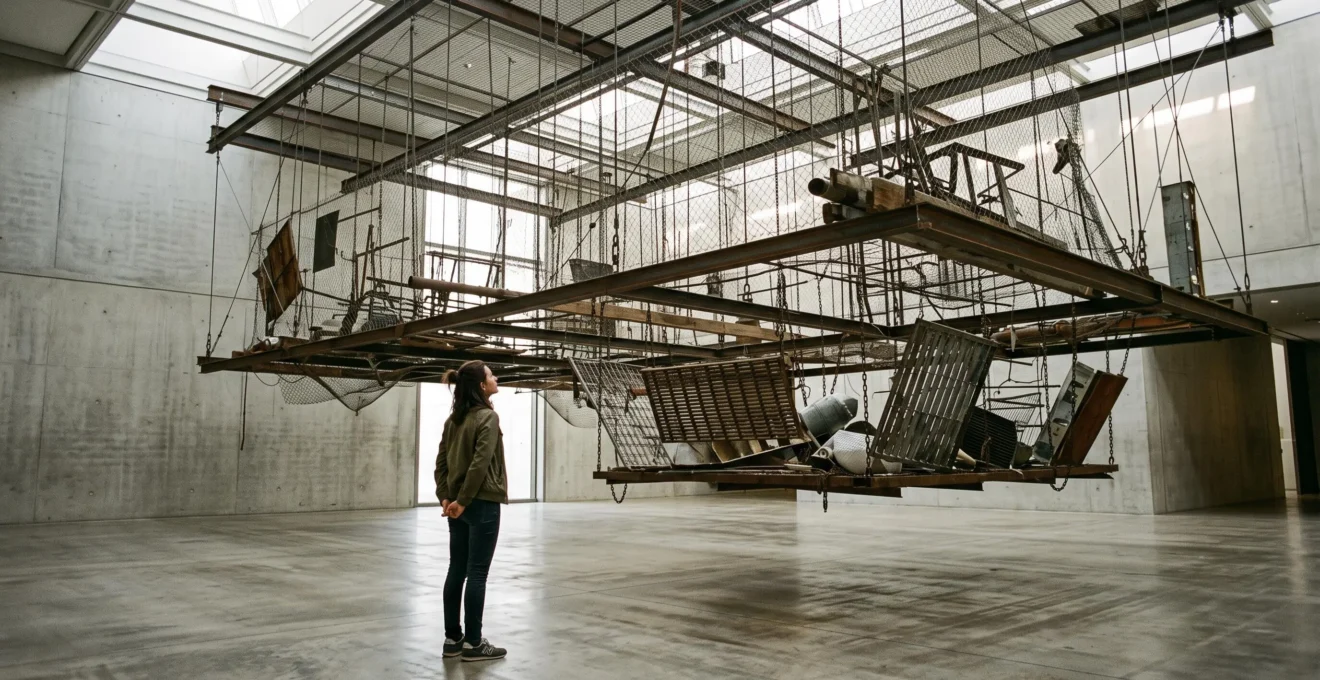
A monumental artwork fills an entire gallery. The ceiling disappears behind suspended materials, the walls seem to shift, and everyone around you reaches for their phone. Yet the installation leaves you strangely unmoved. Is the artwork disappointing, or have you encountered it from the wrong position?
Large-scale installation art often needs two different viewpoints to become meaningful: one that establishes its relationship with the surrounding architecture, and another that reveals what happens when your body enters, approaches or moves alongside its spatial structure. Neither is necessarily the obvious photography spot.
Distance, movement and attention can change what you notice without changing the artwork itself. A room that initially resembles an oversized theatrical set may become a complex environment when you recognise its depth, material construction and relationship with other visitors.
The challenge is not to admire everything for longer. It is to recognise when to stand back, when to move closer, and when to stop moving altogether. These techniques offer practical ways to explore an installation without pretending there is one correct emotional response.
How to get more from a monumental installation
- Find two contrasting viewpoints: establish the artwork’s scale from a distance, then approach an accessible position where its spatial relationships change.
- Let your attention settle: notice sound, material detail, bodily sensations and the surrounding room before deciding whether the work affects you.
- Control your route: experiment with different angles and pauses rather than automatically following the crowd or the most photographed viewpoint.
- Why Can Huge Installations Feel Emotionless When You See Them Too Quickly?
- How to Experience Large-Scale Installation Art Using the 3-Position Walk Without Missing the Main Effect?
- Which Gives a Better Read of Large-Scale Work: A Crowded Room or a Quieter Slot With Less Energy?
- The One-Angle Mistake That Makes Large-Scale Installations Feel Like Stage Props
- When Should You See Large-Scale Installations: First Thing or After You’ve « Warmed Up » With Smaller Rooms?
- How to Move Through an Immersive Installation in 4 Phases Without Missing the « Payoff »?
- How to Build an Immersive Museum Route in 20 Minutes Without a Map Obsession?
- Why Do Immersive Museum Experiences Feel Shallow When You Follow the Crowd’s Route?
Why Can Huge Installations Feel Emotionless When You See Them Too Quickly?
Huge installations can feel emotionally empty during a quick encounter because recognising their overall shape is not the same as experiencing their spatial qualities. Your eyes may register the spectacle almost immediately, while quieter details, changing viewpoints and bodily sensations require further attention. Staying longer creates opportunities to notice these elements, although emotional engagement is never guaranteed.
A monumental installation can present its most obvious feature in seconds: an enormous structure, a dramatic light source or an unexpected use of architectural space. That first impression tells you what the work looks like. It may reveal considerably less about how the work operates.
Depth becomes more apparent when you notice overlapping materials. Sound may seem different once you stop walking. A suspended structure that initially appears solid can reveal gaps, shadows and changing relationships with the ceiling.
This creates a useful distinction between capturing an installation and taking it in. Photographing a striking view records one arrangement of objects. Sustained observation allows you to examine relationships that a single image may not communicate.
A phone is not automatically an obstacle. Photography can encourage close attention to composition and detail. But when obtaining a photograph becomes the entire visit, it can limit the time available for exploring other aspects of the work.
The Museum of Modern Art offers a practical alternative through MoMA’s Slow Looking itinerary. Its exercises encourage viewers to change vantage points, notice visual details and attend to bodily or emotional responses. One suggested starting exercise involves five minutes of looking, not because five minutes is a scientifically established threshold, but because deliberate observation can reveal things initially overlooked.
Artists may place significant details above, below or beyond the immediately obvious viewing area. Such features may become noticeable only after you change position or examine the surroundings more carefully.
Before deciding that a work is emotionless, try a brief sensory check:
- Sound: Is there an audible element, echo or change in the room’s acoustics?
- Smell: Does the permitted exhibition environment have a noticeable material or atmospheric quality?
- Shadow and movement: Does your position affect the shadows, reflections or relationships between visible elements?
Not every installation includes all three channels. Their absence is not a defect. The exercise simply helps distinguish an initial visual judgement from a more considered encounter.
Longer looking cannot manufacture an emotional response. It can, however, give the artwork a fairer opportunity to reveal what its initial appearance conceals. Once that distinction becomes clear, the next decision concerns where to stand.
How to Experience Large-Scale Installation Art Using the 3-Position Walk Without Missing the Main Effect?
The 3-Position Walk is a practical viewing exercise that moves from an entry viewpoint to a midpoint and then to a deeper, accessible position. Each stop reveals different relationships between the installation, its surroundings and your body. The sequence helps you compare impressions without assuming that every artwork has three prescribed viewing spots.
Begin at the room’s entrance or another permitted viewpoint that offers a broad sightline. Before approaching, look at the distance between the artwork and the surrounding walls, ceiling and floor.
This first position establishes the work’s architectural scale. Notice whether it fills the room, interrupts an existing axis or leaves unexpected empty space around its materials.
Next, approach a midpoint where the internal structure becomes clearer. Materials that looked uniform from the entrance may separate into layers. Suspended elements may overlap differently, while shadows and gaps reveal how the work has been arranged.
Finally, move to an accessible position closer to, beside or within the installation, depending on the artist’s design and museum rules. Here, the work may no longer read as one object in front of you. Instead, individual components can become part of your surrounding field of vision.
The sequence matters because it preserves the contrast between seeing the whole and encountering its components. Beginning close to the artwork can be equally interesting, but it may make the initial sense of scale harder to appreciate.
There is no need to enforce identical waiting periods. At each position, remain until your observations begin to settle and you can identify what has changed since the previous stop. Move when further looking is no longer revealing much, rather than obeying a stopwatch.
To locate promising viewpoints, pay attention to open sightlines, entrance thresholds and architectural alignments. A long central axis may reveal the complete work, while an accessible side position may expose its depth. These are clues, not proof of the artist’s intended viewing route.
Five actions for your next large-scale installation
- Identify the entry viewpoint: stop where the whole work is visible and name one feature that establishes its scale.
- Find a structural midpoint: move closer and identify one material layer, connection or spatial relationship that was previously unclear.
- Test a second angle: shift sideways within the permitted area and identify one visible change in overlap, alignment or depth.
- Choose an accessible deep position: notice one way the work relates to your body, peripheral vision or surrounding space.
- Compare the impressions: before leaving, identify which two positions revealed the most meaningful difference and what each contributed.
The central lesson is that three stops are a method of exploration, not a rule imposed on the artwork. Some installations are designed for one specific viewpoint; others invite continuous movement or prohibit entry. Adapt the exercise accordingly.
The two most revealing positions may ultimately be the distant view and the position where the artwork’s spatial logic becomes tangible. Whether they are easy to reach can depend on another variable: the people sharing the room.
Which Gives a Better Read of Large-Scale Work: A Crowded Room or a Quieter Slot With Less Energy?
Neither a crowded room nor a quiet slot is automatically better for experiencing large-scale installation art. Crowds can contribute movement, interaction and collective atmosphere, while quieter conditions can make sound, space and material detail easier to observe. The better choice depends on whether other visitors form part of the artwork’s experience or mainly obstruct it.
Consider an installation that changes through visitor movement, reflective surfaces or interactive technology. The presence of other people may make its behaviour more visible and create relationships that would not exist in an almost empty room.
By contrast, an installation composed of carefully spaced objects may benefit from fewer people interrupting sightlines. Quiet conditions can also make subtle sound elements easier to distinguish, although an artwork’s acoustic design matters more than any universal visitor rule.
One documented example is Olafur Eliasson‘s The weather project, presented at Tate Modern in London in 2003. In The Guardian’s interview on the making of The Weather Project, the artist recalled visitors lying down, moving and waving beneath the mirrored ceiling.
Their physical behaviour became part of the remembered collective experience. This illustrates why other visitors need not be treated merely as interruptions.
| Viewing factor | Crowded room | Quieter slot |
|---|---|---|
| Interactive or responsive elements | May reveal more varied visitor-generated effects | May make individual responses easier to isolate |
| Spatial structure | People can provide a sense of human scale but obstruct details | Usually offers clearer sightlines to the room and materials |
| Sound | Visitor noise may mingle with or obscure the work | Subtle acoustic elements may be easier to distinguish |
| Personal pace | Movement and queues may encourage shorter stops | There may be more freedom to pause and reconsider |
| Collective atmosphere | Shared reactions can become part of the encounter | Individual observation may become more prominent |
For a largely static spatial construction, consider a weekday morning or the first hour after opening, when suitable tickets are available. These periods may be quieter, but visitor numbers vary by exhibition, venue and day.
For participatory work, a busier session can be worthwhile if the interaction between visitors is central to the installation. That does not mean choosing the most congested time available.
There is also a behavioural trade-off. In busy rooms, people may feel pressured to keep moving or to occupy only the most obvious viewpoint. A useful compromise is to stand outside the main circulation path, where permitted, while remaining able to see the work and its participants.
If an installation becomes particularly important to you, experiencing it under two different visitor conditions can reveal how much the surrounding audience contributes to its character.
The objective is not to eliminate other visitors. It is to understand whether their presence supports the installation, changes its meaning or limits your ability to explore it. Even in a quiet room, however, one viewing habit can flatten the experience.
The One-Angle Mistake That Makes Large-Scale Installations Feel Like Stage Props
The most limiting viewing mistake is treating a monumental installation as though it were a flat image intended to be seen only from the front. A carefully composed frontal view may explain the artwork’s overall appearance, but moving to another permitted angle can reveal its depth, construction and relationship with the gallery.
Imagine a suspended installation viewed from the entrance. Its components overlap into a dramatic silhouette. From that position, the work might resemble a theatrical backdrop: impressive, neatly framed and apparently complete.
Move sideways and those overlapping elements may separate. What looked like a single surface becomes a collection of independent materials arranged at different distances.
Approach from another accessible direction and the relationship between the installation and its supporting architecture may become clearer. The work stops behaving like an image and begins to reveal the decisions that make its spatial experience possible.
This distinction is consistent with the National Galleries of Scotland‘s installation art glossary, which explains how installation artists can create environments that surround viewers rather than presenting a single object for observation.
That does not make frontal viewing invalid. Some installations deliberately privilege a specific sightline. The mistake is assuming the first attractive view exhausts the artwork’s possibilities.
A useful corrective exercise is to seek a viewpoint where the installation looks less polished or less immediately comprehensible. A side angle may expose supports, seams, attachment points or awkward overlaps that the frontal composition conceals.
These details are not necessarily flaws. They can help explain the relationship between an artwork’s visible effect and the physical means used to create it.
A real installation: The weather project at Tate Modern
Olafur Eliasson’s The weather project occupied Tate Modern’s Turbine Hall in 2003. The installation combined a semicircular illuminated screen, artificial mist and a mirrored ceiling. The reflected semicircle appeared as a complete sun, while the mirror visually expanded the hall.
According to Studio Olafur Eliasson‘s documentation of The weather project, visitors could see how the artificial sun was constructed by walking towards the far end of the hall. From the museum’s top floor, they could also observe the reverse of the mirror structure. These different positions revealed aspects of the same work that were not equally visible from its principal viewing area.
The case demonstrates the value of changing viewpoints within a particular installation. It does not establish a universal rule that hidden construction is always the most meaningful part of installation art.
When exploring an artwork’s perimeter, remain within public access areas. Never cross barriers, enter restricted technical spaces or touch materials unless the exhibition explicitly permits interaction.
The two positions worth looking for are often a broad viewpoint that establishes scale and an accessible angle that changes your understanding of the work. Their precise locations depend on the installation.
Understanding construction does not necessarily diminish wonder. It can give the initial spectacle greater complexity. The next challenge is deciding when during a museum visit you will have enough attention to appreciate that complexity.
When Should You See Large-Scale Installations: First Thing or After You’ve « Warmed Up » With Smaller Rooms?
See a large-scale installation first if you arrive ready to give it sustained attention and want an encounter free from earlier comparisons. Start with smaller rooms if you need time to settle into looking at art. Neither sequence suits everyone; the better approach depends on your energy, expectations and the installation’s operating schedule.
Entering the monumental gallery immediately can make its scale feel unusually direct. You have not yet adjusted to the museum’s rooms, lighting or exhibition rhythm, so the work may establish its own reference point.
There is a cost to this approach. Arriving from a busy street, crowded foyer or stressful journey may leave you mentally distracted. The first few minutes inside could be spent adjusting rather than observing.
A short warm-up through smaller galleries offers another possibility. Looking at contained artworks can help you become attentive to proportion, material and composition before confronting a much larger environment.
However, extended preliminary viewing can also reduce the attention available for the installation you most wanted to see. Museum fatigue is not a fixed timetable; it varies between visitors and circumstances.
Choose the route that matches your typical behaviour:
- Fresh-encounter route: visit the main installation early if you usually concentrate well at the beginning of a museum trip.
- Short warm-up route: spend a limited period in one or two smaller rooms if you need to settle into the experience.
- Reset route: use a quieter transitional gallery, where available, to slow your pace before entering the main installation.
The reset room need not contain a particular type of artwork. Its function is simply to provide a moment away from competing visual and social demands.
Time-based installations require an additional decision. A video work, sound sequence or programmed light environment may have a defined cycle. Check the exhibition information for its running time and whether visitors should enter at a particular moment.
For example, if an installation runs as a complete audiovisual loop, arriving partway through may prevent you from recognising how its opening and closing sequences relate. In that case, the work’s timing is more relevant than a general preference for visiting early.
Do not assume that every loop has a conventional beginning, or that every installation needs to be experienced from start to finish. Follow the information provided by the venue.
The most useful itinerary is one that protects attention for the work that matters to you. Once inside an immersive environment, a further method can help determine how long to remain.
How to Move Through an Immersive Installation in 4 Phases Without Missing the « Payoff »?
Move through an immersive installation using four flexible phases: orientation, exploration, saturation and deliberate exit. First understand the space, then sample its different effects, remain long enough to move beyond the first surprise, and finally leave with a clear impression of what changed. This is a practical viewing framework, not an experimentally proven formula for emotional engagement.
The first phase, orientation, begins before you attempt to understand the artwork’s meaning. Locate entrances, exits, boundaries and any instructions governing movement, photography or interaction.
Notice whether the environment has a central focus or several competing zones. Some installations invite exploration; others depend on remaining in a designated viewing area.
During exploration, compare accessible parts of the room. Does the sound change as you move? Do mirrors alter your sense of depth? Do surfaces appear different under changing illumination?
Allow those observations to accumulate rather than trying to interpret every detail immediately.
The third phase, saturation, begins when the most obvious spectacle becomes familiar. The initial excitement may fade, leaving you free to notice subtler qualities.
For some installations, this is when repetition, atmospheric sound or changing spatial relationships become more apparent. For others, the experience remains essentially the same. Staying longer is an experiment in attention, not a guarantee of revelation.
A useful rule of thumb is to remain a little beyond the moment you first feel ready to leave, provided the conditions are comfortable and the venue allows it. Use those extra moments to test whether something new emerges.
Boredom is not automatically a sign that you have reached a deeper artistic threshold. If the work continues to feel unengaging, that response is valid too.
The fourth phase is deliberate exit. Instead of drifting towards the doorway while checking your phone, take a final look at the whole environment. Notice whether its dimensions, materials or atmosphere now seem different from when you entered.
The four-phase approach complements the earlier 3-Position Walk, but the methods answer different questions. The walk helps determine where to stand. The phases organise how attention develops across the encounter.
A visitor might therefore begin at an entry viewpoint, explore a midpoint and deeper position, remain after the initial novelty has settled, then return to the entrance for a final comparison.
That sequence works only where the artwork’s access rules, circulation and design support it.
The aim is not to endure an installation until you feel something. It is to give your perception enough flexibility to detect what may otherwise be missed. Even a short museum visit can accommodate that approach if time is allocated carefully.
How to Build an Immersive Museum Route in 20 Minutes Without a Map Obsession?
A 20-minute immersive museum route works best as a selective encounter, not a miniature tour of the entire collection. Spend the opening minute identifying two or three promising spaces, give most of the remaining time to the strongest installation, and treat other rooms as optional comparisons. A map should support initial orientation rather than dictate every movement.
Twenty minutes is rarely enough to explore several large-scale installations in depth. The practical choice is to prioritise one encounter instead of trying to give equal attention to everything available.
Begin with the museum’s floor plan or gallery signage. Identify rooms that contain installations, immersive environments, video works or spatial constructions. Check opening restrictions and whether the artwork has a fixed duration.
Then put the map away unless you need it again for navigation. Constantly consulting it can interrupt attention and shift your focus towards completing a route rather than experiencing a work.
When choosing between nearby rooms, look for practical clues. A substantial difference between room size and displayed materials may suggest that space itself contributes to the work. Sound or light spilling into a corridor may indicate an environment with effects extending beyond a conventional object display.
Visitor behaviour can offer another clue. People sitting quietly or remaining in one area may indicate a work that rewards sustained attention. It is not proof: seating, queues, instructions and personal preferences can produce the same behaviour.
Here is an illustrative allocation for a 20-minute visit:
| Time allocation | Action | Purpose |
|---|---|---|
| Minute 0–1 | Scan signage or a floor plan | Select accessible candidate rooms |
| Minutes 1–4 | Locate and briefly assess the strongest candidate | Decide whether it deserves most of the visit |
| Minutes 4–16 | Explore the main installation | Compare positions and allow attention to settle |
| Minutes 16–19 | Revisit a revealing angle or sample a nearby room | Consolidate or contrast the experience |
| Minutes 19–20 | Exit deliberately | Identify the observation worth remembering |
This timetable is a planning example, not a recommended minimum viewing duration established by research.
Its value lies in unequal allocation. If the main installation immediately demonstrates greater complexity than expected, there is no obligation to leave simply because the illustrative schedule says another room should follow.
Conversely, if the installation offers little to explore or is unsuitable for your preferences, moving on is reasonable. Being selective is different from rushing.
A 20-minute approach is especially useful when visiting a museum between other commitments, but it cannot replace a comprehensive exhibition visit. Large audiovisual cycles or timed-entry works may require more time than the available budget permits.
The real constraint is rarely the map itself. It is the assumption that a successful visit means following the established sequence and seeing as much as possible. That assumption becomes particularly powerful when other visitors are moving in the same direction.
What to remember before following the crowd
- A popular circulation route is not necessarily the route that reveals the most about an installation.
- Moving away from busy sightlines can improve observation, but visitor interaction may also form part of the artwork.
- Independent pacing matters more than finding a supposedly secret viewpoint; every alternative route must respect the installation’s access rules.
Why Do Immersive Museum Experiences Feel Shallow When You Follow the Crowd’s Route?
Following the crowd can make immersive museum experiences feel shallow when it keeps you moving through the same obvious viewpoints without enough opportunity to pause or explore. Entrances, signage and room layouts naturally guide visitor circulation, but the most convenient route may not reveal every spatial quality of an installation. Choosing your own pace can create a more considered encounter.
Imagine entering a large gallery where visitors automatically turn towards the brightest feature. Phones rise, people stop briefly and then move towards the next doorway.
This behaviour is understandable. The visible route offers immediate orientation, particularly in an unfamiliar environment. Yet following it without question can make your experience resemble everyone else’s initial glance.
An installation may contain quieter peripheral areas, changing reflections or relationships between materials that become apparent only from another permitted position.
When most people occupy a single sightline, it can be harder to notice those possibilities. The problem is not that the crowd is incapable of appreciating art. Rather, a shared circulation pattern can discourage individual experimentation.
The distinction between visitor flow and artistic experience matters. A museum route may be designed to manage access, safety and movement efficiently. An artwork may demand a different rhythm of attention within those boundaries.
Small adjustments can make a substantial practical difference:
- Stand outside the main flow: where the layout permits, choose a side position instead of occupying the most congested viewpoint.
- Approach from another permitted direction: compare the work’s appearance from the far side of the room, if accessible.
- Sit where seating is allowed: a lower viewing position and an unhurried pause may change how the environment appears.
- Revisit a viewpoint: return to an earlier position after exploring the work to compare your first and later impressions.
Reversing the suggested direction through a gallery can also be interesting when circulation rules allow it. Never reverse a one-way route, obstruct an exit or enter a restricted area simply to obtain a different perspective.
The alternative to crowd-following is not necessarily solitude. In participatory installations, watching others interact can reveal an important dimension of the work. Independent viewing means making deliberate choices about when to observe the crowd and when to separate from its movement.
It also means accepting uncertainty. A side position may reveal nothing remarkable. A long pause may leave you unmoved. The purpose of changing your route is to discover what the artwork offers, not to force yourself into an approved reaction.
Return to the article’s central question: where are the two positions that make the installation feel different?
For many accessible spatial works, a useful pair is the viewpoint that establishes the installation against the architecture and another that changes your physical relationship with its components. Those locations may be away from the popular photo spot, but they are not necessarily hidden, fixed or universally superior.
At your next large-scale installation, resist the urge to photograph the obvious view immediately. Find the room’s broader perspective, explore one alternative accessible position and allow enough time to compare them. If the work changes meaning between those two spots, you have discovered something that no single photograph could have shown you.
Do you need to understand the artist’s intention before entering an installation?
No. You can begin by observing the work’s materials, scale, spatial arrangement and effect on your perception. Reading the exhibition text afterwards may help you connect those observations with the artist’s intentions. However, check practical instructions before entering, particularly where access, interaction or safety restrictions apply.
Is it acceptable to dislike a monumental artwork after spending time with it?
Yes. Careful observation does not require admiration. Spending additional time with an installation may clarify why it feels unconvincing, repetitive or emotionally distant to you. A considered negative response can be just as thoughtful as enthusiasm. Viewing methods are intended to help you explore the artwork, not prescribe your judgement.
What should you do when an installation cannot be entered or approached closely?
Use the viewpoints that the venue permits. You might compare a central view with an accessible side angle, observe the relationship between the work and the room, or change your viewing distance without crossing barriers. The idea of a deep position is flexible: it can mean greater perceptual involvement rather than physically entering the artwork.
Can taking photographs help you appreciate installation art?
Photography can support careful looking when it encourages you to notice framing, light, materials and relationships between objects. It becomes limiting when obtaining a single picture replaces exploration. Where photography is permitted, consider observing the installation first and taking a photograph afterwards, when you have a better sense of what you want the image to communicate.
How can you experience large installations if standing for long periods is difficult?
You do not need to stand continuously or complete a particular walking route. Use available seating, accessible viewing areas and permitted rest points. Compare what you can observe from comfortable positions, including differences in distance, sound and perspective. Contact the museum or consult its accessibility information if you need to know whether a particular installation offers step-free access, seating or alternative viewing arrangements.